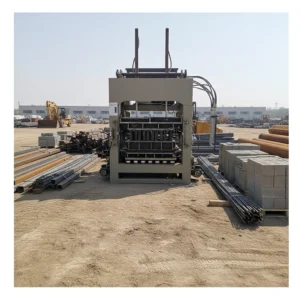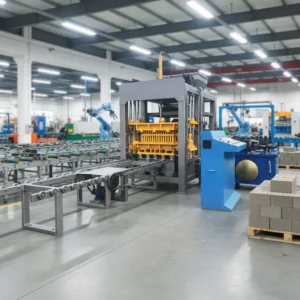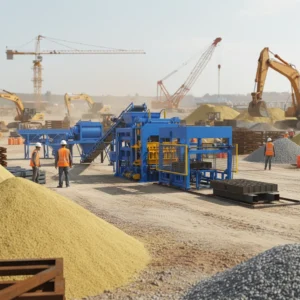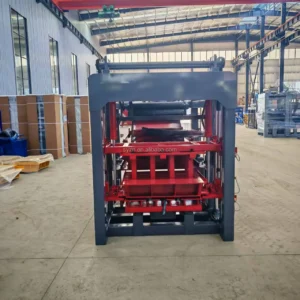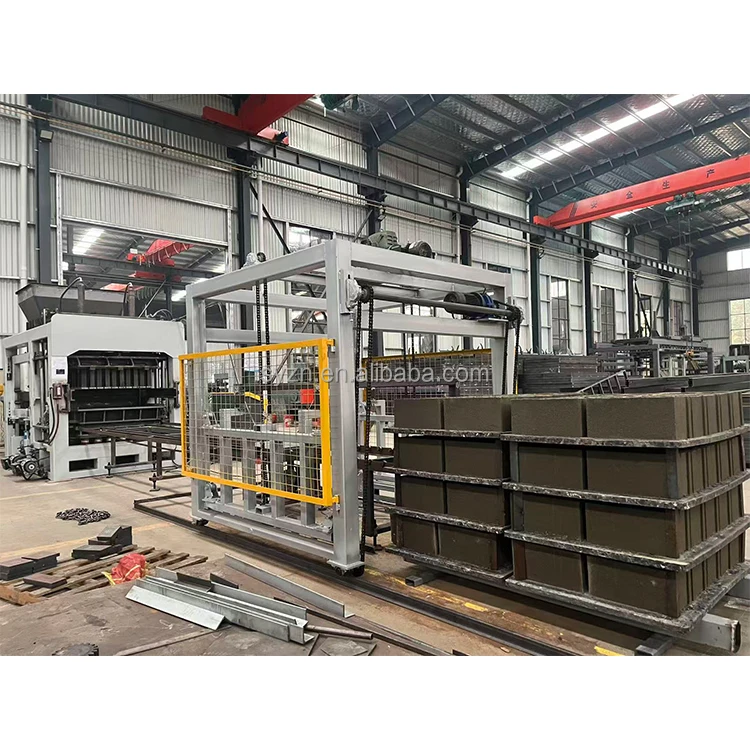
Integrated Line Configuration — The QT10-15 interlocking block making machine production line is specified as one matched system where pallet feeding, hydraulic station, and PLC control are coordinated so no station waits on another.
Technical Specifications
| Parameter | Value |
|---|---|
| Model | QT10-15 |
| Product Type | Interlocking Concrete Block Making Machine |
| Moulding Cycle | 15–20 s (hollow blocks / standard bricks); 20–25 s (paving blocks / interlocking bricks) |
| Output Capacity | 1,800–2,400 pcs/h based on 400×200×200 mm hollow block, 10 pcs/mould |
| Output Capacity | 2,160–2,880 pcs/h based on 400×150×200 mm hollow block, 12 pcs/mould |
| Output Capacity | 8,928–11,160 pcs/h based on 240×115×53 mm standard brick, 62 pcs/mould |
| Output Capacity | 5,184–6,480 pcs/h based on 200×100×60 mm paving block, 27 pcs/mould |
| Output Capacity | 4,032–5,040 pcs/h based on 225×112.5×60 mm interlocking brick, 24 pcs/mould |
| Control System | PLC control cabinet |
| Hydraulic System | Independent integrated hydraulic station, isolated from host vibration and dust |
| Vibration System | Vertical station mode resonance with automatic FM-AM |
| Machine Configuration | Pallet feed machine, block making machine, storage hopper, conveyor, hydraulic unit, PLC control cabinet |
| Assembly State | Line configuration with supporting equipment |
| Warranty | 1 year for the whole machine (excluding spare parts) |
| Pallet Size | (basis to be confirmed) |
| Voltage & Frequency | (basis to be confirmed) |
| Hydraulic Pressure | (basis to be confirmed) |
| Vibration Force | (basis to be confirmed) |
| Overall Dimensions | (basis to be confirmed) |
| Net Weight | (basis to be confirmed) |
| Certification | CE (declared where applicable) |
Application Suitability
| Application | Material or Output |
|---|---|
| Hollow block production for residential and commercial walls | Crushed stone, sand, cement, and fly ash aggregates |
| Interlocking brick manufacturing for paving and landscaping | Fine aggregate blends with cement binder |
| Standard solid brick output for masonry and infill | Local sand and gravel mixes with Portland cement |
| Paving block production for roads and walkways | High-strength concrete mixes with coarse aggregate |
| Multi-cellular brick runs for lightweight partition walls | Lightweight aggregate or expanded clay with cement |
Why the Press Is Never the Bottleneck on This Line
The interlocking block making machine production line is timed station-by-station so the press cycle and upstream material feed stay locked together.
I once configured a high-output press for a Middle East block plant. The machine itself ran fine, but the mixer downstream could not keep pace. The press sat idle between cycles waiting for fresh batch material, and the daily throughput ended up well below what the buyer had planned. That job changed how I approach every line layout. With the QT10-15, the storage hopper, conveyor, and pallet feed machine are all matched to the press moulding cycle of 15–25 seconds so the press never stands still. Every supporting station is calculated against the actual block format the buyer produces, not a catalogue headline [NEED_CITE: line-level cycle matching methodology for concrete block plants].
How Stations Connect Across the QT10-15 Line
The storage hopper feeds raw material to the conveyor at a rate calculated against the press cycle time. When the press completes a moulding cycle in 15–20 seconds for hollow blocks, the pallet feed machine must deliver the next pallet within that same window. The PLC control cabinet coordinates these movements so no station overruns or starves the next. This interlocking block making machine production line is designed from the mixer outlet through to the conveyor discharge as a single timed sequence rather than a collection of independent machines.
Where Cycle Time Matching Prevents Lost Output
Every station on the line has its own cycle, and the slowest station sets the real daily output. The independent integrated hydraulic station is isolated from host vibration and dust, which means hydraulic response stays consistent over long shifts. If the hydraulic cycle drifted even a few seconds per mould, that gap would compound across thousands of cycles per day. The vertical station mode resonance vibration system with automatic FM-AM adjusts frequency and amplitude to the mould format in use, keeping compaction time within the 15–25 second range. When a buyer switches from 400×200×200 mm hollow blocks to 225×112.5×60 mm interlocking bricks, the PLC recalculates the feed and pallet timing so every supporting station adapts at the same time [NEED_CITE: PLC-controlled coordination in multi-format block production lines].
Reading the Numbers Behind Each Block Format
The QT10-15 produces 1,800–2,400 hollow blocks per hour based on a 400×200×200 mm format at 10 pcs per mould, and 4,032–5,040 interlocking bricks per hour based on a 225×112.5×60 mm format at 24 pcs per mould. The difference is not just mould cavity count — it reflects the vibration force and hydraulic pressure required to compact each format to target strength. Standard bricks at 240×115×53 mm yield 8,928–11,160 pcs/h at 62 pcs per mould because the smaller format cycles faster and fills more cavities. The vertical station mode resonance system adjusts vibration energy to match the mass and geometry of each mould, ensuring consistent density whether the press is running heavy hollow blocks or thin interlocking pavers. The independent hydraulic station delivers stable pressure throughout the compaction phase, which directly determines block strength and surface finish quality.
What Happens When Line Stations Are Not Matched
A press quoted at high output means little when the pallet feed machine cannot keep up or the conveyor backs up cured blocks at the discharge end. Buyers who have experienced this describe shifts where the operator spends more time clearing jams than running production. Pallet handling that is not included in the line quotation forces manual stacking, which slows the entire output rhythm. When the pallet size is chosen without checking the curing area dimensions or the forklift already on site, pallets pile up in aisles and blocks cure unevenly. These mismatches are not visible in a single-machine spec sheet — they only appear when the line runs under real conditions [NEED_CITE: common causes of output shortfall in concrete block production plants].
Why Procurement Here Covers the Full Line
Block machinery is our single focus, so the QT10-15 press, mould, pallet, and handling equipment are specified as one matched system rather than assembled from separate suppliers. Configuration is set against the buyer’s actual mix design and local aggregate, not a catalogue default. Mould design covers the formats the buyer’s market sells, including custom drawings when needed. Automation level is selectable — a buyer can start with semi-automatic pallet handling and add automatic stacking later. Installation and commissioning support includes operator training so the line runs at its calculated capacity from the first shift.
Documentation & Verification
- Line layout and capacity calculation stating the block format assumed for each throughput figure
- Machine specification sheet with hydraulic and electrical schematic for the QT10-15 configuration
- Mould drawing and format list covering hollow, paving, interlocking, and standard brick options
- Voltage, frequency, and PLC display language confirmation document before production begins
- Factory test record showing cycle times per block format before dispatch
- Operation and maintenance manual with wear parts and mould replacement schedule
Installation, Commissioning & Support
- Foundation plan based on the QT10-15 overall dimensions and hydraulic station placement requirements
- Dedicated power circuit matching confirmed voltage and frequency for the PLC control cabinet and hydraulic unit
- Machine arrives in line configuration with supporting equipment pre-matched for assembly sequencing
- First-run commissioning includes cycle time verification for each block format on the buyer’s mix design
- Operator training covers PLC interface navigation, mould change procedure, and daily maintenance checks
- Wear parts list and mould inventory provided for planned replacement scheduling
What to Include in Your Inquiry
To configure the QT10-15 interlocking block making machine production line for your plant, share the block formats you sell and the daily output you need for each. Confirm your local raw materials — aggregate type, cement grade, and any admixtures — so the mix design matches what you can actually source. Specify your site voltage, frequency, and preferred PLC display language to avoid delays at commissioning.
Frequently Asked Questions
Q: How is line-level capacity calculated, and which block format does each figure assume?
A: Every capacity figure on the QT10-15 is stated with a specific block format, mould cavity count, and cycle time range. For example, 1,800–2,400 pcs/h is based on a 400×200×200 mm hollow block at 10 pcs per mould with a 15–20 second cycle. The line layout document you receive will show throughput for each format you plan to produce.
Q: How do the stations connect so the press is not left waiting?
A: The PLC control cabinet coordinates pallet feed timing, press cycle, and conveyor discharge as one sequence. The storage hopper and conveyor are sized to deliver material within the 15–25 second moulding window, so the press completes each cycle without idle time between stations.
Q: What supporting equipment is included in the line quotation?
A: The standard QT10-15 line includes the pallet feed machine, storage hopper, conveyor, independent hydraulic station, and PLC control cabinet. Items such as raw material batching, curing racks, and forklift handling remain the buyer’s scope unless added to the configuration.
Q: How does the independent hydraulic station protect against vibration and dust?
A: The hydraulic station is physically separated from the press vibration zone and sealed against dust ingress. This isolation maintains consistent hydraulic pressure across long shifts, preventing the cycle drift that would otherwise slow the entire line.
Q: What voltage and PLC language options are confirmed before shipment?
A: Voltage, frequency, and PLC display language are confirmed during the quotation stage and documented before production. This ensures the control cabinet matches the buyer’s site electrical supply and the operator can read the interface on day one.