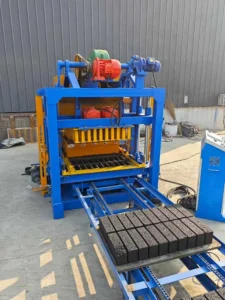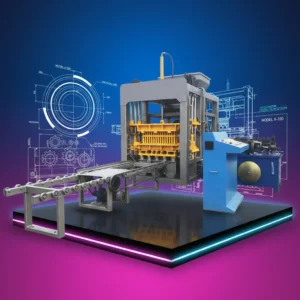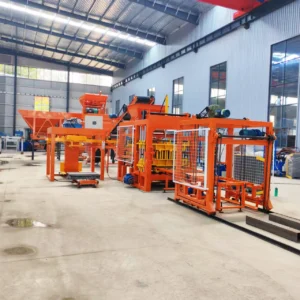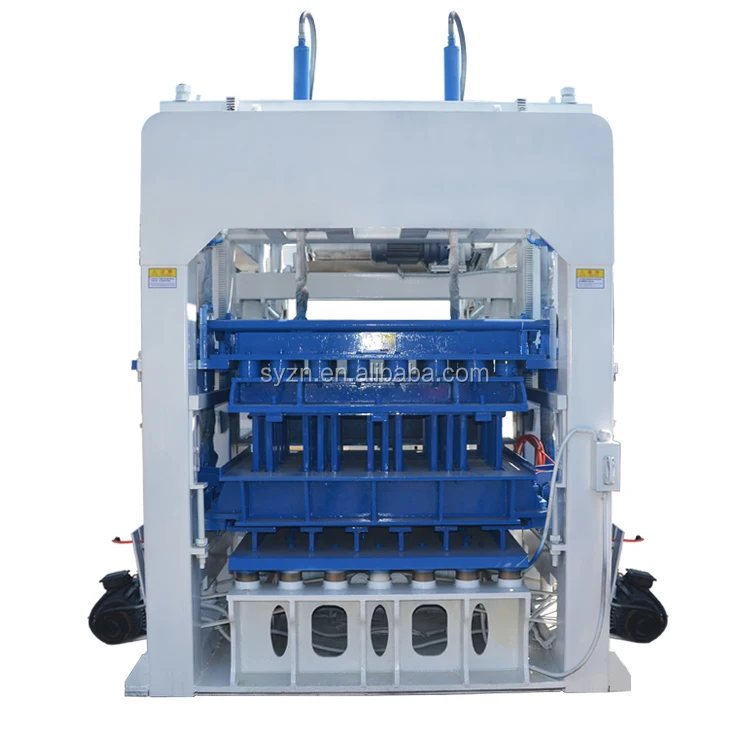
Matched Line Rhythm — Every station from pallet feed to conveyor is timed to the QT10-15 press cycle, so the host machine never idles waiting on upstream batching or downstream handling.
Technical Specifications
| Parameter | Value |
|---|---|
| Model | QT10-15 |
| Product Type | Automatic Concrete Block Making Machine |
| Control System | PLC control cabinet |
| Hydraulic System | Independent integrated hydraulic station |
| Vibration Mode | Vertical station mode resonance, automatic FM-AM |
| Mould Change | Simple replacement for multi-format production |
| Cycle Time (Hollow Block) | 15–20s (based on 400×200×200mm format) |
| Output Capacity (Hollow Block) | 1800–2400 pcs/hour; 14400–19200 pcs/8hr (10 pcs/mould, 400×200×200mm) |
| Cycle Time (Standard Block) | 15–20s (based on 400×150×200mm format) |
| Output Capacity (Standard Block) | 2160–2880 pcs/hour; 17280–23040 pcs/8hr (12 pcs/mould, 400×150×200mm) |
| Cycle Time (Solid Brick) | 15–20s (based on 240×115×53mm format) |
| Output Capacity (Solid Brick) | 8928–11160 pcs/hour; 71424–89280 pcs/8hr (62 pcs/mould, 240×115×53mm) |
| Cycle Time (Paving Block) | 20–25s (based on 200×100×60mm format) |
| Output Capacity (Paving Block) | 5184–6480 pcs/hour; 41472–51840 pcs/8hr (27 pcs/mould, 200×100×60mm) |
| Cycle Time (Interlocking Block) | 20–25s (based on 225×112.5×60mm format) |
| Output Capacity (Interlocking Block) | 4032–5040 pcs/hour; 32256–40320 pcs/8hr (24 pcs/mould, 225×112.5×60mm) |
| Line Components | Pallet feed machine, block making machine, storage hopper, conveyor, hydraulic unit, PLC control cabinet |
| Automation Level | Automatic |
| Mould Format Range | Hollow block, solid brick, paving block, interlocking block, multicellular brick |
| Warranty | 1 year (excluding spare parts) |
Application Suitability
| Application | Material or Output |
|---|---|
| Large-scale hollow block production | Crushed stone, sand, cement, fly ash aggregates |
| Paving block manufacturing for municipal projects | Granite chips, quartz sand, pigment-blended concrete |
| Solid brick output for load-bearing walls | Dense aggregate mixes with fine sand grading |
| Interlocking block for slope and retaining structures | Low-slump concrete with coarse aggregate |
| On-site production for housing developments | Locally sourced aggregate and cement |
Why the Mixer Must Keep Up With the Press
An automatic block machine production line only runs as fast as its slowest station.
I have seen full-scale block plants where the press was rated for high hourly output, yet the actual daily tally fell well short because the mixer could not deliver fresh batch material at the pace the QT10-15 demanded. The host machine ended up pausing between cycles, waiting for the storage hopper to refill. When a buyer evaluates a turnkey block making line, the conversation usually starts with press capacity, but the real constraint often sits three stations upstream [NEED_CITE: material flow rate calculations for concrete batching stations].
The same bottleneck shows up downstream. If the pallet feed machine cannot position a new pallet before the press finishes its cycle, every second of idle time compounds across a shift. An automatic block machine production line must be specified station by station, not just by the headline number on the press nameplate.
Synchronising Every Station Around the Press Cycle
The QT10-15 completes a hollow block cycle in 15–20 seconds, which means the pallet feed machine, the raw material conveyor, and the storage hopper must each finish their tasks inside that same window. If the conveyor takes longer to deliver a fresh charge of concrete than the press takes to mould a batch, the entire automatic block machine production line slows to the conveyor’s pace. Matching these intervals is the core of line configuration work.
Where Line Integration Decides Actual Output
When the independent hydraulic station, PLC cabinet and vibration system are all tuned to the same cycle, the press reaches its stated capacity for each format. When they are not, operators compensate by manually feeding pallets or skipping curing steps, introducing inconsistency that no amount of press automation can correct [NEED_CITE: PLC-controlled cycle synchronisation in concrete block plants]. The turnkey block making line approach treats every component as one timed system rather than a collection of standalone machines.
Reading the Specs Through a Line Builder’s Eyes
Hydraulic pressure and vibration force work together to compact concrete into the mould cavity. The vertical station mode resonance with automatic frequency modulation adjusts vibration to the mix density, which matters when a plant switches between lightweight hollow blocks and heavier paving blocks within the same shift. The independent integrated hydraulic station sits apart from the main frame, reducing the dust and shock that shorten seal life on stations exposed to direct vibration. Pallet size, though not fixed in the draft specification, must match both the mould footprint and the curing racks the buyer already uses — specifying pallets without checking the forklift and curing area dimensions is a frequent cause of post-installation delays.
The Hidden Cost of an Unmatched Station
A plant that pairs a high-speed press with an undersized mixer will see the press draw down the storage hopper faster than it refills, creating gaps in production that accumulate across an eight-hour shift. Similarly, if the pallet feed machine is rated for a lighter pallet than the line actually uses, pallet jams become routine and operators resort to manual handling, negating the automation the buyer invested in. These mismatches rarely appear in the quotation stage because each station is often quoted separately [NEED_CITE: common causes of throughput loss in automatic block lines].
Why Line Configuration Starts Before the Quotation
Every automatic block machine production line we configure begins with the buyer’s target block format, local aggregate type, and site curing layout. The QT10-15 and its surrounding stations are then selected as a matched set, not pulled from a catalogue default. Mould design covers the specific formats the buyer’s market requires, including custom drawings when standard moulds do not match local dimensions. Voltage, frequency and PLC display language are confirmed before production starts, so the control cabinet arrives ready for the target market rather than needing rewiring on site. Factory testing runs the full line — pallet feed through conveyor — before packing, and the test record travels with the shipment.
Documentation & Verification
- Line layout drawing showing station spacing and cycle time per format for the QT10-15
- Capacity calculation sheet stating the block format behind each output figure
- Hydraulic and electrical schematics matching the shipped PLC cabinet and station
- Pallet specification confirming dimensions and material against the buyer’s curing setup
- Factory test record documenting cycle times across all supplied mould formats
- Packing photographs of each line component before container loading
Installation, Commissioning & Support
- Foundation plan reflecting the QT10-15 footprint and vibration isolation requirements
- Power circuit schedule confirming voltage and frequency for the PLC cabinet and hydraulic station
- On-site assembly of the pallet feed machine, press, hopper and conveyor as one line
- First-run commissioning with the buyer’s local aggregate and target block format
- Operator training covering mould change procedure and PLC fault code reading
- Wear parts list with mould and hydraulic seal replacement intervals
What We Need to Size Your Line Accurately
To specify the QT10-15 and its surrounding stations correctly, share the block formats you intend to produce along with your target daily output for each. Let us know your local aggregate type and the voltage and frequency available at the site. If you already have curing racks or forklifts, send their dimensions so we can match the pallet size and conveyor height to your existing handling equipment.
Frequently Asked Questions
Q: How is the output capacity for each block format calculated?
A: Every capacity figure in the QT10-15 specification sheet states the exact block format, mould cavity count and cycle time range it assumes. For hollow blocks, that is 10 cavities at 400×200×200mm with a 15–20 second cycle. For paving blocks, 27 cavities at 200×100×60mm with a 20–25 second cycle. No single unqualified hourly number is used.
Q: Which line stations are included in the turnkey block making line quotation?
A: The standard QT10-15 line package covers the pallet feed machine, the block making machine itself, the storage hopper, the raw material conveyor, the independent hydraulic unit and the PLC control cabinet. Any additional stations such as automatic stacking or curing rack handling are specified separately so the buyer knows exactly what is and is not included.
Q: How do you prevent bottlenecks between the press and upstream stations?
A: We calculate the cycle time for each station — mixer discharge, conveyor travel, hopper refill, pallet positioning — against the QT10-15 press cycle for the buyer’s target format. If any station falls outside the press window, we adjust its specification before the line is built, not after installation reveals the gap.
Q: What voltage and PLC language options are confirmed before production?
A: Voltage, frequency and PLC display language are confirmed during the quotation stage and written into the production order. The QT10-15 control cabinet is then assembled and tested at those exact settings so no rewiring or software change is needed when the automatic block machine production line arrives at the buyer’s site.
Q: What does on-site installation and operator training cover?
A: Our team assembles the full line from pallet feed to conveyor, runs production cycles using the buyer’s own aggregate and mould formats, and trains operators on the PLC interface, mould change sequence and daily maintenance points specific to the QT10-15 hydraulic station and vibration system.