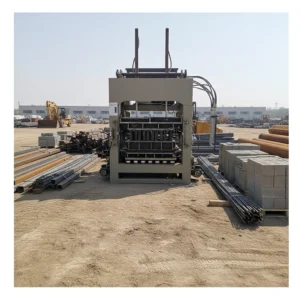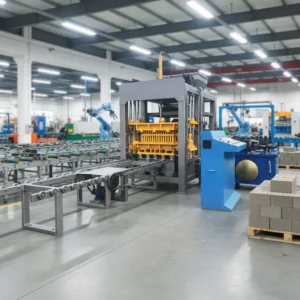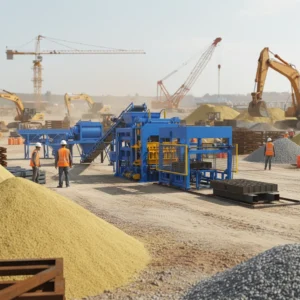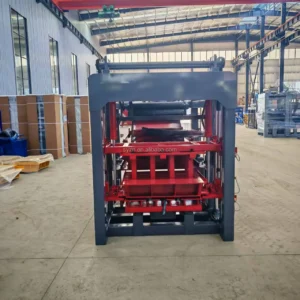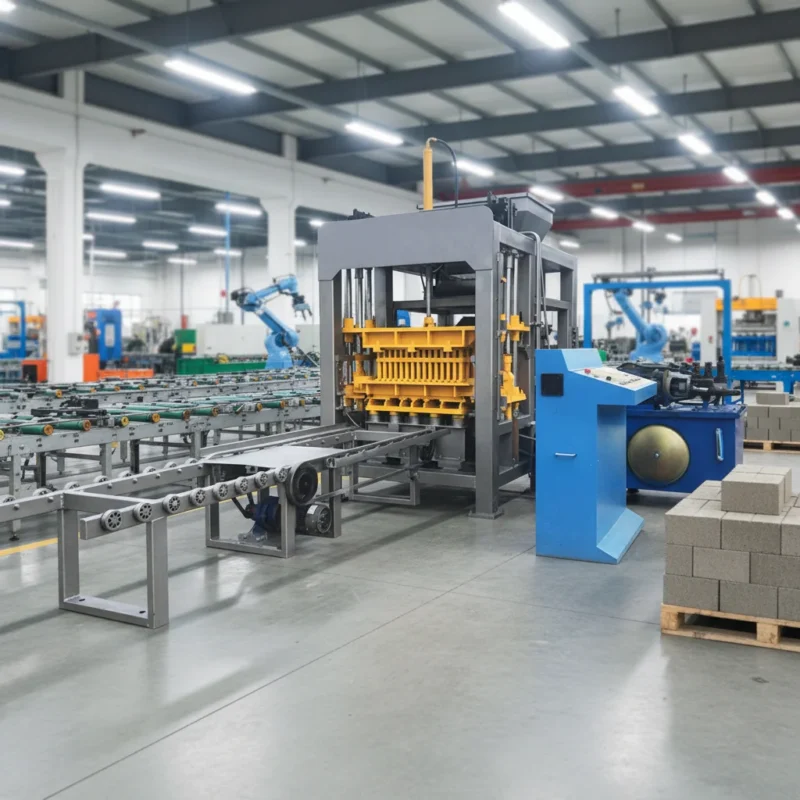
Integrated line engineering — the press, pallet feed, and hydraulic stations are matched to one cycle time, preventing the bottleneck that stalls standalone block machines.
Technical Specifications
| Parameter | Value |
|---|---|
| Model | QT10-15 |
| Product Type | Automatic Cement Block Making Machine |
| Control System | PLC control cabinet |
| Hydraulic System | Independent integrated hydraulic station |
| Vibration Mode | Vertical station mode resonance, automatic FM-AM |
| Mould Change | Simple replacement of mould for multi-format production |
| Components Included | Pallet feed machine, block making machine, storage hopper, conveyor, hydraulic unit, PLC control cabinet |
| Output Capacity (Hollow Block 400×200×200mm) | 1800–2400 pcs/hour, 14400–19200 pcs/8hr (basis: 15–20s molding cycle, 10 pcs/mould) |
| Output Capacity (Hollow Block 400×150×200mm) | 2160–2880 pcs/hour, 17280–23040 pcs/8hr (basis: 15–20s molding cycle, 12 pcs/mould) |
| Output Capacity (Solid Brick 240×115×53mm) | 8928–11160 pcs/hour, 71424–89280 pcs/8hr (basis: 15–20s molding cycle, 62 pcs/mould) |
| Output Capacity (Paving Block 200×100×60mm) | 5184–6480 pcs/hour, 41472–51840 pcs/8hr (basis: 20–25s molding cycle, 27 pcs/mould) |
| Output Capacity (Paving Block 225×112.5×60mm) | 4032–5040 pcs/hour, 32256–40320 pcs/8hr (basis: 20–25s molding cycle, 24 pcs/mould) |
| Cycle Time (Hollow Blocks) | 15–20s |
| Cycle Time (Paving Blocks) | 20–25s |
| Automation Level | Automatic (stacking and cubing scope to be confirmed) |
| Rated Power (kW) | (basis to be confirmed) |
| Voltage & Frequency | (basis to be confirmed) |
| Pallet Size | (basis to be confirmed) |
| Warranty | 1 year for the whole machine (excluding spare parts) |
Application Suitability
| Application | Material or Output |
|---|---|
| Hollow block production for load-bearing and partition walls | Cement, crushed stone, sand, and local aggregates |
| Solid brick manufacturing for masonry and infill | Concrete mix with fine aggregate grading |
| Paving block production for roads, walkways, and yards | High-density concrete with coarse aggregate |
| Interlocking brick and kerbstone forming | Standard concrete mixes adapted to mould geometry |
| Multi-cellular brick runs for thermal and acoustic walls | Lightweight aggregate blends where locally sourced |
Why a Press Rated at 2400 Pieces per Hour Still Misses Its Daily Target
The quoted capacity assumes every upstream and downstream station keeps pace — when one lags, the entire block production line equipment stalls.
I have watched QT10-15 class machines sit idle for seconds at a time because the mixer could not deliver fast enough or the pallet feeder jammed on warped boards. The press cycles perfectly, but the line output drops well below the brochure number. Buyers who sourced the press alone, then bolted on mismatched conveyors and hoppers, end up chasing bottlenecks for months after installation [NEED_CITE: common causes of throughput loss in concrete block plants].
Matching Every Station to the Same Cycle Time
A 15–20 second press cycle means the pallet feeder must deliver a fresh board in under 15 seconds, the storage hopper must discharge a full batch in the same window, and the wet-side conveyor must clear the finished block before the next pallet arrives. When we configure this block production line equipment, each station is timed against the press cycle so no single point forces the others to wait.
What Happens When the Line Is Treated as Separate Purchases
Sourcing the press from one supplier, the mixer from another, and the pallet system from a third often leads to voltage mismatches, incompatible PLC signals, and conveyor speeds that cannot be adjusted to the press rhythm. The result is a collection of capable machines that cannot run as one continuous block production line equipment.
How the Independent Hydraulic Station Holds Up Over Long Shifts
The QT10-15 isolates its hydraulic station from the vibration table and dust zone. Oil temperature stays within a stable band across multi-shift operation, and seals are not shaken loose by the high-frequency resonance that compacts the concrete. This separation matters most in hot climates where continuous production pushes hydraulic fluid toward its thermal limit [NEED_CITE: hydraulic system reliability in continuous concrete block production].
Reading the Specs That Actually Determine Daily Output
Vibration force and hydraulic pressure work together: vibration settles the aggregate into the mould cavity, while hydraulic pressure compresses it to final density. If either value is too low for the buyer’s mix design, block strength drops regardless of cycle speed. The vertical station mode resonance with automatic FM-AM on the QT10-15 adjusts frequency and amplitude to match different mould geometries, which is why the same line can switch between hollow blocks and paving blocks without manual vibration tuning. Pallet size must also align with the buyer’s curing racks and forklifts — ordering a pallet dimension that does not fit existing infrastructure forces a costly re-rack of the entire curing yard.
The Cost of Overlooking Pallet Handling and Curing
When the quotation covers the press and mixer but stops at the stacking point, blocks pile up on the floor and workers spend half a shift moving them by hand. Daily output falls, breakage climbs, and the curing area becomes a bottleneck of its own [NEED_CITE: manual handling losses in block plants without automatic stacking]. Specifying the pallet return system and rack handling as part of the block production line equipment from the start avoids this gap.
Why Buyers Source the Full Line from One Configuration Point
Every station on the QT10-15 line is specified against the buyer’s target block format, local aggregate, and curing area dimensions — not pulled from a generic catalogue. The PLC control cabinet coordinates pallet feed, press cycle, and conveyor speed as one program, so adjustments propagate across the line. Moulds are matched to the vibration table and hydraulic pressure settings, ensuring block density is consistent from the first piece to the last. Factory testing runs the complete line with the buyer’s selected mould before shipment, catching timing mismatches before they reach the site. Documentation covers the hydraulic schematic, electrical layout, and PLC language so the local electrician can commission without guessing [NEED_CITE: importance of matched documentation in export machinery].
Documentation & Verification
- Line layout drawing showing station spacing and pallet flow path for the QT10-15
- Capacity calculation sheet stating block format, cycle time, and daily output assumptions
- Hydraulic and electrical schematics with component part numbers for local sourcing
- Factory test record running the buyer’s selected mould before container loading
- Voltage, frequency, and PLC display language confirmation sheet signed before production
Installation, Commissioning & Support
- Foundation plan specifying load points and pit depth for the QT10-15 vibration table
- Dedicated circuit requirement matching the confirmed kW rating and voltage at the buyer’s site
- Machine shipped in dismantled modules sized for standard container loading
- On-site alignment of pallet feeder, press, and conveyor to verified cycle timing
- Operator training covering mould change procedure and PLC fault diagnostics
- Wear parts list with hydraulic seal and vibration spring replacement intervals
What to Include in Your First Inquiry
Send your target block format with dimensions, the daily volume you need for that specific format, and the raw materials available within hauling distance of your site. Include your site voltage and frequency, the PLC display language your operators read, and the dimensions of your existing curing area and forklift capacity so we can size the pallet system to match.
Frequently Asked Questions
Q: How are cycle times matched across pallet feed, press, and conveyor stations to prevent bottlenecks?
A: Each station is timed to complete its task within the press cycle window. The pallet feeder delivers a board before the press opens, the hopper discharges while the press closes, and the conveyor clears the finished block before the next pallet arrives. Timing is verified during factory testing.
Q: What supporting equipment is included versus quoted separately?
A: The standard configuration covers the pallet feed machine, block making machine, storage hopper, conveyor, hydraulic unit, and PLC cabinet. Mixer capacity, automatic stacking, and curing rack handling are confirmed during line configuration and may be added to the quotation.
Q: How is the hydraulic station protected from vibration and dust in continuous production?
A: The QT10-15 uses an independent integrated hydraulic station physically separated from the vibration table. This isolation keeps oil temperature stable, prevents dust ingress into valves, and extends seal life across extended shifts.
Q: Can the line be configured for semi-automatic operation now and upgraded to full automatic later?
A: Yes. The PLC control cabinet and mechanical interfaces allow semi-automatic pallet handling at start-up. When you add automatic stacking and cubing later, the control program is expanded without replacing the core press or hydraulic system.
Q: What is the pallet size, and does it match my existing curing racks and handling equipment?
A: Pallet dimensions are confirmed during configuration based on your curing rack spacing and forklift capacity. We specify the size and material before production so the boards fit your existing infrastructure without modification.