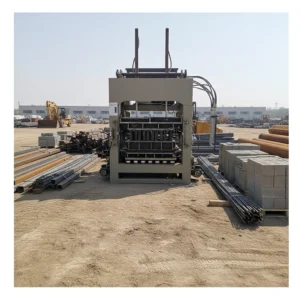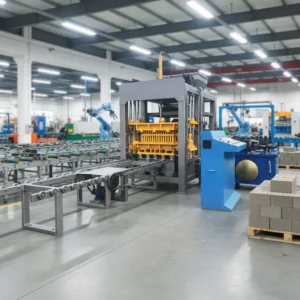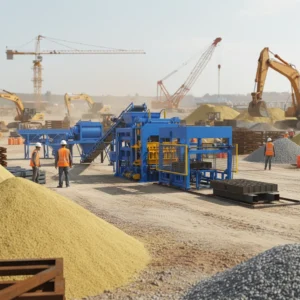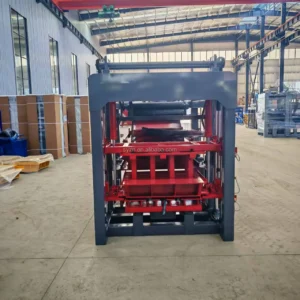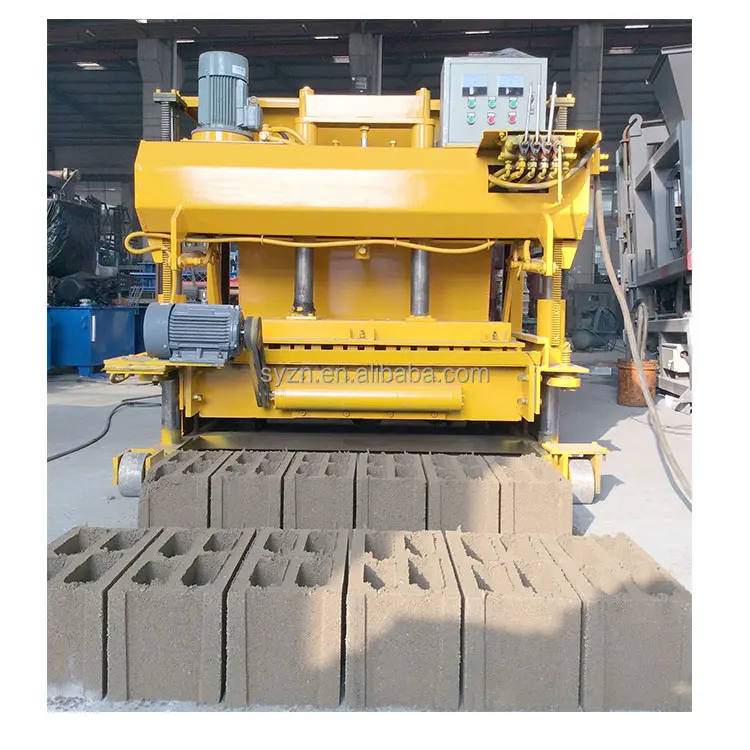
Mobile Line Integration — the QMY6-25 egg-layer press, mixer and material feeding are sized as one matched loop so the molding station is never left waiting for the next batch.
Technical Specifications
| Parameter | Value |
|---|---|
| Product Type | Mobile Egg Layer Block Making Machine |
| Model | QMY6-25 |
| Molding Capacity | 6 pcs/mold |
| Hydraulic Pressure | 16 MPa |
| Vibration Form | Mold Vibration |
| Molding Cycle | 20 s – 25 s (basis not stated in source — confirm block format, material and thickness) |
| Turning Method | Hydraulic |
| Total Power | 9.6 kW |
| Total Mass | 2.5 Tons |
| Block Formats | Hollow bricks, solid bricks, paving bricks (via mold change) |
| Voltage | Configurable to buyer’s local supply (frequency to be confirmed) |
| Mixer Options | JS500 double shaft mixer or JQ500 / JQ750 pan mixer |
| Feeding Method | Wheel loader or trolley (optional) |
| Stacking Method | Block clamper for dry block stacking (optional, not included by default) |
| Assembly State | Mobile / egg-laying, no fixed plant required |
Application Suitability
| Application | Material or Output |
|---|---|
| On-site hollow block production for building contractors | Crushed stone, sand, cement, water — mixed to local aggregate grading |
| Solid brick runs for housing and development projects | Local river sand or quarry dust blended with Portland cement |
| Paving brick production for estate and road-edge works | Fine aggregate with pigment additives, mold-swapped on the same press |
| First block plant for entrepreneurs entering the market | Low-capex mobile setup producing saleable blocks without a fixed facility |
Why "Cycles per Hour" Means Nothing Without the Rest of the Line
A mobile egg layer is only as fast as the mixer and feeding loop that supplies it.
In my years running block lines across West and East Africa, the most common complaint is never the press itself. It is the gap between the press finishing one mold and the next batch arriving from the mixer. When a mobile egg layer block making machine production line is quoted on press cycles alone, daily output on site falls noticeably short of the brochure figure because the mixer cannot keep pace or the wheel loader spends half the shift traveling to the stockpile [NEED_CITE: typical output gap between quoted cycles and actual daily production on mobile block lines].
How the Mixer Sets the Real Pace
The QMY6-25 completes a mold every 20 to 25 seconds, which means the mixer must deliver a fresh batch within that same window or the press sits idle. A JS500 double shaft mixer handles heavier, drier mixes typical of hollow block production and discharges faster than a pan mixer of equivalent volume. For lighter paving brick mixes with finer aggregate, the JQ500 or JQ750 pan mixer gives a more uniform blend. Choosing the wrong mixer type does not damage the press, but it does turn a mobile egg layer block making machine production line into a stop-and-wait operation.
Feeding and Stacking Close the Loop
Between the mixer discharge and the press hopper, a wheel loader covers longer distances across an open yard while a trolley suits a compact working area. At the output end, blocks are laid directly on the ground by the egg-layer mechanism. Without a block clamper, every freshly laid block must be left to cure in place, and the curing footprint grows with every shift. Adding the optional clamper lets a single operator stack cured blocks for transport, closing the mobile egg layer block making machine production line from raw material input to stacked output [NEED_CITE: curing area requirements for egg-layer block production without pallets].
Reading the Specs That Matter on Site
Hydraulic pressure at 16 MPa combined with mold vibration determines how densely the mix is compacted. Higher pressure alone does not guarantee block strength; the vibration must match the aggregate size and moisture content of the local mix. The 6-piece mold capacity means each cycle produces six hollow blocks at once, so cycle time directly sets the hourly run rate for that specific format — switching to a paving brick mold changes both the piece count and the cycle, and any output figure must be restated for the new format. Total power of 9.6 kW covers press and vibration motors; the mixer runs on a separate circuit, so the site generator or transformer must account for both loads simultaneously. Voltage and frequency must be confirmed before the line ships, because rewiring a control panel on site in a remote project area adds days of downtime.
What Happens When the Line Is Not Matched
I have watched a contractor in Côte d’Ivoire pair a fast-cycling egg layer with an undersized pan mixer and lose an entire afternoon to press idle time. The mixer simply could not discharge fast enough, and the crew resorted to hand-feeding half-mixed material into the hopper. Block strength dropped, rejection rates climbed, and the project engineer blamed the press when the real bottleneck was upstream [NEED_CITE: common misalignment between mixer discharge rate and egg-layer cycle time]. When stacking is left out of the quotation entirely, the crew spends the last two hours of every shift moving cured blocks by hand, which is the exact labor cost the machine was supposed to remove.
Why Buyers Specify the Full Line Here
Block machinery is the single focus at Shiyue, so the QMY6-25 is never shipped as a standalone press with mismatched peripherals bolted on later. The mixer, feeding method and optional clamper are specified against the buyer’s target block format and local aggregate, not a catalogue default. Molds for hollow, solid and paving formats are designed in-house, including custom drawings when the local market demands a non-standard size. Configuration starts from the buyer’s actual mix design, so hydraulic pressure and vibration settings are adjusted before the factory test. Voltage, frequency and control language are confirmed in writing before production begins, avoiding the commissioning delays that plague machines shipped with generic panels. Documentation covers the full line, not just the press.
Documentation & Verification
- Line layout drawing showing mixer-to-press distance and material flow path
- Capacity calculation sheet stating which block format each output figure assumes
- Machine specification sheet with hydraulic pressure matched to buyer’s mix design
- Voltage and frequency confirmation record signed before production starts
- Factory test record on buyer’s specified block format before dispatch
- Operation and maintenance manual in the confirmed control language
Installation, Commissioning & Support
- Ground must be level and compacted; the 2.5-ton QMY6-25 needs no fixed foundation but requires a firm working surface
- Separate power circuit for the 9.6 kW press and the chosen mixer, confirmed against local voltage and frequency
- Machine arrives assembled; hydraulic turning system and mold are checked and calibrated on site
- First production run supervised to set molding cycle against buyer’s actual mix and aggregate
- Operator training covers mold change procedure, daily greasing points and vibration force adjustment
- Wear parts list and mold inventory provided with recommended reorder quantities
What to Include in Your Inquiry
To size the complete line around your project, share the block formats you sell locally, the daily volume you need to hit, and the aggregate sources available near your site. Confirm your site voltage, frequency and the language your operators read. Let us know whether the yard space allows a wheel loader loop or if a trolley feed fits better, and whether you want the clamper included to close the line from press to stacked block.
Frequently Asked Questions
Q: How is daily output calculated and which block format does it assume?
A: The 20 to 25 second molding cycle applies to a specific block format and mix. When the format changes — for example, from hollow block to paving brick — the piece count per mold and the cycle time both shift. We state daily output separately for each format in the capacity calculation, so the figure you plan against matches the block you actually sell.
Q: What mixer capacity matches the QMY6-25 without bottlenecking the press?
A: The JS500 double shaft mixer discharges fast enough to keep pace with the press cycle on standard hollow block mixes. For finer paving mixes, the JQ500 or JQ750 pan mixer gives better blend uniformity. We match mixer type and volume to your target block format during line configuration.
Q: What feeding equipment is needed between mixer and press?
A: A wheel loader covers longer yard distances and suits open sites. A trolley works in compact areas where loader access is limited. Both are optional in the line quotation, so we confirm the method that fits your site layout before the order is finalized.
Q: Can block stacking be added to close the line?
A: The optional block clamper stacks cured dry blocks after the egg layer has laid them on the ground. Without it, blocks cure in place and are moved by hand. We include or exclude the clamper based on your labor plan and curing area size.
Q: What voltage and frequency confirmation is required before shipping?
A: We need your site voltage, phase and frequency in writing before the control panel is wired. This avoids rewiring on arrival, which is especially difficult on remote project sites where electrical components are not locally available.