
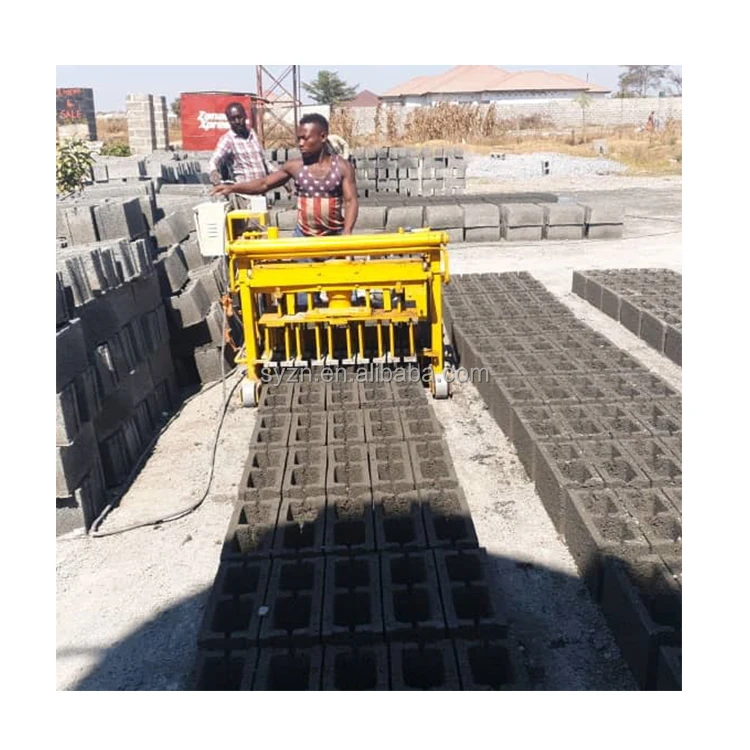
Line-Matched System Design — every QMY4-30 mobile block making machine production line we quote includes mixer throughput, curing footprint and material flow matched to the press cycle, so the machine never waits for the next batch.
Technical Specifications
| Parameter | Value |
|---|---|
| Model | QMY4-30 |
| Product Type | Mobile Hydraulic Block Making Machine |
| Vibration Method | Mould box excitation |
| Transmission System | Hydraulic |
| Demold Method | Hydraulic |
| Molding Cycle | 25–30 seconds (basis: standard hollow block formats) |
| Total Power | 5.95 kW |
| Voltage & Frequency | Configurable per destination market (confirm at inquiry) |
| Control System | Manual mobile operation (confirm options at inquiry) |
| Pallet Requirement | None — palletless egg-laying design |
| Output Capacity | 480 pcs/h based on 400×200×200 mm hollow block, 4 pcs/mould |
| Output Capacity | 600 pcs/h based on 400×150×200 mm hollow block, 5 pcs/mould |
| Output Capacity | 840 pcs/h based on 400×100×200 mm hollow block, 7 pcs/mould |
| Daily Output (8 hr) | 3,840 pcs based on 400×200×200 mm format |
| Daily Output (8 hr) | 4,800 pcs based on 400×150×200 mm format |
| Daily Output (8 hr) | 6,720 pcs based on 400×100×200 mm format |
| Operating Environment | Mountainous, hilly, industrial/mining, desert and coastal areas |
| Mould Heat Treatment | Carburization technology |
| Standards | ISO 9001:2000, CE |
Application Suitability
| Application | Material or Output |
|---|---|
| On-site housing project block production | Hollow blocks from crushed stone, sand and cement laid directly on prepared ground |
| Remote construction camps without fixed plant infrastructure | Palletless egg-laying hollow blocks in mountainous or desert terrain |
| Entrepreneur-led first block plant with minimal capital | Standard hollow block formats from locally sourced aggregate |
| Coastal and industrial zone masonry supply | Salt-resistant hollow blocks using washed sand and Portland cement |
What "480 Pieces per Hour" Actually Means for Your Site
Every output figure on this page names the exact block format it assumes — no hidden multipliers.
I once watched a contractor in Tanzania count on a mobile press to deliver enough hollow blocks for a 200-unit housing phase, only to discover the quoted capacity assumed a 100 mm wall block while his project specified 200 mm. The daily shortfall stalled masonry crews for three weeks. Capacity numbers detached from format are meaningless on a job site. [NEED_CITE: block format and wall thickness impact on mould cavity count] A mobile block making machine production line only performs when the mixer, curing area and material feed are each scaled to the specific format the buyer actually sells.
Mixer Throughput Must Outrun the Press Cycle
The QMY4-30 completes a moulding cycle in 25–30 seconds, which means the mixer must deliver a fresh batch to the hopper within that same window. If the mixer is undersized, the mobile block making machine production line spends a portion of every cycle waiting — and that idle time compounds across an eight-hour shift. Matching mixer drum volume and discharge rate to the press consumption rate is the first line-design decision that separates a quoted capacity from a real one.
Curing Footprint Dictates How Far the Machine Travels Each Day
Because the QMY4-30 lays blocks directly on the ground without pallets, the curing area must expand outward as production continues. [NEED_CITE: ground curing space requirements for palletless egg-laying block production] A site that cannot clear and level enough ground for several days of output will force the operator to move the machine back over partially cured blocks, risking surface damage. Planning the curing corridor length and access paths before the machine arrives prevents this bottleneck from appearing mid-project.
Reading the Specs That Shape Real Output
Mould box excitation transfers vibration energy directly into the concrete mix inside the cavity, which is critical for palletless production where the block must hold its shape the instant the mould lifts. Hydraulic transmission and hydraulic demoulding work together: the press applies consistent downward force during compaction, then retracts the mould box smoothly so the freshly formed block is not disturbed. The 5.95 kW total power draw stays within the range a standard site diesel generator can supply, removing the need for a dedicated grid connection at remote locations. Carburization-treated moulds resist abrasive wear from crushed stone aggregate, extending the interval between mould replacements on high-volume runs. These four parameters — excitation method, hydraulic circuit, power rating and mould metallurgy — collectively determine whether the machine maintains cycle consistency over a full shift.
When the Supporting Equipment Is an Afterthought
A mobile press quoted without a matching mixer, water metering system or curing plan leaves the buyer assembling a line from unrelated sources. The result is a machine that technically runs but never reaches its stated output because one station is always the bottleneck. [NEED_CITE: consequences of unmatched station throughput in block production lines] On remote sites where a replacement part is a week away by air freight, an undersized component fails faster under constant overwork — and the entire line stops until it arrives.
Why Buyers Source This Line Here
Block machinery is our single focus, so the QMY4-30 is specified alongside its mixer, water supply and curing layout as one matched system rather than a standalone press. Configuration is set against the buyer’s local aggregate and target block format, not a catalogue default. Mould design covers the hollow block sizes the buyer’s market actually sells, with custom drawings available. The automation level starts at manual mobile operation and can be upgraded as the plant grows. Installation support includes operator training on-site so the crew understands cycle timing and mould change procedures from day one.
Documentation & Verification
- Line layout showing mixer, press and curing corridor positions with distances
- Capacity calculation sheet stating block format assumed for each output row
- Machine specification sheet with confirmed voltage and frequency for destination
- Mould drawing and format list covering buyer’s required hollow block sizes
- Factory test record run on buyer’s specified block format before dispatch
- Operation and maintenance manual with wear parts list for first replacement
Installation, Commissioning & Support
- Ground must be level and compacted to support QMY4-30 travel without pallet tracks
- Power supply must deliver 5.95 kW at confirmed voltage and frequency via dedicated circuit
- Machine ships assembled; wheels and mould box inspected on arrival before first run
- Mould change procedure trained on-site using buyer’s primary hollow block format
- Wear parts list and first-replacement hydraulic seal kit reviewed during commissioning
- Daily maintenance checklist covers hydraulic fluid level and mould box bolt torque
Before You Request a Quote
Tell us which hollow block formats your market sells and the wall thickness your projects require. Share the aggregate type available near your site, the daily output you need to meet your construction schedule, and the voltage and frequency standard in your area. If you already have a mixer or generator on site, send the model and rated capacity so we can confirm compatibility with the mobile block making machine production line.
Frequently Asked Questions
Q: How is daily output calculated, and which block format does each figure assume?
A: Every output figure on this page names the exact block format behind it. The 480 pcs/h rate assumes a 400×200×200 mm hollow block with four cavities per mould; the 600 pcs/h rate assumes 400×150×200 mm with five cavities; and the 840 pcs/h rate assumes 400×100×200 mm with seven cavities. Daily figures multiply the hourly rate by an eight-hour shift.
Q: What supporting equipment must be planned around the mobile press?
A: A pan mixer sized to deliver a fresh batch within the 25–30 second moulding cycle, a metered water supply, and a cleared and levelled curing corridor long enough to hold several days of output without the machine crossing freshly laid blocks. We specify each station to match the press throughput.
Q: What voltage and frequency options are available for the destination site?
A: Voltage and frequency are confirmed during the quotation stage to match the buyer’s local grid or generator standard. The control language on any instrumentation is also confirmed at this point to avoid commissioning delays after the machine arrives.
Q: How does palletless design change curing area and forklift requirements?
A: Because the QMY4-30 lays blocks directly on prepared ground, there is no pallet investment and no curing-rack handling system to maintain. The trade-off is a larger ground curing footprint that must expand as production continues, and block collection is done after the curing period rather than immediately.
Q: What is included in the shipment and how is the machine prepared?
A: The QMY4-30 ships with moulds, hydraulic seal kit, operation manual and wear parts list. Container loading and dismantling for shipment are arranged by our logistics team, and an arrival estimate is provided before dispatch so the buyer can prepare the curing area and power connection.


