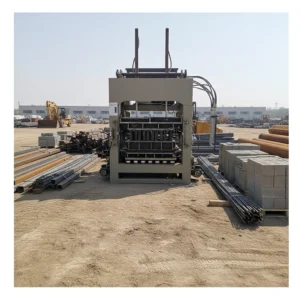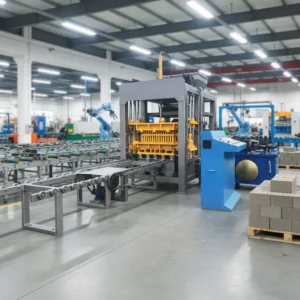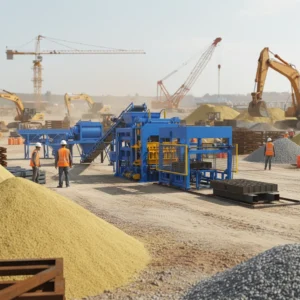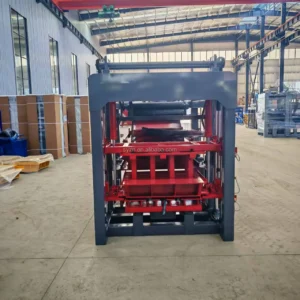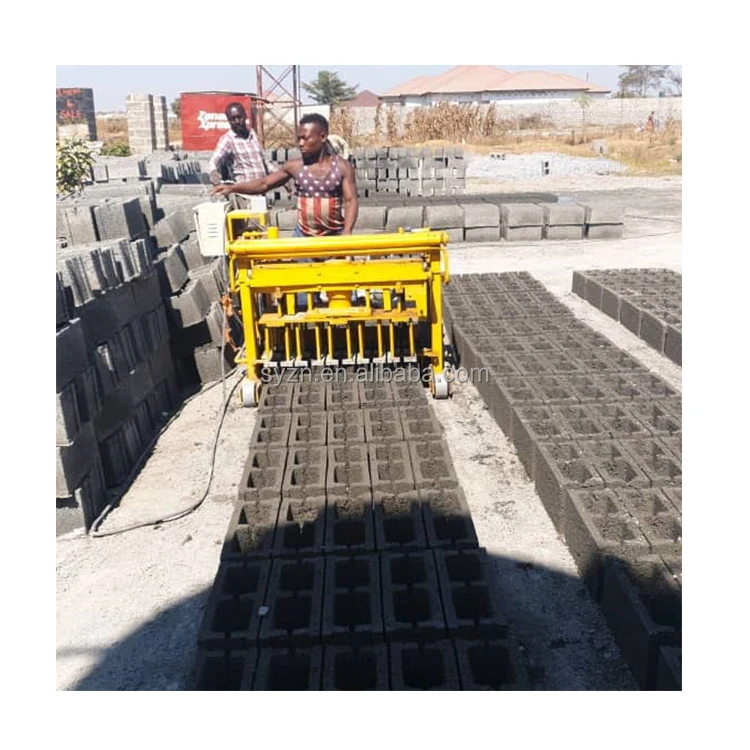
Matched to your site layout — the QMY4-30 egg-laying press is mapped against upstream mixing throughput and downstream curing space so the block production line equipment around it never starves the press or bottlenecks the output.
Technical Specifications
| Parameter | Value |
|---|---|
| Model | QMY4-30 |
| Product Type | Mobile Egg-Laying Block Making Machine |
| Overall Dimensions (L×W×H) | 1300 x 1500 x 1000 mm |
| Total Mass | 950 kgs – 1000 kgs |
| Vibration Method | Mold Vibration |
| Vibration Force (Exciting Power) | 28.6 kN |
| Excitation Frequency | 4500 r/min |
| Total Power | 5.95 kW |
| Molding Cycle | 30 s |
| Output Capacity | 3000 pcs/day (8 hours) (basis not stated in source — confirm block format / material / thickness) |
| Raw Materials | Concrete, sand, cement, fly ash, lime, stone dust, construction waste, slag, mine tailings, river sand, coal gangue |
| Control System | Manual handle operation |
| Mould Format | Customizable to buyer drawings |
| Automation Level | Manual / egg-laying mobile |
Application Suitability
| Application | Material or Output |
|---|---|
| On-site housing project block production | Concrete and stone dust mixes laid directly on a prepared ground bed |
| Small contractor yard overflow formats | Fly ash, river sand and cement blends for non-standard pavers or kerbs |
| Remote or temporary block manufacturing | Raw earth and local aggregate blends where fixed plant infrastructure is unavailable |
| Entrepreneur starter block cell | Low-investment entry producing solid blocks and hollow blocks from locally sourced sand and cement |
What a 30-Second Cycle Really Demands from Your Block Production Line Equipment
A press that cycles every 30 seconds will expose every weak link in the material supply chain within the first hour of operation.
I have stood on sites where a mobile egg-laying unit sat idle for twenty minutes every hour because the pan mixer could not discharge fast enough. The block production line equipment feeding the press must match its hunger, not the other way around. When the mixer batch size is too small or the discharge chute too narrow, the operator spends more time waiting than pulling the handle. That downtime is never in the brochure [NEED_CITE: mixer discharge rate matching press cycle time in small block plants].
How Upstream Mixing Throughput Must Align with the QMY4-30
A 30-second molding cycle means the press expects a fresh batch of mixed material roughly every half minute during continuous operation. The supporting block machine line must include a mixer whose batch volume and discharge rate sustain that rhythm. A small drum mixer rated for a single bag of cement may require two full minutes to mix and discharge, leaving the QMY4-30 waiting. The upstream station should be sized so that mixing completes within or slightly faster than the press cycle, with a buffer hopper between the mixer and the machine to decouple the two rhythms.
Why Generator Sizing Becomes a Line-Level Decision
The QMY4-30 draws 5.95 kW in total, but that figure covers only the press itself. Add the mixer motor, a water pump, and site lighting, and the total load on a remote project site can climb well beyond what a small portable generator handles comfortably. Voltage sag under starting current causes the vibration motor to run below its rated frequency, which changes the compaction behavior of the mix. Planning the block production line equipment as a single electrical load prevents the situation where the generator runs fine until the mixer starts, and then the press vibration drops [NEED_CITE: voltage drop effects on vibration motor performance in block making].
Reading the Vibration and Mass Numbers Together
The 28.6 kN vibration force operating at 4500 r/min through mold vibration is what compacts the concrete into the mould cavity. This force must be matched to the mix design the buyer actually uses on site. A dry, zero-slump mix with coarse local aggregate needs the full vibration force to consolidate properly, while a wetter mix with fine sand may over-compact and produce laminated blocks. The 950–1000 kg total mass of the QMY4-30 provides the static weight that keeps the machine stable during vibration on a prepared ground surface. If the ground is soft or uneven, part of the vibration energy dissipates into the subgrade instead of compacting the block, which is why site preparation is part of the line layout, not an afterthought.
When Pallet and Curing Planning Gets Left Out
An egg-laying mobile machine does not use pallets in the conventional sense — it lays blocks directly on the ground and moves forward. This changes the entire downstream layout. Instead of pallet return conveyors and stacking stations, the line requires a flat, level curing area large enough to hold a full day’s output before the blocks can be moved. If the curing area is too small, the operator runs out of floor space halfway through a shift and production stops. Forklift traffic paths must be planned so that cured blocks are collected without driving over freshly laid ones [NEED_CITE: floor curing area calculation for egg-laying block machines].
Why the Supporting Block Machine Line Matters More Than the Press Alone
Every block production line equipment purchase starts with the press, but the output is only as consistent as the weakest station in the chain. A mixer that delivers uneven batches produces blocks that vary in density and strength from one end of the curing floor to the other. A water supply that runs inconsistently changes the moisture content between batches. Specifying the QMY4-30 alongside its mixer, water dosing, and curing area as one system means each station is checked against the others before the line is built.
What Happens When Line Stations Are Specified Separately
Buyers who source the press from one supplier and the mixer from another often find that the two were never matched for throughput or discharge height. The mixer outlet may sit too high or too low for the QMY4-30 feed hopper, requiring improvised chutes that cause material segregation. The supporting block machine line should be quoted with dimensional drawings showing how each station connects physically, not just listed as separate line items on an invoice.
- Line layout drawing showing raw material feeding, mixer placement, and curing area relative to the QMY4-30 travel path, with capacity calculated per block format
- Factory test record confirming actual molding cycle time on the buyer’s target block format and mix design
- Mixer batch size and discharge rate confirmation matched to the 30-second press cycle
- Voltage, frequency, and control language confirmation document before shipment
- Mould drawing and format list for every block type the buyer intends to produce
- Operation manual covering ground preparation requirements for egg-laying operation
Installation, Commissioning & Support
- Ground surface must be level and compacted to support the 950–1000 kg mass of the QMY4-30 during vibration without settlement
- Electrical supply confirmed for 5.95 kW total draw plus mixer and auxiliary loads with dedicated circuit protection
- Machine arrives as a single mobile unit requiring no fixed foundation, reducing site preparation to ground leveling
- First-run commissioning includes vibration frequency and cycle time verification against the buyer’s local aggregate mix
- Operator training covers manual handle sequence, mould change procedure, and daily mold cleaning routine
- Wear parts list provided for vibration motor bearings and mold liner surfaces with recommended inspection intervals
What to Share Before Requesting a Quotation
To size the block production line equipment around the QMY4-30 accurately, provide the block formats your market demands, the daily volume you need per format, and the raw materials available locally including aggregate type and grading. Share your site dimensions so the curing area and machine travel path can be laid out before the line is quoted. Confirm your available voltage and frequency so the motor specifications are locked before production begins.
Frequently Asked Questions
Q: What mixer capacity and discharge rate do I need so the QMY4-30 is never starved of material?
A: The mixer should complete a batch and discharge within or slightly faster than the 30-second molding cycle. A buffer hopper between the mixer outlet and the press feed helps decouple the two rhythms. Specify the mixer batch size against the volume each mould cavity requires so the press receives enough material per cycle without overflow.
Q: How do I calculate realistic daily output when my block format differs from the supplier’s test piece?
A: The 3000 pcs/day figure in the specification sheet has no stated block format basis, so treat it as a starting reference only. Request a capacity calculation that names your exact block dimensions, wall thickness, and mix design. The molding cycle may remain 30 seconds, but the number of blocks per mould and the handling time between cycles change with format.
Q: Does the line include pallet feeding, stacking and curing rack handling, or are those quoted separately?
A: The QMY4-30 is an egg-laying mobile machine, so it does not use pallets or conventional stacking stations. Instead, the line requires a prepared ground curing area and a plan for collecting cured blocks. Clarify with the supplier whether ground preparation guidance, curing area layout, and block collection equipment are included in the quotation.
Q: What voltage and frequency confirmation is required before the machine leaves the factory?
A: The motor windings and vibration motor must be wound for your site’s exact voltage and frequency before assembly. Provide this information at the inquiry stage so it is confirmed on the specification sheet and checked during the factory test. A motor wound for the wrong frequency will run at the wrong vibration speed and produce inconsistent block density.