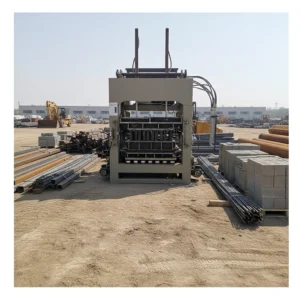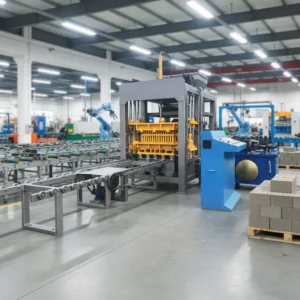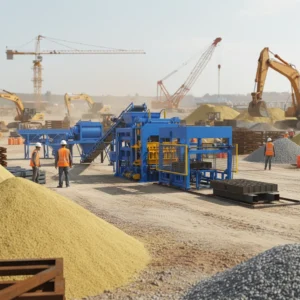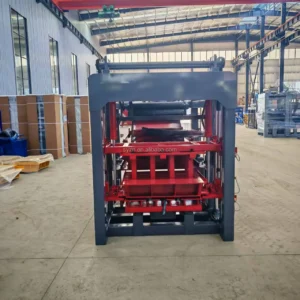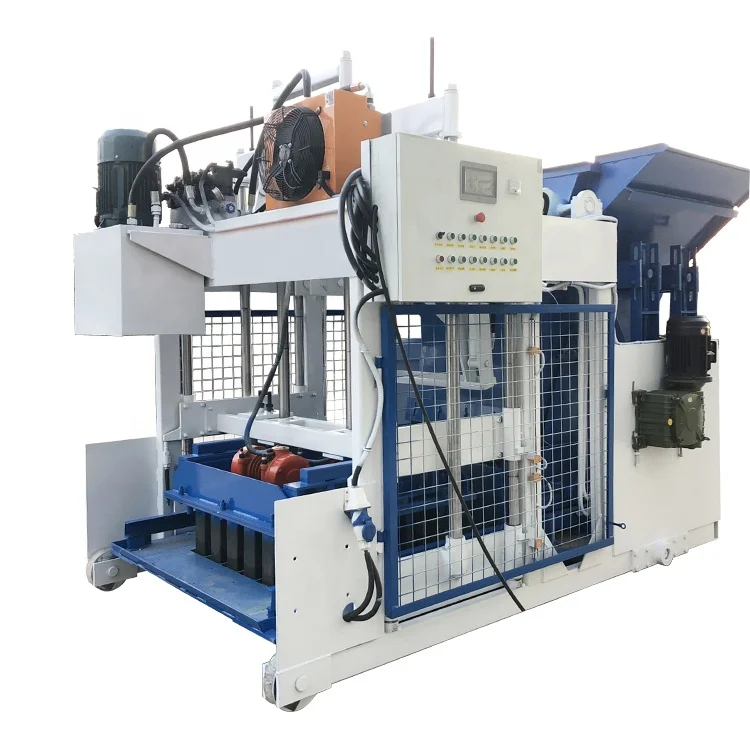
Line-Matched Throughput — the QMY18-15 mobile egg laying block machine is specified alongside mixer output, feeder rate, and curing footprint so no station bottlenecks the press on your site.
Technical Specifications
| Parameter | Value |
|---|---|
| Model | QMY18-15 |
| Product Type | Automatic Mobile Egg Laying Cement Block Making Machine |
| Working Method | Hydraulic |
| Rated Power | 24 kW |
| Control System | PLC |
| Output Capacity | about 34,000 pcs per shift (based on 400×200×200 mm block format) |
| Block Type | Customizable according to buyer requirement |
| Mould Format | Customizable |
| Pallet Requirement | None (egg laying type, blocks produced directly on ground) |
| Voltage | Customized according to local industrial voltage |
Application Suitability
| Application | Material or Output |
|---|---|
| On-site hollow block production for housing projects | Cement, sand, crushed stone, water |
| Solid block manufacturing at remote construction sites | Local aggregate blended with cement |
| First-stage plant for block entrepreneurs | Crusher dust, gravel, cement mixes |
| Paving and interlocking block runs between project locations | Fine aggregate and cement at site-specific ratios |
Why "34,000 Pieces per Shift" Can Mislead Your Whole Line Plan
The number only holds if every upstream station feeds the press without pause.
I watched a contractor in Johor lose an entire week because his mixer could not keep up with a mobile egg laying block machine production line running at full cycle. The press sat idle while workers waited for the next batch. When capacity is quoted without stating the block format, daily output falls far short of what was promised [NEED_CITE: block format assumptions in capacity quotations]. The QMY18-15 figure of 34,000 pieces per shift assumes a 400×200×200 mm hollow block. Smaller formats will yield a higher piece count, larger formats will yield less, and none of that matters if the mixer or water supply cannot match the press cycle.
How Stations Connect Around the Press
The QMY18-15 eliminates pallet feeding, pallet return, and pallet handling from the line because it lays blocks directly on the ground. That simplification removes several stations but places more weight on raw material feeding and mixing. If the mixer batch size does not align with the press hopper volume, the operator either overfills or starves the system. A matched mobile egg laying block machine production line starts with a mixer whose discharge cycle is timed to the press consumption rate.
Ground Preparation and Curing Area Layout
Egg laying machines need a flat, compacted surface that can bear repeated passes without settling. The curing area must extend far enough from the production path so that freshly laid blocks are not disturbed by the machine’s next pass. In humid tropical sites, drainage becomes critical — standing water softens the ground and undermines block integrity. Planning the curing footprint before the machine arrives prevents the crew from improvising paths that collide with freshly produced stock [NEED_CITE: ground preparation standards for mobile block production].
Reading the Spec Sheet Against Your Actual Site Conditions
The 24 kW rated power tells you the total electrical draw the press demands. Your generator or site transformer must accommodate this alongside the mixer motor, water pump, and any feeder conveyor. Hydraulic working method means block density depends on hydraulic pressure and vibration force acting together — if your local aggregate is coarser than standard, the pressure setting must compensate to maintain strength consistency. PLC control simplifies daily operation and allows cycle time adjustments, but the display language must be confirmed before shipment so your operators can read fault codes without translation delays. Mould format is customizable, which means you should specify the exact block dimensions your market sells rather than accepting a catalogue default that may not move in your region.
The Cost of Skipping Line-Level Coordination
When a mobile egg laying block machine production line arrives without a matched mixer, the buyer either rents a larger one locally at premium rates or runs the press at half capacity for weeks. Voltage mismatches discovered at commissioning can idle the entire site while a transformer is sourced. Unconfirmed PLC language means operators guess at error screens, leading to unnecessary shutdowns and mould damage [NEED_CITE: commissioning delays caused by voltage and language mismatches]. These are not machine defects — they are line planning gaps that turn a fast setup into a costly delay.
Why Buyers Specify the Whole Line Here
Block machinery is the single focus, so the QMY18-15 is never quoted in isolation — mixer capacity, feeder rate, and curing plan are calculated together before the quotation is issued. Configuration is set against your actual mix design and local aggregate, not a generic catalogue entry. Mould design covers the formats your market actually buys, including custom drawings when standard formats do not match. Automation level is selectable so you can begin with manual material handling and add feeder automation as output grows. Installation and commissioning support includes operator training so your crew understands cycle timing across every station.
Documentation & Verification
- Line layout showing mixer, feeder, and press positions with cycle time per station
- Capacity calculation sheet stating the 400×200×200 mm block format assumption
- Hydraulic and electrical schematic matching your confirmed voltage and frequency
- Factory test record run on your specified mould format before dispatch
- Operation and maintenance manual in your confirmed PLC display language
- Packing photographs and customs documentation support for your port of entry
Installation, Commissioning & Support
- Flat compacted ground surface prepared to bear repeated machine passes without settling
- Power supply matching the confirmed 24 kW draw plus upstream mixer and pump loads
- PLC display language and voltage verified against site conditions before shipment
- First production run supervised to set hydraulic pressure for your local aggregate mix
- Operator training covering mould change procedure and cycle time adjustment
- Wear parts list and mould inventory provided for first replacement planning
What to Share Before Requesting a Quotation
Provide the exact block dimensions and formats your market sells, along with the daily output you need to sustain. Share your local aggregate type and source so the mix design can be matched to your material. Confirm your site voltage, frequency, and preferred PLC language to avoid commissioning delays. Describe your available ground area and curing space so the line layout accounts for the machine’s travel path and block storage zone.
Frequently Asked Questions
Q: How is the realistic daily output calculated, and which block format does the 34,000 pcs/shift figure assume?
A: The 34,000 pieces per shift figure assumes a 400×200×200 mm hollow block format. Smaller blocks such as paving units will yield a higher piece count, while larger formats reduce the total. Realistic daily output also depends on mixer batch speed and ground conditions keeping the press moving without idle gaps between cycles.
Q: What supporting equipment is needed around the QMY18-15 to form a complete line?
A: You need a mixer sized to match the press hopper consumption rate, a water supply system with adequate flow, and raw material feeding equipment such as a belt conveyor or loader. Since this is an egg laying machine, no pallet handling system is required, which simplifies the line considerably.
Q: How do I confirm voltage, frequency, and PLC language match my site before the machine ships?
A: Share your site electrical specifications and preferred operator language during the inquiry stage. These details are confirmed in writing before production begins, and the factory test is conducted at your specified voltage setting to verify compatibility before dispatch.
Q: What ground preparation and curing area does an egg laying mobile machine require on site?
A: The ground must be flat, compacted, and well-drained to support the machine weight and block curing without soft spots. The curing area should extend beyond the production path so freshly laid blocks are not disturbed during subsequent passes of the mobile egg laying block machine production line.
Q: How does the hydraulic system cycle time coordinate with upstream mixing and material feeding?
A: The PLC controls the press cycle, and the mixer discharge rate must be timed so the hopper never runs empty or overflows. If the mixer batch is too slow, the press idles between cycles. Line layout planning matches each station’s timing so the press operates continuously at its rated pace.