
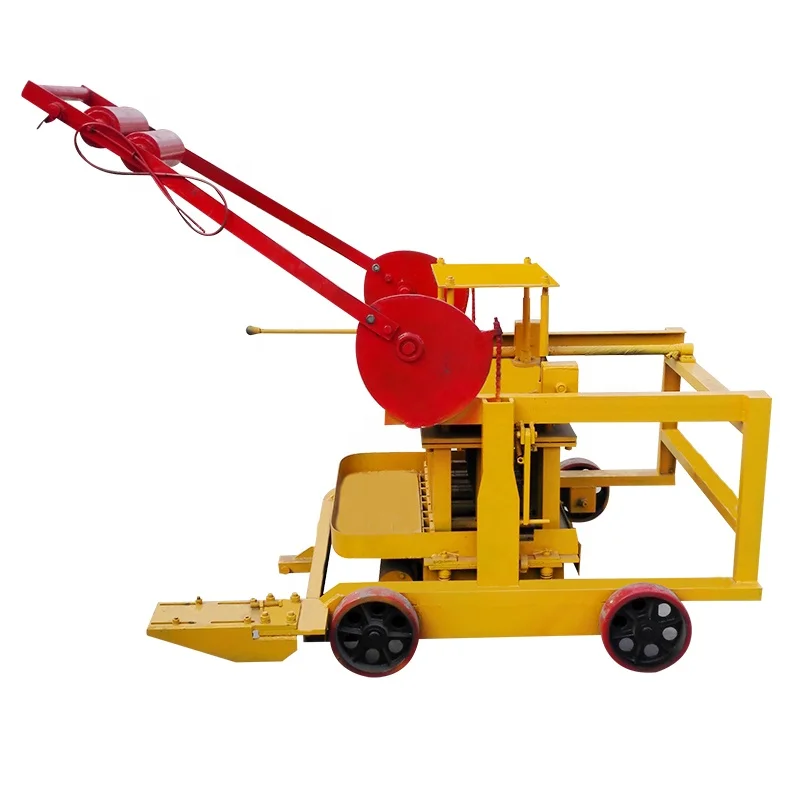
Line-Synchronized Output — A brick plant is a system where every station must keep pace; the QMR4-45 mobile block making machine production line is configured so mixing, forming, and curing align without bottlenecking the press.
Technical Specifications
| Parameter | Value |
|---|---|
| Model | QMR4-45 |
| Product Type | Diesel/Electric Mobile Interlocking Clay Block Making Machine |
| Power Source | Diesel engine or electric motor (dual configuration available) |
| Hydraulic Pressure Supply | Diesel engine driven |
| Pallet Requirement | None (egg-laying / mobile operation) |
| Concrete Floor Requirement | Not required |
| Mould Change | Supports multiple block formats via mould swap |
| Automation Level | Manual / Semi-automatic |
| Output — Hollow Brick 400×200×200 mm | 320 pcs/h, 2,600 pcs/8 hr (basis: 4 pcs per mould, 30–45 s cycle) |
| Output — Hollow Brick 400×150×200 mm | 400 pcs/h, 3,200 pcs/8 hr (basis: 5 pcs per mould, 30–45 s cycle) |
| Output — Hollow Brick 400×100×200 mm | 560 pcs/h, 4,480 pcs/8 hr (basis: 7 pcs per mould, 30–45 s cycle) |
| Molding Cycle | 30–45 s (basis: hollow brick formats above) |
Application Suitability
| Application | Material or Output |
|---|---|
| On-site hollow brick production | Crushed stone, sand, cement, and water mix |
| Interlocking brick forming | Clay or concrete mix via mould change |
| Paving brick production | Concrete aggregate with mould swap |
| Remote construction sites with limited grid power | Diesel-powered operation on existing soil |
| Small-scale entrepreneur block plant | Low-infrastructure startup without fixed factory |
| Housing project local block supply | Mobile egg-laying output directly on ground |
What "2,600 Blocks per Shift" Actually Requires from the Rest of the Line
A mobile block making machine production line is only as fast as its slowest station upstream or downstream of the press.
I once watched a QMR 4-45 sit idle on a site in Latin America because the mixer batch cycle ran forty seconds longer than the press cycle. The hopper overflowed, the operator shut everything down, and the afternoon’s output dropped to a fraction of the quoted figure [NEED_CITE: mixer-to-press cycle synchronization in mobile block plants]. The press itself never broke down — the line around it did. When buyers evaluate daily capacity, the number on the spec sheet assumes the mixer can deliver a fresh batch every 30–45 seconds, the raw material feed keeps up, and the curing area has enough ground space to accept continuous egg-laid output without forcing the machine to stop.
How the Stations Connect Around a Pallet-Free Press
Because the QMR4-45 lays blocks directly on the ground, the pallet feeding, pallet return, and curing rack handling stations that dominate a fixed plant are entirely absent. This collapses the mobile block making machine production line into a shorter chain: raw material feeding, mixing, forming, and open-air curing. Each remaining station must still match the 30–45 second molding cycle, or the press waits and output falls.
Why the Mixer Is the Real Bottleneck on a Mobile Site
On a fixed plant, a large pan mixer buffers several batches ahead. On a mobile site, space and budget usually mean a single smaller mixer feeding one press. If that mixer cannot complete a batch within the molding cycle, the mobile block making machine production line stalls every few minutes [NEED_CITE: batch cycle versus press cycle mismatch in small-scale block production]. Sizing the mixer to the press — not the other way around — is the first configuration decision that determines whether the quoted hourly output is achievable.
Reading the Capacity Table Honestly
The three hollow brick formats listed above produce different piece counts per mould — four, five, or seven — and the hourly figures reflect that difference at the same cycle time. If your market primarily buys the 400×200×200 mm format, your realistic daily output is 2,600 pieces per eight-hour shift. Switching to the 100 mm width nearly doubles the count, but the block weight, curing time, and market price per piece change as well. Always confirm which format the quoted capacity assumes before comparing machines.
The Specs That Decide Block Strength on Site
Diesel-driven hydraulic pressure gives the QMR4-45 an advantage on sites where electric supply cannot sustain the peaks a hydraulic pump demands. The pressure, combined with vibration force — not stated in the current source and requiring confirmation — determines the green density of each block as it leaves the mould. Higher green density means the block can survive the handling that occurs before curing is complete, which is critical when blocks are egg-laid on uneven ground rather than sitting flat on a pallet.
What Happens When the Supporting Equipment Is Undersized
A mobile block making machine production line that omits the mixer capacity calculation or skips the curing area layout often shows its problem within the first week. The press runs at full speed for twenty minutes, then idles while the mixer catches up. Blocks laid too close together in the curing zone get knocked over by workers moving the machine forward. These are not machine failures — they are line design failures [NEED_CITE: curing area spacing requirements for egg-laying block machines]. The cost shows up as wasted labor hours and cracked product, not as a warranty claim.
Why Buyers Choose This Configuration
Block machinery is our single focus, so the QMR4-45 is never quoted as a standalone press. We specify the mixer, raw material feeder, and curing layout as one matched system against the buyer’s actual aggregate and target block format. Mould design covers the formats the buyer’s local market sells, including custom interlocking and paving profiles drawn to buyer specifications. The dual diesel-electric power option means a contractor can start on a site with no grid connection and later switch to electric when permanent power arrives, without replacing the press. Voltage, frequency, and control language are confirmed before production so commissioning is not delayed by a mismatch on arrival.
Documentation & Verification
- Line layout showing mixer-to-press cycle match for your chosen block format
- Capacity calculation stating the hollow brick size assumed in daily output
- Mould drawing and format list including interlocking and paving options
- Hydraulic and electrical schematic with voltage and frequency noted
- Factory test record on your target block format before dispatch
Installation, Commissioning & Support
- No concrete floor needed; level compacted ground is sufficient for egg-laying operation
- Diesel engine or electric motor confirmed to match site power availability before build
- Mould change procedure covered during on-site operator training session
- Hydraulic pressure and vibration settings adjusted to buyer’s local aggregate during commissioning
- Wear parts and mould list supplied with first replacement intervals noted
Before You Request a Quote
Tell us which block format your market buys most — the 200 mm, 150 mm, or 100 mm width — and what daily output you need from an eight-hour shift. Share whether your site has reliable grid electricity or requires diesel power, and describe the local aggregate you plan to use. If you already own a mixer, give us its batch capacity and cycle time so we can confirm it will keep pace with the press.
Frequently Asked Questions
Q: How is the daily output calculated and which block format is it based on?
A: Each output figure in the specification table is tied to a specific hollow brick dimension and the corresponding number of cavities per mould. The 2,600-piece figure, for example, assumes the 400×200×200 mm format at four pieces per mould over a 30–45 second cycle across an eight-hour shift. Always confirm which format underpins any quoted capacity.
Q: Diesel or electric motor — how do I choose for my site?
A: If your construction site lacks reliable three-phase grid power or operates in a region with frequent outages, the diesel configuration keeps production running independently. Where stable electricity is available, the electric motor option reduces fuel cost and noise. Both configurations drive the same hydraulic pressure system.
Q: What supporting equipment do I still need if pallets and a concrete floor are not required?
A: You still need a mixer sized to match the press cycle, a raw material feed method, and enough flat ground for curing. The absence of pallets removes pallet handling and rack systems, but mixing capacity and curing space remain critical to sustaining the quoted output.
Q: What mould formats are available beyond the hollow bricks listed?
A: The QMR4-45 supports mould changes for interlocking bricks and paving bricks in addition to the three hollow brick sizes documented above. Custom mould profiles can be designed to buyer drawings, allowing production of formats that match specific local market demand.
Q: How does the machine integrate with a mixer on a mobile site?
A: The mixer must complete a batch within the 30–45 second molding cycle to prevent the press from idling. We calculate the required mixer batch volume and recommend a model that keeps material flowing continuously, ensuring the mobile block making machine production line runs without stoppages.


