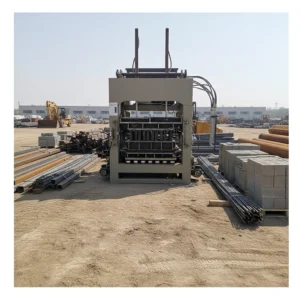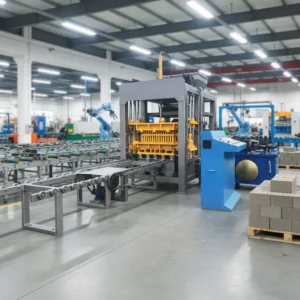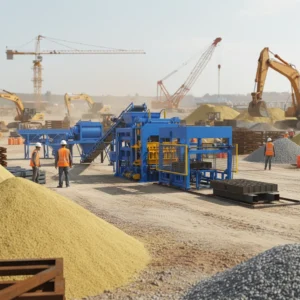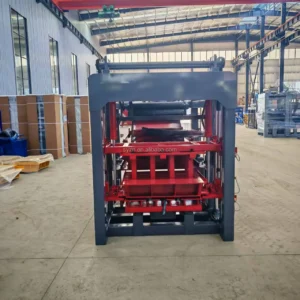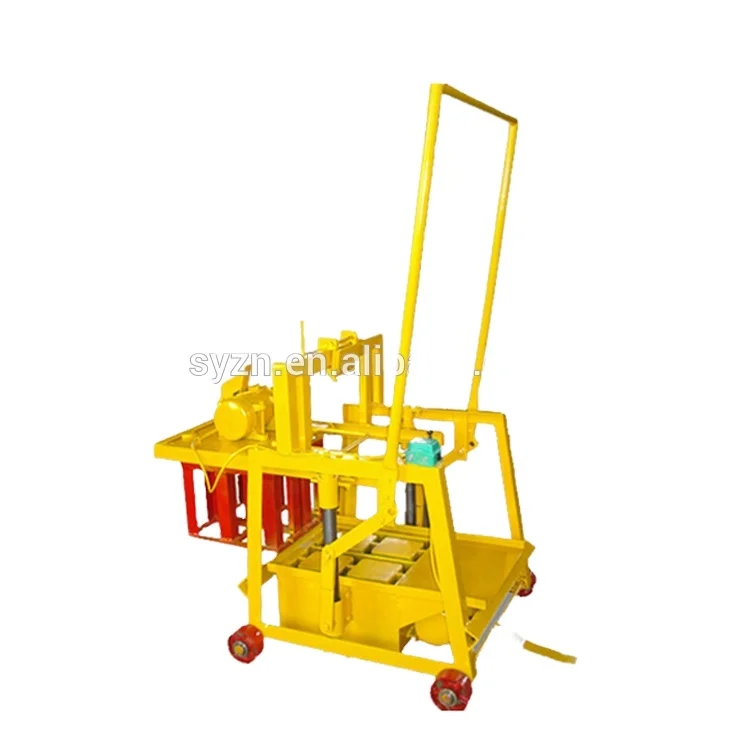
Matched line integration — every upstream mixer, feeder and downstream curing rack is sized to the QMJ2-45 block machine production line / supporting equipment cycle so the press never sits idle waiting for material or space.
Technical Specifications
| Parameter | Value |
|---|---|
| Model | QMJ2-45 |
| Product Type | Manual Hollow Block Making Machine |
| Rated Power | 1.5 kW |
| Voltage & Frequency | Configured to buyer’s local supply (basis to be confirmed) |
| Control System | Semi-automatic with top die push-pull and automatic scraper |
| Overall Dimensions (L×W×H) | 1300 × 1300 × 1150 mm |
| Net Weight | 400 kg |
| Molding Cycle | 45 s |
| Vibration System | Bed mould vertical vibration + upper mould compression vibration |
| Output Capacity | 1200 pcs/day based on 400×200×200 mm hollow block, 2 pcs/mould |
| Output Capacity | 1760 pcs/day based on 400×150×200 mm hollow block, 3 pcs/mould |
| Theoretical Throughput | 150 pcs/hour based on 400×200×200 mm hollow block |
| Theoretical Throughput | 220 pcs/hour based on 400×150×200 mm hollow block |
| Raw Materials | Concrete, sand, cement, fly ash, lime, gypsum |
| Automation Level | Semi-automatic, mobile egg-laying type |
Application Suitability
| Application | Material or Output |
|---|---|
| Small workshop hollow block production | Crushed stone, sand and cement mix, 400×200×200 mm format |
| On-site block laying by building contractors | Fly ash, lime and gypsum blends, 400×150×200 mm format |
| Start-up block plant adding hollow formats | Local aggregate with cement binder, subject to mould availability |
Why a 45-Second Cycle Means Nothing Without the Rest of the Line
A press is only as fast as the station feeding it.
I have watched a QMJ2-45 block machine production line / supporting equipment sit idle for fifteen seconds every cycle because the pan mixer upstream was undersized, and the contractor had no idea the quoted throughput assumed continuous feed. The press was ready, the operator was ready, but the concrete was not. That gap repeats hundreds of times a shift, quietly erasing the daily output the buyer counted on [NEED_CITE: line balancing principles for concrete block production]. Sizing the entire line around the press cycle, not just the press itself, is the only way the numbers hold up on the shop floor.
Feeding Rhythm and Mixer Sizing
The QMJ2-45 completes a moulding cycle every 45 seconds, which means the mixer must deliver a fresh batch to the hopper within that same window. A pan mixer with insufficient capacity forces the press operator to wait, and each idle cycle compounds across an eight-hour shift. The QMJ2-45 block machine production line / supporting equipment layout must specify mixer drum volume, discharge height and conveyor length so material arrives at the hopper without manual shoveling. When the feeder and press are matched, the semi-automatic scraper and top die push-pull keep working at their intended pace.
Curing Area Footprint and Block Handling
Output rated at 1200 pieces per day based on 400×200×200 mm hollow blocks translates into a specific floor area for curing, and that area must be ready before the first block leaves the press. With an egg-laying mobile configuration, blocks are set directly on the ground, so the curing zone needs level, compacted surface with enough clearance for the machine to travel and for workers to move between rows. If the curing area is too small, blocks stack up near the press and the operator spends time relocating finished product instead of running the next cycle [NEED_CITE: concrete curing space requirements for small block plants]. Planning the QMJ2-45 block machine production line / supporting equipment means measuring the available yard and confirming it can absorb a full day’s output.
Vibration Force, Mix Design and Block Density
The bed mould vertical vibration combined with upper mould compression vibration determines how densely the concrete packs into the mould cavity. A mix with too much fines content will absorb vibration energy differently than a coarse aggregate blend, producing blocks with inconsistent wall thickness and compressive strength. The QMJ2-45 block machine production line / supporting equipment configuration should be set against the buyer’s actual local aggregate and cement ratio, not a generic catalogue default. When the vibration profile matches the mix, blocks leave the mould with uniform density and the rejection rate stays low.
What Happens When Upstream Stations Are an Afterthought
I once saw a contractor receive a mobile block press with no mixer or feeder in the shipment, assuming those could be sourced locally at any hardware store. The locally bought mixer discharged too slowly, the hopper adapter did not fit, and the first week of production ran at half the expected rate. The QMJ2-45 block machine production line / supporting equipment quotation had listed the press alone, and nobody asked what else was on site [NEED_CITE: common line integration gaps in small-scale block production]. The cost of retrofitting a feeder and resizing the mixer after arrival always exceeds the cost of specifying them together before dispatch.
Why Line-Level Specification Matters Here
Block machinery is our single focus, so the QMJ2-45 is never quoted as a standalone press without confirming what sits upstream and downstream. Configuration is set against the buyer’s actual mix design, local aggregate and target block format rather than a default table. Mould design covers the hollow formats the buyer’s market actually sells, and custom drawings are available when standard moulds do not match. Automation level is selectable, so a buyer running manual pallet handling today can add semi-automatic stacking later. Installation support includes operator training on the full line, not just the press controls.
Documentation & Verification
- Line layout drawing showing mixer, feeder, QMJ2-45 press and curing area with cycle-matched throughput at each station
- Capacity calculation stating the hollow block format and shift hours assumed for the output figure
- Voltage, frequency and control language confirmation sheet signed before production begins
- Mould drawing and format list covering 400×200×200 mm and 400×150×200 mm hollow blocks
- Factory test record run on the buyer’s specified mould format before dispatch
Installation, Commissioning & Support
- Level compacted ground required across the curing zone to match the 1300 × 1300 mm machine footprint and egg-laying travel path
- Dedicated 1.5 kW circuit with voltage and frequency confirmed to local supply before the QMJ2-45 is wired
- Machine shipped as a single assembled unit weighing 400 kg, requiring only hopper and vibration motor connection on site
- First-run moulding cycle set to 45 seconds and adjusted against the buyer’s actual concrete mix during commissioning
- Operator training covers semi-automatic scraper, top die push-pull and mould change procedure for both standard hollow formats
Before You Send the Inquiry
Tell us which hollow block format your market sells most, what local aggregate and cement you can source, and how many hours per shift you plan to run. Confirm your site voltage, frequency and whether the curing area is indoors or an open yard. If you already have a mixer or feeder on site, share the model and capacity so we can check whether it keeps pace with the 45-second press cycle.
Frequently Asked Questions
Q: How is daily output calculated for the QMJ2-45, and which block format does it assume?
A: The 1200 pcs/day figure is based on 400×200×200 mm hollow blocks at 2 pcs per mould over a standard shift, while 1760 pcs/day assumes 400×150×200 mm blocks at 3 pcs per mould. Both figures assume the mixer feeds continuously and the curing area absorbs the full day’s production without bottleneck.
Q: What mixer capacity is needed to keep the QMJ2-45 running without idle time?
A: The mixer must discharge a batch within the 45-second moulding cycle so the hopper never runs empty. Exact drum volume depends on the block format being produced and the mix design weight per block, which we confirm during line layout before quotation.
Q: Does the QMJ2-45 require pallets, or is it a pallet-less egg-laying machine?
A: The QMJ2-45 is a mobile egg-laying type that lays blocks directly on level ground, so no pallet feeding or return system is needed. The curing surface must be compacted and flat enough for the machine to travel smoothly between rows.
Q: How do I size the curing area to match the press output?
A: Calculate the total blocks produced per shift based on your chosen format, then multiply by the floor space each block occupies plus walking clearance between rows. We include a curing area layout in the line drawing so the yard is sized before the machine arrives.