
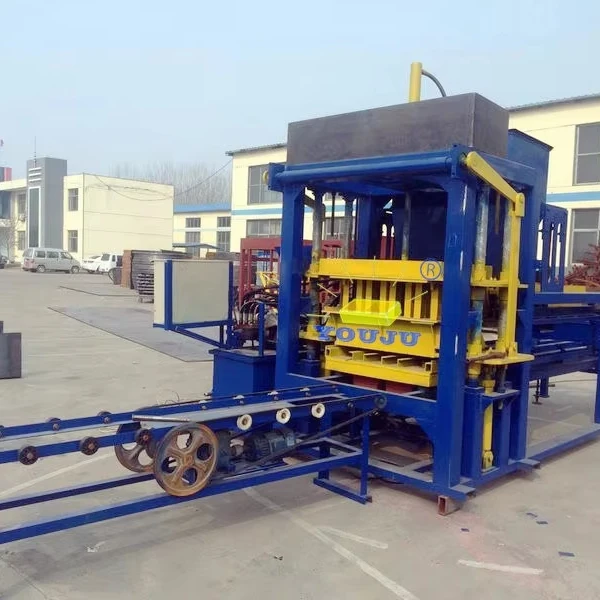
Matched Line Synchronization — The QT4-20 is positioned as one station within a full block production line, with upstream mixing and downstream pallet handling timed to the press cycle rather than quoted as isolated throughput.
Technical Specifications
| Parameter | Value |
|---|---|
| Model | QT4-20 |
| Product Type | Stationary Hydraulic Block Making Machine |
| Overall Dimensions (L×W×H) | 7100×1600×2610 mm |
| Molding Area | 400×800 mm |
| Pallet Size | 1020×570 mm |
| Rated Pressure | 16–21 MPa |
| Main Vibration Form | Platform Vibration |
| Vibration Frequency | 4600 r/min |
| Vibration Force | 40 kN |
| Molding Cycle | 15–25 s |
| Overall Power | 27.5 kW |
| Total Mass | 5 T |
| Demolding Method | Hydraulic |
| Recommended Factory Area | 500 m² |
| Control System | PLC (brand and display language to be confirmed before production) |
| Voltage & Frequency | To be confirmed against buyer’s local supply |
| Output — Hollow Brick (400×200×200 mm, 4 pcs/mold) | 7200–9600 pcs/day (based on 15–20 s cycle) |
| Output — Porous Brick (240×115×90 mm, 14 pcs/mold) | 20200–26800 pcs/day (based on 15–20 s cycle) |
| Output — Standard Brick (240×115×53 mm, 28 pcs/mold) | 47400–53700 pcs/day (based on 15–17 s cycle) |
Application Suitability
| Application | Material or Output |
|---|---|
| Hollow block production for load-bearing walls | Crushed stone, sand, cement, gravel at 16–21 MPa hydraulic compaction |
| Solid block production for partition and infill | Fly ash, slag, sand blended with cement |
| Paving brick manufacturing for walkways and yards | Fine aggregate and cement mixes at high vibration frequency |
| Porous brick production for insulation and drainage | Lightweight aggregate blends requiring precise vibration control |
Why a 15-Second Cycle Means Nothing Without the Rest of the Line
A press that finishes a cycle in 15 seconds is only as fast as the station that feeds it and the station that takes the pallet away.
I have watched stationary block making machine production line setups where the mixer took 40 seconds per batch while the press waited empty for a third of every minute. The quoted output assumed a cycle that never actually happened in continuous operation. Upstream feeding, mixing capacity, pallet return speed, and downstream stacking all have to match the 15–25 s molding window of the QT4-20, or the daily count drops well below the brochure figure [NEED_CITE: line-level cycle matching principles in block production].
How Upstream Feeding Sets the Real Rhythm
The stationary block making machine production line begins well before the press. Raw material feeding and mixing must deliver a consistent batch to the hopper within the molding cycle window. If the mixer is undersized for the 27.5 kW press demand, every cycle extends by the seconds the operator spends waiting for the next batch. Line-level capacity calculation should state which mixer model, batch size, and mixing time are included.
Where Pallet Handling Becomes the Bottleneck
Downstream from the press, the 1020×570 mm pallets must be fed in, extracted, and moved to the curing area without pause. A pallet feeder that cannot keep up with the 15–25 s cycle forces the press to hold. Equally, if the curing rack spacing does not match the pallet dimensions, forklift operators spend extra time aligning loads — and the return loop slows [NEED_CITE: pallet handling impact on block plant throughput]. The QT4-20 quotation should specify pallet material, quantity, and whether a pallet return conveyor is included.
Vibration and Pressure Working as a Paired System
Platform vibration at 4600 r/min delivers 40 kN of compaction force through the mold, while the hydraulic system applies 16–21 MPa of pressing pressure from above. These two forces must arrive simultaneously and hold for the full molding cycle to achieve consistent block density. When vibration is strong but pressure is weak, blocks crack during demolding; when pressure is high but vibration is insufficient, the mix does not fill the mold corners completely. The QT4-20 pairs both systems at the press station, but the mix design and local aggregate must be confirmed so that force settings match what the material actually requires.
What Happens When One Station Is Oversized
Buying a high-capacity press and connecting it to an undersized mixer or manual pallet stacker does not produce a high-capacity line. It produces an expensive press that idles between cycles. I have seen plants where the owner paid for full automation at the press but handled stacking by hand, so finished blocks piled up on the pallets and the return loop stalled every few minutes. The investment at the press was wasted because the supporting stations were never included in the scope [NEED_CITE: consequences of unmatched station capacity in block lines]. Line-level quotation — covering feeding, mixing, pallet handling, stacking, and curing rack transfer — prevents this mismatch from appearing on the factory floor.
Why Line-Level Specification Matters Here
Block machinery is the single focus at this facility, which means the QT4-20 is not sold as a standalone press dropped into an unknown layout. The machine, mold, pallet, and handling equipment are specified as one matched system. Configuration is set against the buyer’s actual mix design and local aggregate rather than a catalogue default. Molds are designed for the block formats the buyer’s market sells, including custom drawings where needed. The automation level is selectable, allowing a buyer to start with semi-automatic pallet handling and add automatic stacking later. Installation support includes line-level commissioning, not just press startup.
Documentation & Verification
- Line layout drawing showing every station from raw material intake to curing rack
- Capacity calculation stating which block format each output figure assumes
- Hydraulic and electrical schematic with confirmed voltage and PLC language
- Pallet specification sheet covering size, material, and quantity for the line
- Factory test record covering full line sequence, not the press alone
- Operation and maintenance manual for all stations in the quoted scope
Installation, Commissioning & Support
- Foundation plan based on the 7100×1600 mm press footprint and 5 T operating mass
- Dedicated power circuit sized for the 27.5 kW total load at confirmed voltage
- Pallet return conveyor alignment checked against curing rack spacing on site
- PLC display language and control parameters set before line commissioning begins
- Operator training covering mold change, pallet feed, and stacking station sequence
- Wear parts list covering hydraulic seals, vibration springs, and mold liners
Preparing a Line Inquiry
To size the stationary block making machine production line correctly, share the target block formats, required daily output per format, and the local aggregate available for the mix. Include workshop dimensions, existing forklift and curing rack specifications, and local voltage and frequency. State whether upstream mixing and downstream stacking are already in place or need to be included in the scope.
Frequently Asked Questions
Q: How is daily output calculated for each block format on this line?
A: Output figures are based on a specific molding cycle per format — for example, 7200–9600 hollow blocks per day assumes a 15–20 s cycle with 4 pieces per mold. The line-level capacity calculation states which upstream mixer and downstream stacker are included so that the cycle time is achievable in continuous operation, not just in a single test run.
Q: Are pallet feeding and stacking included in the line quotation?
A: This depends on the configuration selected. The 1020×570 mm pallet size must be matched to the buyer’s curing area and forklift. Pallet material, quantity, feeder type, and stacking method are confirmed during the proposal stage so nothing is left to manual handling after the press completes its cycle.
Q: How does the mixer capacity match the press cycle time?
A: The mixer must deliver a full batch within the 15–25 s molding window of the QT4-20. If mixing takes longer, the press idles between cycles. The line proposal specifies the mixer model and batch volume so that feeding rhythm aligns with press demand across all block formats.
Q: What electrical and control details are confirmed before shipment?
A: Voltage, frequency, and PLC display language must be confirmed against the buyer’s local supply and operator preference before production begins. The hydraulic and electrical schematic is shared for approval so that commissioning can proceed without delays caused by mismatched power supply or unreadable control screens.
Q: What factory footprint is needed for the complete line?
A: The 500 m² recommended area covers the press, mixer, pallet feed, stacking, and curing zones as a baseline. Actual layout depends on pallet return path, curing rack arrangement, and raw material storage. A line layout drawing is provided showing every station and clearance requirement before equipment is dispatched.


