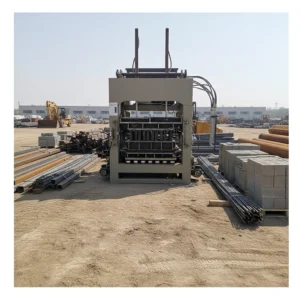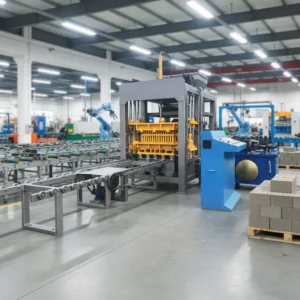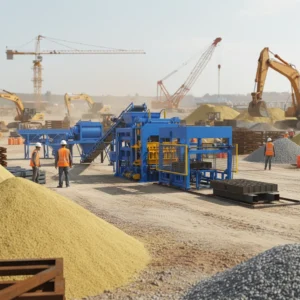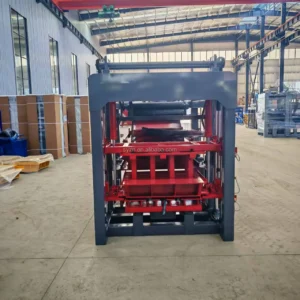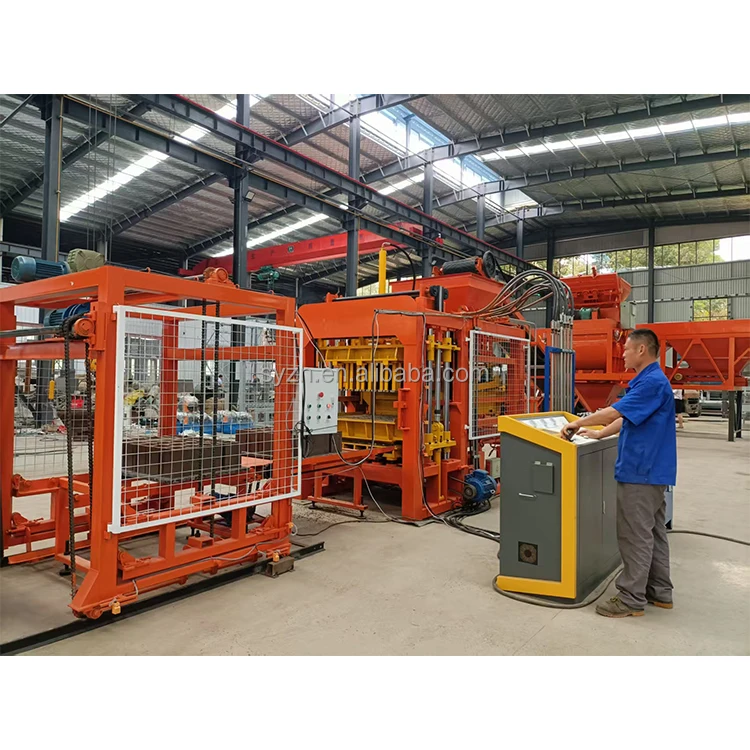
Coordinated line flow — Every station around the QT6-15 is specified so the press never waits for upstream material or downstream pallet handling, keeping the 15-20 s cycle intact across an eight-hour shift.
Technical Specifications
| Parameter | Value |
|---|---|
| Model | QT6-15 |
| Product Type | Hydraulic Concrete Block Making Machine |
| Overall Dimensions (L×W×H) | 8200×1700×2950 mm |
| Total Mass | 7 T |
| Overall Power | 37 kW |
| Vibration Form | Platform Vibration |
| Vibration Frequency | 0-60 Hz |
| Vibration Force | 45 kN |
| Moulding Mode | Automatic loading, vibration moulding |
| Demolding Method | Hydraulic |
| Pallet Size | 880×850 mm |
| Molding Cycle | 15-20 s |
| Control System | PLC with touch screen, fault diagnosis system |
| Factory Area Required | 1200 m² |
| Output — Hollow Block 400×200×200 mm | 8640-11520 pcs/8hr (6 pcs/mould, 15-20s cycle) |
| Output — Hollow Block 400×150×200 mm | 11520-15360 pcs/8hr (8 pcs/mould, 15-20s cycle) |
| Output — Solid Brick 240×115×53 mm | 46080-61440 pcs/8hr (32 pcs/mould, 15-20s cycle) |
| Output — Rectangular Paver 200×100×60 mm | 17280-23040 pcs/8hr (21 pcs/mould, 20-25s cycle) |
| Output — Zigzag Paver 225×112.5×60 mm | 17280-23040 pcs/8hr (15 pcs/mould, 20-25s cycle) |
| Block Compressive Strength | >15 MPa |
| Raw Material Adaptability | Waste ash, slag, various aggregates |
| Hydraulic System | Independent integrated station, isolated from vibration and dust |
| Warranty | 1 year (excluding spare parts) |
Application Suitability
| Application | Material or Output |
|---|---|
| Hollow block production for building walls | Cement blended with crushed stone, slag or ash |
| Solid brick production for masonry | Sand, fine aggregate and cement mixes |
| Rectangular and zigzag paving brick production | High-density aggregate blends for road and walkway surfaces |
| Industrial waste utilization | Fly ash, slag and other by-products combined with cement |
| Medium-to-high capacity block plants | Facilities with approximately 1200 m² available area |
Why the Pallet Question Must Come Before the Machine Price
A pallet size mismatched to your curing racks turns automatic output into manual chaos.
When I plan a QT6-15 block making machine production line, the press itself is only the center of a longer chain. Buyers often focus on the cycle time figure without checking whether the 880×850 mm pallet fits the curing racks already welded on site or the forklift tines already in the yard. If those three dimensions do not agree, finished blocks pile up at the end of the conveyor and workers start stacking by hand within the first week. I have watched entire shifts break down because pallet handling was treated as an afterthought instead of the backbone of the line [NEED_CITE: pallet circulation planning in block plants].
Raw Material Feeding and Mixing Must Match the Press Cycle
The QT6-15 block making machine production line begins at the batching station, where aggregate and cement enter the mixer on a timed belt. If the mixer batch size is too small, the press hopper starves before the next cycle; too large, and the mix begins losing workability while it waits. We size the mixer drum and belt speed against the 15-20 s molding cycle so fresh material arrives exactly when the mold opens. This coordination is where capacity numbers on paper either survive or collapse in real production.
Pallet Feeding, Stacking and Curing Rack Handling
Downstream of the press, wet blocks ride the pallet through the stacker and into the curing rack. Each station must complete its movement within the same window as the press cycle. If the stacker arm hesitates or the curing rack carriage is still returning from the previous load, the press pauses and the cycle stretches from 20 s toward 28 s. Over an eight-hour shift that gap compounds into thousands of missing pieces. We specify the pallet return conveyor, stacker travel speed and curing carriage motor so every handoff happens inside the press cycle envelope [NEED_CITE: line synchronization standards in concrete product plants].
Reading the Specs That Actually Matter
The 45 kN vibration force and hydraulic demolding work together to compact the mix into the mold cavity. Platform vibration at 0-60 Hz settles aggregate into a dense matrix while hydraulic pressure locks the shape before the mold lifts. If vibration amplitude is set too high for a lean cement mix, the block surface spalls; too low and the core stays porous. The independent hydraulic station sits apart from the main frame so dust and press shock do not shorten seal life across continuous shifts. The 37 kW overall power rating covers the press, mixer feed and pallet conveyor running simultaneously, which matters when you are sizing the transformer and main breaker for the 1200 m² plant area.
The Hidden Cost of Ignoring Line-Wide Coordination
I have seen plants where the press was specified in isolation and every other station was sourced separately. The result is a bottleneck at the weakest link — usually the pallet return belt or the curing rack carriage. Blocks queue on the floor, cure unevenly, and compressive strength varies from one pallet to the next. By the time the owner realizes the daily tally is half of the quoted figure, the installation crew has already left the country and the warranty conversation stalls on who is responsible for the mismatch [NEED_CITE: equipment integration liability in multi-supplier lines].
Why This Line Is Planned as One System
We treat the QT6-15 block making machine production line as a single specification rather than a press plus a list of optional extras. The raw material feeder, mixer, pallet magazine, stacker and curing rack carriage are all selected against the target block format and your local aggregate. Pallet size is confirmed against your curing area layout and forklift rating before the first steel is cut. Voltage, frequency and PLC display language are locked in writing so the touch screen speaks the operator’s language on day one. Factory test records show the actual cycle time achieved on your chosen format, not a catalogue average.
Documentation & Verification
- Line layout drawing with capacity stated per block format and cycle time
- Pallet specification matched to your curing rack dimensions and forklift rating
- Hydraulic and electrical schematic before production begins
- Voltage, frequency and PLC language confirmation sheet signed off
- Factory test record on your chosen block format before dispatch
- Operation and maintenance manual with wear parts list
Installation, Commissioning & Support
- Foundation plan sized for the 7 T press mass and 8200 mm footprint
- 37 kW power supply with dedicated breaker and voltage confirmation before wiring
- Pallet conveyor and curing rack carriage assembled and timed to the 15-20 s cycle on site
- PLC touch screen parameters set for your block format and local language during commissioning
- Operator training covering mold change procedure and fault diagnosis system use
- Wear parts and hydraulic seal list supplied with first spare parts order
What to Send With Your Inquiry
Share your target block format and the daily output you need so we can calculate the line configuration per format. Confirm the curing rack layout and forklift you already have on site so pallet size can be matched. Let us know your local voltage and frequency, and which language the operators need on the PLC display [NEED_CITE: export machinery voltage and frequency requirements].
Frequently Asked Questions
Q: How are cycle times matched across stations so the QT6-15 is never left idle?
A: Every station — feeder, mixer, pallet magazine, stacker and curing carriage — is timed to complete its movement within the 15-20 s press cycle. If any station takes longer, the press pauses. We calculate the travel speed and motor rating of each unit against your chosen block format before the line is built, so the press runs continuously rather than queuing wet blocks on the conveyor.
Q: What pallet size is specified and how does that relate to my curing racks?
A: The standard pallet size is 880×850 mm, but we confirm this against your curing rack spacing and forklift tine width before production. If your racks were built for a different pallet, we adjust the pallet magazine and return conveyor to match, preventing a bottleneck at the end of the line.
Q: Which stations are included in the quotation?
A: The quotation covers raw material feeding, mixing, pallet feeding, the QT6-15 press, automatic stacking and curing rack handling as one line. Nothing is treated as an optional extra that you discover only after the press arrives. Each station appears in the line layout with its own cycle time allocation.
Q: Can the automation level be staged for future expansion?
A: Yes. You can start with semi-automatic pallet handling and manual stacking, then add the automatic stacker and curing rack carriage later. The PLC control system and hydraulic station are specified with upgrade headroom so the press does not need to be replaced when you add downstream automation.
Q: What voltage, frequency and PLC language are confirmed before shipment?
A: We confirm your site voltage, frequency and the language for the PLC touch screen in writing before production starts. The electrical schematic and factory test record show these settings locked in, so there is no delay rewiring panels or translating the display when the line arrives at your plant.