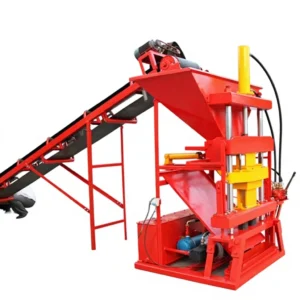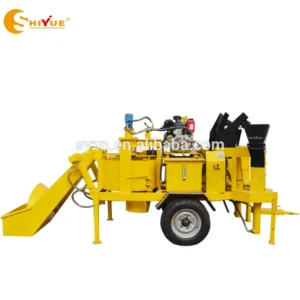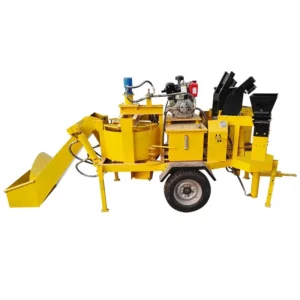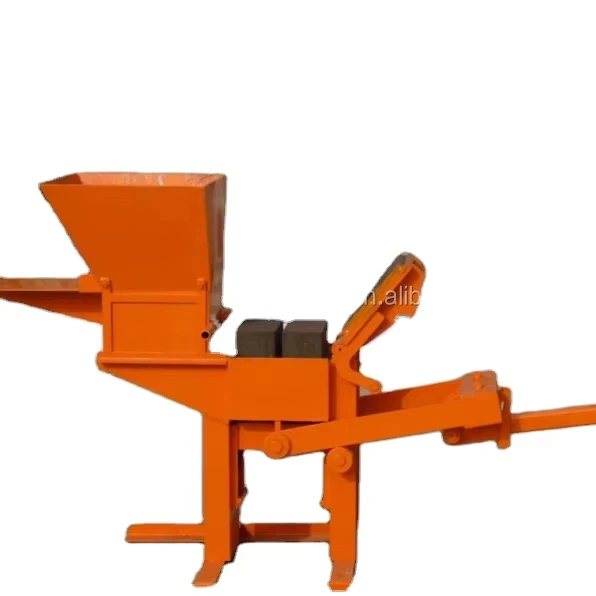
Matched System Layout — every upstream station from mixer to pallet return is sized against the LY2-40 press cycle so the operator is never waiting on material.
Technical Specifications
| Parameter | Value |
|---|---|
| Model | LY2-40 |
| Product Type | Manual Clay Interlocking Brick Making Machine |
| Total Power | No power, completely manual operation |
| Lifting System | Manual lever mechanism |
| Mobility | Steel wheels for on-site repositioning |
| Overall Dimensions (L×W×H) | 1600 × 700 × 1200 mm |
| Net Weight | 200–240 kg |
| Molding Cycle | 30–40 s (basis not stated in source — confirm block format and mix) |
| Output Capacity | 400–1000 pcs/day (basis not stated in source — confirm block format and mix) |
| Mould Configuration | Changeable moulds for various interlocking brick formats |
| Mixer Pairing Options | JFA-1 Mixer or JQ350 Mixer |
| Automation Level | Fully manual, no electrical supply required |
| Warranty | 1 Year |
Application Suitability
| Application | Material or Output |
|---|---|
| Off-grid interlocking brick production | Soil-cement mix in areas without reliable electrical infrastructure |
| On-site housing project construction | Locally sourced clay and soil blended with cement and water |
| Small-scale contractor block yards | Manual batching workflows feeding a single LY2-40 press |
| Supplementary manual line alongside automatic plants | Interlocking formats produced without additional power draw |
What "400–1000 Pieces per Day" Leaves Out on a Manual Clay Interlocking Brick Machine Production Line
The quoted range only becomes real once you define the brick format, mix moisture, and who is feeding the press.
A capacity figure without a format assumption is the most common source of disappointment I see on manual interlocking brick projects. The operator presses one brick every 30–40 seconds, but that cycle assumes the mix is already at the hopper, the pallet is in position, and the finished brick has been cleared. In practice, a two-person crew handling mixing, feeding, pressing, and pallet return will land toward the lower end of the range on larger interlocking profiles, while a four-person crew with a dedicated mixer operator and pallet handler can push toward the upper end on smaller formats [NEED_CITE: manual brick press crew sizing and cycle assumptions].
Upstream Stations That Govern Press Idle Time
A Manual Clay Interlocking Brick Machine production line lives or dies by how quickly mix reaches the hopper between cycles. The JFA-1 and JQ350 mixer options differ in batch volume and homogenization speed; pairing the wrong mixer with the 30–40 second press cycle means the operator stands idle waiting for the next batch. On soil-cement mixes with higher clay content, the JQ350’s longer blending time may be necessary to achieve uniform moisture distribution, but that longer blend must be offset by preparing a second batch in a reserve tub so the press never waits.
Pallet Return Loop and Curing Area Layout
The steel-wheel mobility of the LY2-40 lets a contractor reposition the press as the curing area fills, but that mobility must be planned into the site layout from day one. Pallets travel from the press to the curing zone, then return empty — if the curing racks are placed too far away or the return path crosses the material staging area, pallet turnaround time creeps up and the effective cycle stretches well beyond 40 seconds. I have seen sites where the curing area was set 30 meters from the press with no dedicated pallet runner, cutting actual daily output roughly in half [NEED_CITE: manual pallet handling impact on cycle time].
Reading the Specs That Actually Matter
The 200–240 kg net weight reflects a welded steel frame substantial enough to absorb repeated manual lever actuation without shifting on uneven ground, but it also means two people are needed to reposition the machine even with steel wheels. The 1600 mm length includes the lever swing arc, so the workstation footprint must allow clearance on the operator side. The changeable mould system supports multiple interlocking profiles, yet mould change requires the operator to unbolt and reseat the mould cavity — this is not a quick-release mechanism, so format switches should be batched rather than done mid-shift. The zero-power specification eliminates generator fuel cost and electrical infrastructure entirely, which is the defining advantage for remote housing projects.
The Hidden Cost of an Undersized Mixer Pairing
Choosing a mixer with insufficient batch capacity for the press cycle seems harmless at the quotation stage, but it compounds every single cycle across the working day. The operator finishes a press cycle, waits two or three minutes for the next mix batch, and that idle gap accumulates into hours of lost production by the end of a shift. Worse, when operators sense the bottleneck they begin rushing the mould filling step, producing bricks with incomplete compaction and inconsistent interlocking geometry — defects that only become visible after curing when the bricks are too fragile to stack [NEED_CITE: soil-cement brick compaction consistency].
Why Buyers Plan the Line Here
Block machinery is our single focus, which means the LY2-40 press, its moulds, the mixer pairing, and the pallet specification are quoted as one matched system rather than assembled from separate suppliers. Configuration is set against your actual soil type and local cement availability, not a catalogue default that assumes ideal materials. Mould design covers the interlocking profiles your market actually sells, with custom drawings available for non-standard profiles. The automation level is selectable — you can start with the fully manual LY2-40 and later add a semi-automatic line without relearning the brick format. Installation support includes operator training on mould change procedures and mix proportioning for your specific clay source.
Documentation & Verification
- Line layout drawing showing mixer placement, press position, pallet return path, and curing area dimensions
- Capacity calculation sheet stating the interlocking brick format and crew size assumed for daily output
- Mould drawing and format list confirming the interlocking profiles included in your order
- Mixer specification matched to your local soil type and cement ratio
- Factory test record documenting cycle times on your specified block format before dispatch
Installation, Commissioning & Support
- Site grading and compacted earth base required under the 1600 × 700 mm press footprint to prevent frame twist during lever operation
- No electrical connection needed for the LY2-40 press itself; the JQ350 mixer requires a dedicated circuit matching local voltage and frequency
- Press ships partially assembled with steel wheels attached; lever mechanism and mould cavity require on-site bolt-up
- First-run commissioning includes mix proportion trials using your local clay and cement to confirm brick density and interlocking fit
- Operator training covers lever technique, mould change sequence, and daily greasing points on the pivot assemblies
- Wear parts list identifies the lever pivot bushings and mould liner plates as the first replacement items
Preparing Your Line Inquiry
To size the supporting stations around the LY2-40, we need your target interlocking brick profile and the soil type available at your project site. Share the curing area dimensions you can allocate so we can match pallet size and plan the return loop. If you already own a mixer or material handling equipment, include the model so we can confirm whether it fits the press cycle or needs supplementation.
Frequently Asked Questions
Q: How is the 400–1000 pieces per day capacity verified for the LY2-40?
A: That range depends on the interlocking brick format, crew size, and mixer pairing. Larger profiles with deeper interlocking geometry require longer mould filling and compaction time per cycle. We provide a capacity calculation sheet that states the exact format, mix design, and crew configuration assumed so you can compare it against your project requirements before ordering.
Q: Which mixer pairs better with the LY2-40 cycle — the JFA-1 or the JQ350?
A: The JFA-1 handles lighter soil-cement mixes with shorter blending times, keeping pace with the 30–40 second press cycle in a two-person workflow. The JQ350 suits heavier clay content that needs longer homogenization but requires a reserve batch tub so the press operator is not left waiting between mixes.
Q: What pallet size and material work best for manual handling on this line?
A: Pallet dimensions must match the mould cavity footprint and be light enough for one person to carry when loaded with a wet brick. We size the pallet to your curing rack spacing so bricks move from press to rack without rehandling. Material choice depends on local moisture and whether you can source replacement boards locally.
Q: How long does a mould change take on the LY2-40, and does it need a second person?
A: The mould cavity is bolted in place rather than quick-release, so a format change typically requires one operator with basic hand tools and several minutes to unbolt, swap, and reseat the new mould. We recommend batching production by format rather than switching mid-shift to avoid losing productive cycles.
Q: What supporting stations complete the production line around this press?
A: Beyond the mixer and press, a functional line needs a material staging area for measured soil and cement, a water supply point at the mixer, pallets matched to the mould size, a curing rack layout within manual carrying distance, and a clear pallet return path so empty pallets cycle back to the press without crossing the material feed route.