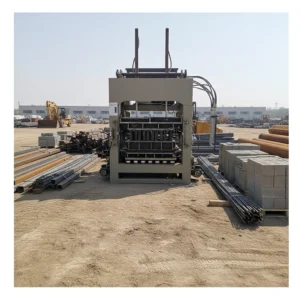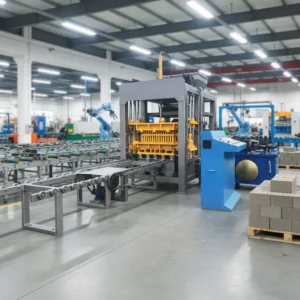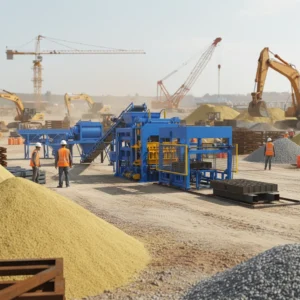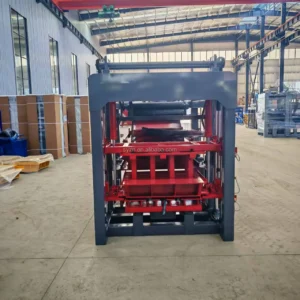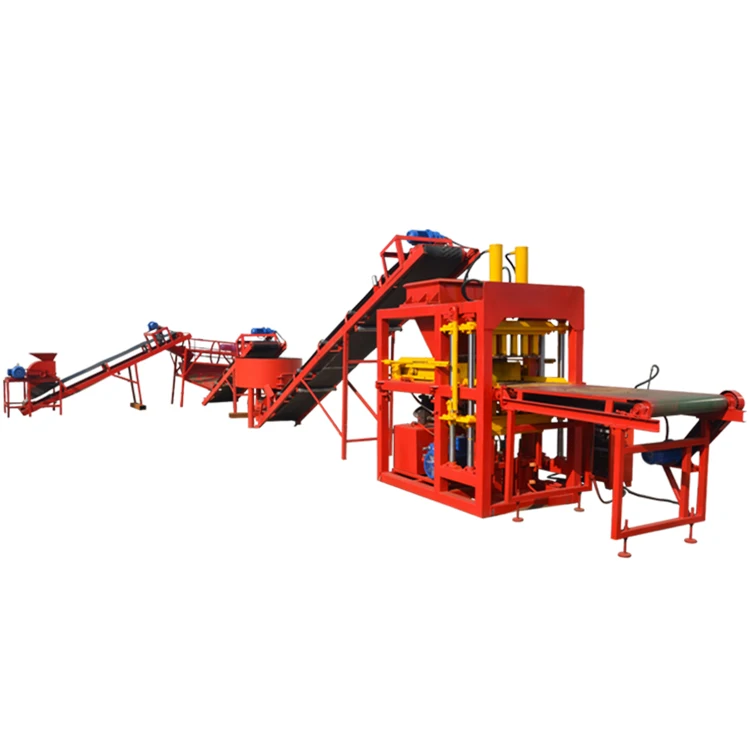
Line-wide cycle matching — every upstream and downstream station configured around the LY4-10’s 10-second press cycle so material feed, pallet circulation and stacking never force the host to idle.
Technical Specifications
| Parameter | Value |
|---|---|
| Model | LY4-10 |
| Product Type | Automatic Clay Brick Making Machine |
| Machine Power | 11 kW |
| Molding Cycle | 10 s |
| Theoretical Productivity | 1,140 pcs/hour (based on 300×150×100mm, 4 pcs/mould) [NEED_CITE: capacity calculation assumes continuous feed and zero downtime] |
| Output Capacity | 11,520 pcs/8 hours (basis not stated in source — confirm block format, material, thickness) |
| Pcs/Mould | 4 (based on 300×150×100mm block) |
| Raw Material | Concrete, sand, cement, fly ash, lime, gypsum |
| Vibration System | Bed mould vertical vibration + upper mould compression vibration |
| Automation Level | Semi-automatic |
| Machine Weight | 1,200 kg |
| Overall Dimensions | 1,600 × 1,400 × 2,100 mm |
| Voltage | Configurable to local voltage and frequency |
Application Suitability
| Application | Material or Output |
|---|---|
| Clay brick production for medium-scale plants | Clay, shale, mixed aggregates |
| Ecological brick manufacturing | Fly ash, lime, gypsum blends |
| Concrete block production | Sand, cement, crushed stone |
| On-site contractor block making | Local aggregate with cement binder |
Why "11,520 Pieces per Day" Means Nothing Without the Rest of the Line
A press is only as fast as the slowest station feeding it or clearing its output.
When a quotation lists the LY4-10 block production line capacity at 11,520 pieces per eight-hour shift without naming the block format, mix design or shift pattern behind that number, buyers regularly discover on commissioning day that real throughput falls well short. The mixer cannot deliver enough batched material between cycles, pallets arrive late because the return conveyor is undersized, or stacking falls behind and the operator is forced to pause the press. I have walked onto sites where the host sat idle for several seconds every cycle simply waiting for the next pallet — the exact opposite of what the capacity table promised. [NEED_CITE: line bottleneck analysis for block making plants]
Matching Every Station to the 10-Second Press Cycle
The LY4-10 completes one moulding cycle in ten seconds, which sets a fixed tempo that every other station in the block production line must match or exceed. If the mixer discharges a batch every forty seconds but the press needs a fresh charge every ten, the mixer must hold at least four batches in buffer or a larger-capacity unit must be specified upstream. The same logic applies downstream: the pallet return conveyor, stacking station and curing rack handler all need cycle times shorter than ten seconds to avoid creating a queue at the press discharge.
Where Semi-Automatic Baseline Meets Line Reality
The LY4-10 ships as a semi-automatic press, meaning pallet feeding, stacking and cubing are not integrated into the host control loop by default. A plant owner assembling a turnkey block plant around this machine must decide which downstream stations to add — manual pallet handling works for low-volume runs but introduces a labour bottleneck the moment daily targets rise. Upgrading to automatic pallet feeding and stacking later is possible, but the pallet dimensions and curing rack spacing must be agreed before the first station is built, not retrofitted after concrete has cured into the floor. [NEED_CITE: semi-automatic to automatic upgrade path in block plants]
Vibration Force, Mix Design and Block Density
The dual vibration system — vertical vibration from the bed mould combined with compression vibration from the upper mould — determines how uniformly the concrete mix is compacted across the pallet. If the local aggregate is coarse or the mix runs lean on cement, insufficient vibration force leaves voids in the block core and reduces compressive strength below the target grade. Conversely, excessive vibration on a fine-sand mix can cause segregation, pushing cement paste to the surface and weakening the block interior. The vibration settings must therefore be matched to the buyer’s specific mix design and target block format before production parameters are locked in. The 4-piece-per-mould layout at 300×150×100 mm also fixes the pallet footprint, which in turn dictates curing rack dimensions and forklift spacing in the yard.
The Hidden Cost of Stations That Do Not Talk to Each Other
When upstream and downstream equipment is sourced separately and bolted onto the press without a shared control reference, the result is a line that technically runs but chronically starves or jams. I have seen plants where the pallet feeder ran on a separate timer that drifted out of sync with the press cycle over the course of a shift, causing a pallet collision roughly once an hour and forcing the operator to reset manually each time. Over an eight-hour shift that small mismatch erased any capacity gain the buyer thought they had secured. [NEED_CITE: PLC synchronisation across block line stations]
Why Sourcing the Line Together Matters
Block machinery is the single focus of the workshop behind this equipment, so the LY4-10 is specified as one node within a complete block production line rather than sold as a standalone press. The mixer capacity, pallet size and stacking configuration are selected against the buyer’s actual block format and daily target, not pulled from a generic catalogue. Moulds are designed for the formats the buyer’s local market sells, with custom drawings accepted. Voltage, frequency and PLC display language are confirmed in writing before production begins. Factory test records include a cycle-by-cycle run with the buyer’s chosen block format so that the stated output can be verified before the machine leaves the workshop.
Documentation & Verification
- Line layout drawing showing station spacing and pallet flow path for the LY4-10
- Capacity calculation sheet stating the exact block format and mix assumed
- Pallet specification matched to buyer’s curing rack and forklift dimensions
- Voltage and control language confirmation signed before production starts
- Factory test record with cycle times logged per block format
- Hydraulic and electrical schematic for the full line configuration
Installation, Commissioning & Support
- Foundation plan reflecting the 1,600 × 1,400 mm press footprint and vibration load
- Dedicated power circuit sized for 11 kW press plus upstream mixer draw
- Pallet return conveyor aligned to LY4-10 discharge height on arrival
- First-run parameter tuning against buyer’s local aggregate and mix ratio
- Operator training on mould change sequence and vibration adjustment
- Wear parts list covering hydraulic seals and mould liner replacement intervals
What We Need to Configure Your Line
To size a block production line around the LY4-10, share the block formats your market demands, the daily output target per format, and the raw materials you can source locally. We also need your site voltage and frequency, the dimensions of any existing curing racks or forklifts, and whether pallet handling and stacking should be semi-automatic or fully automatic from day one.
Frequently Asked Questions
Q: How is the 11,520 pieces per day figure verified?
A: That number assumes a specific block format, mix design and continuous eight-hour shift with zero line stoppages. We issue a capacity calculation sheet that names the exact format — for example 300×150×100 mm at four pieces per mould — so you can compare it against your actual product mix before ordering.
Q: Which stations are included in the quotation?
A: The quotation specifies every station from raw material feeding through to stacking and curing rack handling. Any station left for local sourcing is listed explicitly so there are no gaps when the line is assembled on site.
Q: What pallet size does the LY4-10 require?
A: Pallet dimensions are set by the mould layout — four blocks at 300×150×100 mm dictates a specific pallet footprint. We confirm pallet size against your existing curing racks and forklift before production so the pallets integrate with your yard layout.
Q: Is the vibration force matched to my local aggregate?
A: Vibration settings are adjusted based on the mix design and aggregate you provide. A trial run using your material recipe is logged during factory testing to confirm block density meets your target strength grade.
Q: What voltage and control language ships with the machine?
A: Voltage, frequency and PLC display language are confirmed in writing before production begins. This prevents commissioning delays caused by mismatched power supply or an interface the operator cannot read.