
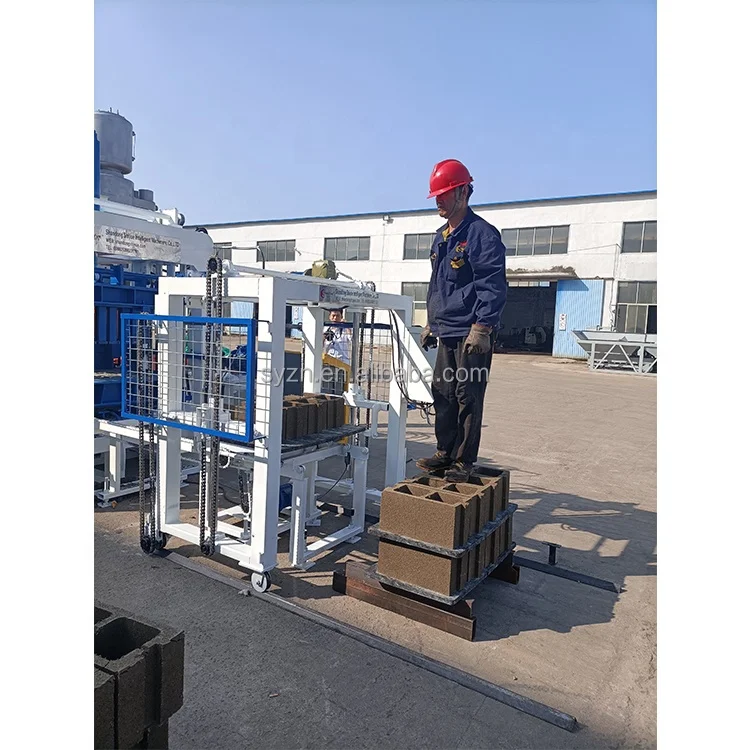
Matched Line Cycle Times — the QT4-18 block making machine production line is configured so raw material feeding, mixing, pallet handling and stacking stations align with the press cycle, preventing the machine from waiting on upstream or downstream equipment.
Technical Specifications
| Parameter | Value |
|---|---|
| Model | QT4-18 |
| Product Type | Hydraulic Automatic Hollow Block Making Machine |
| Vibration Form | Platform Vibration |
| Vibration Frequency | 0-60 Hz |
| Vibration Force | 45 kN |
| Pallet Size | 900×500 mm |
| Molding Cycle | 18-25 s |
| Demolding Method | Hydraulic |
| Control System | PLC with person-machine interface (language options to be confirmed) |
| Automation Level | Automatic (interlocking electric-hydraulic procedures) |
| Output Capacity (Hollow Block) | 799 pcs/h based on 400×200×200 mm block, 4 pcs/mould, 18 s cycle |
| Output Capacity (Solid Brick) | 5199 pcs/h based on 240×115×52 mm brick, 26 pcs/mould, 18 s cycle |
| Block Formats Supported | Hollow block, solid brick, color face brick, environmental protection brick, road curb rock, sod brick |
| Warranty | 1 year for whole machine (excluding spare parts) |
| Voltage & Frequency | Configurable to target market (basis to be confirmed before production) |
| Rated Power | To be confirmed against final line configuration |
| Overall Dimensions | To be confirmed against manufacturer catalog |
| Net Weight | To be confirmed against manufacturer catalog |
Application Suitability
| Application | Material or Output |
|---|---|
| Hollow block production for residential and commercial walls | Crushed stone, sand, cement and fly ash mixes on 900×500 mm pallets |
| Solid brick and face brick manufacturing | Local aggregate and cement blends targeting specific compressive strength |
| Paving brick and road curb rock production | Dense aggregate mixes requiring high vibration force and hydraulic pressure |
| On-site production for housing and infrastructure projects | Multiple block formats from a single press with mould change capability |
What "Automatic" Leaves Out of the Quotation
A press running alone is not a production line.
Many quotations list the QT4-18 as a standalone unit, leaving pallet feeding, raw material mixing and stacking as manual tasks that the buyer must organize on arrival. When the mixer cannot keep up with the press cycle, the machine sits idle; when pallets are not returned fast enough, the next cycle is delayed. These gaps mean the quoted capacity is never reached in practice. The QT4-18 block making machine production line addresses this by specifying each station — feeder, mixer, pallet return and stacker — as part of one system with matched cycle times [NEED_CITE: block production line station synchronization principles].
Stations That Keep the Press Running
The raw material feeding station meters aggregate and cement into the mixer in batches timed to the press cycle. A surge hopper between mixer and press holds enough material for several cycles, absorbing minor delays without stopping production. This configuration means the QT4-18 block making machine production line maintains its molding rhythm even when upstream delivery fluctuates slightly.
Pallet Handling as Part of the System
The 900×500 mm pallet size determines how many blocks are cured per rack and which forklift can move them. When pallet specification is decided without checking the buyer’s existing curing area and handling equipment, the result is a mismatch that slows the entire downstream process. This line confirms pallet dimensions, material and return speed against the buyer’s site conditions before the order is placed [NEED_CITE: pallet size and curing area coordination in block plants].
Reading the Specifications Beyond the Brochure
Platform vibration at 45 kN with variable frequency from 0 to 60 Hz allows the operator to adjust compaction force depending on the mix design and block format. Lower frequency suits larger hollow blocks where the concrete must settle into deep cavities, while higher frequency consolidates fine aggregate for solid face bricks. The hydraulic demoulding system applies consistent pressure to release blocks without cracking, which is particularly important when producing thin-walled hollow blocks or interlocking pavers. Molding cycles between 18 and 25 seconds cover the range from simple solid bricks to more complex curb stones, and the PLC interlocks the electric and hydraulic sequences so that a pallet is never advanced before the mould has fully lifted.
When Line Stations Are Mismatched
If the mixer output falls short of the press consumption rate, operators begin skipping cycles to wait for material, and daily production drops well below the quoted figure. Similarly, if the stacking station cannot clear cured pallets quickly enough, the press queue backs up and the machine stops. These bottlenecks are not visible in a single-machine quotation but become the limiting factor on the production floor [NEED_CITE: impact of station mismatch on block plant daily output].
Why Specify the Full Line Here
This equipment is built around a single focus on block machinery, so the press, mould, pallet and handling stations are designed as one matched system rather than assembled from separate suppliers. The line layout document states the block format assumed for each capacity figure, so buyers can verify daily output before committing. Mould drawings and format lists are provided with the quotation, allowing the buyer to confirm that the available formats match local market demand. Voltage, frequency and PLC display language are confirmed before production, avoiding commissioning delays on arrival. Factory test records are generated using the buyer’s target block format, not a generic test block.
Documentation & Verification
- Line layout showing station sequence and capacity calculation per block format
- Machine specification sheet with hydraulic pressure and vibration force ratings
- Mould drawing and complete format list for hollow, solid, paving and curb blocks
- Pallet specification matched to buyer’s curing rack dimensions and forklift capacity
- Voltage, frequency and PLC language confirmation signed before production starts
- Factory test record produced on buyer’s target block format before dispatch
Installation, Commissioning & Support
- Foundation plan indicating load points for the QT4-18 press and mixer stations
- Power supply requirement confirmed for local voltage and frequency before shipment
- Machine dismantling sequence documented for container loading and site reassembly
- PLC parameter setting on site to match buyer’s mix design and target block format
- Operator training covering mould change procedure across all supplied block formats
- Wear parts list with hydraulic seals and vibration box bearings identified for first reorder
Before You Request a Quotation
To configure the QT4-18 block making machine production line accurately, provide the target block formats and daily output requirement, the local aggregate type and cement availability, and the voltage and frequency at the installation site. Details on existing forklift capacity and curing area dimensions help confirm the pallet specification.
Frequently Asked Questions
Q: How is the line capacity verified for each block format?
A: Each output figure in the capacity table states the exact block dimensions, number of cavities per mould and molding cycle assumed. For example, the 799 pieces per hour figure is based on a 400×200×200 mm hollow block with four cavities and an 18-second cycle. This lets buyers calculate realistic daily production for the format they actually sell.
Q: Which supporting stations are included in the line?
A: The line covers raw material feeding, mixing, pallet feeding, the QT4-18 press, and stacking and curing rack handling. Each station is specified so that its cycle time aligns with the press, preventing bottlenecks. The exact configuration depends on the automation level selected, from semi-automatic pallet handling to fully automatic stacking.
Q: How do cycle times match across stations?
A: The mixer batch time, pallet return speed and stacking cycle are all calculated against the 18-25 second press cycle. A surge hopper between mixer and press buffers minor variations, and the pallet return conveyor is rated to clear and replace pallets within the molding window so the press never waits.
Q: What electrical and control details are confirmed before shipment?
A: Voltage, frequency and PLC display language are agreed and documented before production begins. This ensures the control panel is readable by local operators and the motor ratings match the site power supply, avoiding delays during commissioning.


