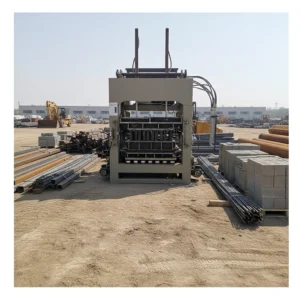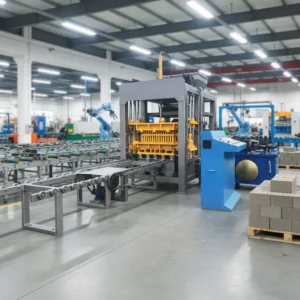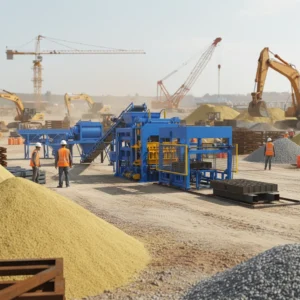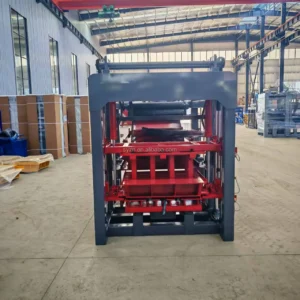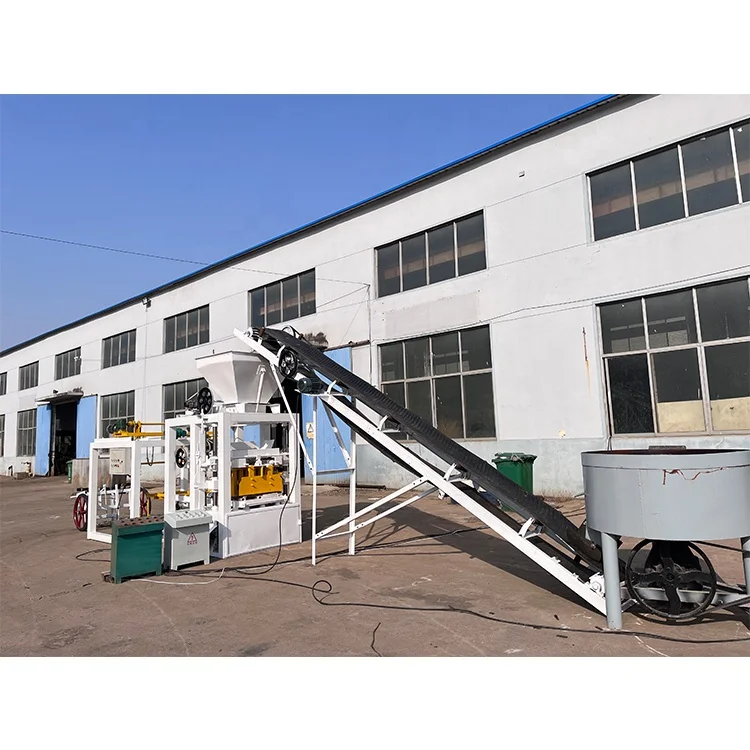
Complete Line Configuration — mixer, pallet size and press cycle confirmed as one system so the station is never left waiting for material or handling.
Technical Specifications
| Parameter | Value |
|---|---|
| Model | QTJ4-26 |
| Product Type | Semi Automatic Concrete Block Making Machine |
| Overall Dimensions | 2060 × 1730 × 2580 mm |
| Molding Cycle | 26 s |
| Vibration Frequency | 4200 r/min |
| Vibration Force | 35.5 kN |
| Total Power | 14.25 kW |
| Mixer Model | JQ350 |
| Pallet Size | 850 × 450 × 20 mm |
| Total Weight | 1800 kg |
| Applied Products | Hollow block (8 inch, 6 inch), solid brick |
| Raw Materials | Crushed stone, sand, cement, dust, fly ash |
| Output Capacity | 480 pcs/hr for 390×190×190 mm hollow block (4 pcs/mould); 600 pcs/hr for 400×150×200 mm hollow block (5 pcs/mould); 2100 pcs/hr for 240×115×53 mm solid brick (18 pcs/mould) |
| Automation Level | Semi-automatic |
| Mould Guide System | Four guide pillars, automatic mould movement |
| Vibration System | Two vibrating motors under mould, direct vertical vibration with upper mould pressing |
| Standards | CE (verify for this specific model) |
Application Suitability
| Application | Material or Output |
|---|---|
| Small to medium block production plants | Hollow blocks and solid bricks from crushed stone, sand and cement |
| On-site construction block production | 8 inch and 6 inch hollow blocks using locally available aggregate |
| First block plant setup by entrepreneurs | Solid brick and hollow block formats from fly ash and dust mixes |
| Existing plants adding formats | Confirmed cycle compatibility across hollow block and solid brick moulds |
What "480 Pieces per Hour" Leaves Out About block production line equipment
A cycle rate only means something when every station around the press can keep up.
I was at a project site near Riyadh where the block press itself ran exactly as the brochure stated, but the mixer could not feed it fast enough and the pallets had to be carried back by hand. The quoted block production line equipment capacity dropped to roughly half because nobody checked the upstream and downstream stations. That gap between catalogue numbers and daily output is where most first-time buyers lose money [NEED_CITE: typical block plant throughput loss from line imbalance].
How the Stations Around the Press Connect
The QTJ4-26 sits in the middle of a sequence: raw material batching, mixing, feeding, pressing, pallet transfer and curing. Each step has a cycle time that must align with the 26-second moulding cycle. If the JQ350 mixer takes longer than one press cycle to prepare a fresh batch, the press stands idle. This is why block production line equipment planning starts with the slowest station, not the fastest one.
Pallet Flow Determines Real Daily Output
With a pallet size of 850 × 450 × 20 mm, the curing area and the forklift already on site must handle that dimension. Pallets that do not fit existing racks sit on the ground, slowing turnover and reducing the number of cycles the press can run in a shift. Block machine supporting equipment specification must account for how pallets move from press to curing and back before the line is ordered.
Reading the Specifications for What They Mean in Practice
The 35.5 kN vibration force and 4200 r/min frequency work together with the upper mould pressing to compact the mix. Different local aggregates respond differently to this combination — a sandy mix needs different vibration than one heavy with crushed stone. The four-pillar guide system keeps the mould aligned during each cycle, which matters when you switch between an 8 inch hollow block mould and a solid brick mould [NEED_CITE: vibration and hydraulic pressure matching to local aggregate in block production]. The 14.25 kW total power covers the vibration motors, hydraulic pump and mixer drive, which determines the electrical supply you need at the site.
The Cost of Skipping Line Integration
When the mixer, press and pallet system arrive from different suppliers with no single party responsible for cycle matching, the buyer ends up debugging the line during production hours. I have walked into plants where pallets stacked by hand bottlenecked the entire press, and the owner had no idea the quotation never included pallet handling equipment. Voltage and control language mismatches discovered after arrival add weeks to commissioning [NEED_CITE: commissioning delays from unconfirmed electrical specifications in exported machinery]. These are not equipment failures — they are specification failures.
Why Specify the Line Through One Source
Block machinery as a single focus means the QTJ4-26, its JQ350 mixer and 850 × 450 mm pallets are confirmed as matched components, not assembled from separate catalogues. Configuration is set against the buyer’s actual mix design and target block format, not a default setting. Mould design covers the formats the local market sells, with custom drawings available. The automation level is selectable, so a buyer can start semi-automatic and add automatic pallet feeding later. Installation support includes operator training on the complete line, not just the press station.
Documentation & Verification
- Line layout with capacity calculation stated per block format
- Machine specification sheet covering press, mixer and pallet dimensions
- Mould drawing and format list for hollow block and solid brick
- Pallet specification confirmed against buyer curing area and forklift
- Voltage, frequency and control language confirmation before production
- Factory test record covering mixer, press and pallet flow together
Installation, Commissioning & Support
- Foundation pad sized to 2060 × 1730 mm footprint with vibration isolation
- Electrical supply matched to 14.25 kW total draw with dedicated circuit breaker
- Machine shipped as single unit with mixer and pallet frame for site assembly
- First-run parameter setting across mixer feed rate and 26-second moulding cycle
- Operator training on mould changeover using four-pillar guide system
- Wear parts list covering vibration motor bearings and mould guide bushings
Before You Send the Inquiry
Tell us the block formats your market actually sells and the daily volume you need for each one. Share your local raw material source, the curing space you have available and the voltage and frequency at your site. If you already have forklifts or pallet racks, send the dimensions so the block production line equipment can be matched to what is already on the ground.
Frequently Asked Questions
Q: How is daily output calculated per block format?
A: Each output figure states the block format and mould cavity count it assumes — 480 pieces per hour for 390×190×190 mm hollow blocks at four per mould, for example. Real daily output depends on mixer feed rate, pallet handling speed and curing area capacity, all of which must be confirmed before the line is finalised.
Q: Does the quotation cover pallet feeding and curing rack handling?
A: The scope depends on what you confirm during the proposal stage. We specify pallet size at 850 × 450 × 20 mm and can include pallet feeding and stacking in the line layout. If these stations are not included, output must be moved by hand, which reduces actual daily throughput.
Q: Is the JQ350 mixer matched to the press cycle time?
A: Yes — the mixer is selected so that one batch is ready before the 26-second moulding cycle completes. If your mix design requires longer blending, a larger mixer model is proposed to prevent the press from standing idle between cycles.
Q: What pallet size is specified and will it fit my curing area?
A: The standard pallet for this machine is 850 × 450 × 20 mm. We confirm this against your existing curing racks and forklift before production so pallets move from press to curing without manual resizing or additional equipment.
Q: How do all stations connect and where must cycle times match?
A: Raw material feeding, mixing, pressing, pallet transfer and curing each have a cycle time. The slowest station determines the line speed. We calculate the full sequence so the mixer, press and block machine supporting equipment are balanced, and we flag any station that would leave the press waiting.