
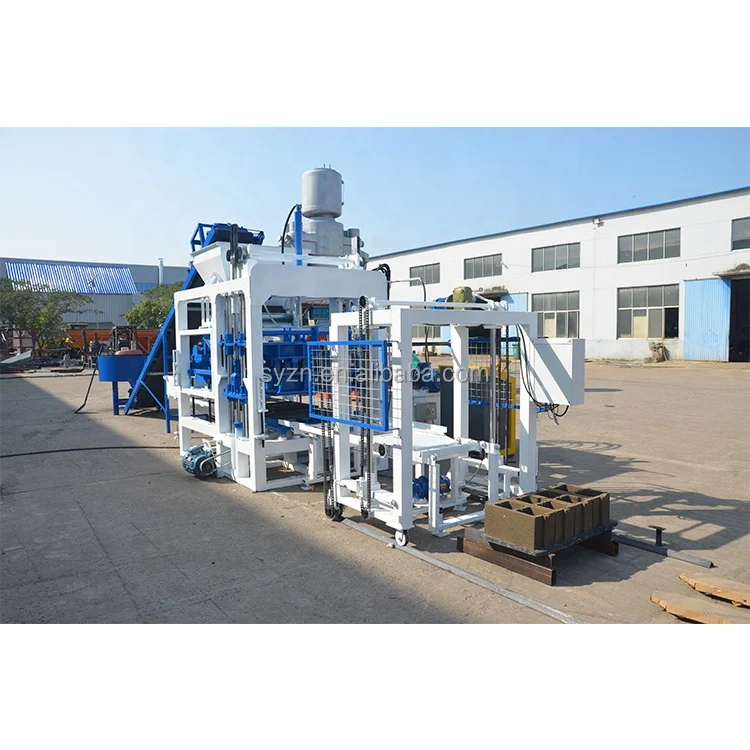
Matched Line Stations — Mixer, conveyor, press and stacker are specified as one timed system, so the QT4-18 never waits on upstream or downstream equipment.
Technical Specifications
| Parameter | Value |
|---|---|
| Model | QT4-18 |
| Product Type | Semi-Automatic Concrete Block Making Machine |
| Overall Dimensions (L×W×H) | 3900×1600×2300 mm |
| Total Weight | 3T |
| Rated Power | 24KW |
| Vibration Force | 40-50KN |
| Molding Cycle | 15-25s |
| Mixer Model | JQ350 |
| Pallet Size | 850×550×25 mm |
| Applied Products | Paver, solid, hollow, curbstone |
| Raw Materials | Crushed stones, sand, cement, dust, fly ash |
| Output Capacity | 1200-1680 Pcs/Hr (based on 400×200×200mm Hollow block, 4 pcs/mould) |
| Output Capacity | 1800-2400 Pcs/Hr (based on 400×150×200mm Hollow block) |
| Daily Output | 9600-13440 Pcs/8hr (based on 400×200×200mm Hollow block) |
| Daily Output | 14400-19200 Pcs/8hr (based on 400×150×200mm Hollow block) |
| Automation Level | Semi-automatic |
| Hydraulic Station | Equipped (high pressure) |
| Vibration System | Bed mould vertical vibration and upper mould compression vibration |
| Assembly State | Nude packing in 20GP container |
| Standards | CE declaration where applicable |
Application Suitability
| Application | Material or Output |
|---|---|
| Block and paver production plants | Hollow blocks, paving blocks from crushed stone, sand, and cement |
| Construction contractors producing on-site | Solid blocks using locally sourced fly ash and dust |
| Concrete product manufacturers | Adding paver and curbstone formats to existing range |
| First block plant entrepreneurs | Full line production of hollow and solid blocks |
Why "15-25 Seconds" Means Nothing Without the Rest of the Line
A Semi-Automatic Block Making Machine production line is only as fast as its slowest station. The QT4-18 press can complete a cycle in 15-25 seconds, but if the JQ350 mixer takes 40 seconds to discharge a batch into the conveyor hopper, the press sits idle for nearly half its shift. I have planned lines where the host machine specs looked perfect on paper, yet daily output fell far below expectation because the feeder or stacker was undersized. This line specifies every station around the press to ensure material arrives and pallets clear without creating a bottleneck [NEED_CITE: line balance principles in concrete block manufacturing].
Synchronizing the Mixer, Conveyor, and Press
The JQ350 mixer is selected to match the QT4-18 cycle time. A pan mixer of this capacity discharges a batch fast enough to keep the host press fed continuously during a standard eight-hour run. The conveyor between the mixer and the press hopper is sized so that material transfer does not extend the interval between mould fills. When planning a Semi-Automatic Block Making Machine production line, matching these upstream intervals is the difference between reaching rated daily output and running at half capacity.
Pallet Flow and Stacker Integration
The 850×550×25 mm pallet size is not chosen at random; it is specified against the curing area dimensions and the forklift capacity the buyer already operates. The automatic stacker receives the pressed block from the pallet return system and builds a stable stack for trolley transfer. This removes the manual handling bottleneck that often limits semi-automatic lines. The stacker cycle is timed to the press ejection so that no finished block waits on the delivery table [NEED_CITE: pallet handling and curing logistics in block plants].
Reading the Core Parameters for Line Balance
The 40-50KN vibration force, combined with the hydraulic station’s high pressure, determines the compaction density of each block. Higher vibration force shortens the consolidation phase inside the mould, allowing the 15-25s cycle to hold even with drier mix designs using fly ash or crusher dust. The 24KW rated power covers the press motor, vibration system, and hydraulic pump running simultaneously, meaning the electrical supply does not need to be oversized for peak draw. Pallet return speed and stacker lift rate are matched to this cycle so the Semi-Automatic Block Making Machine production line runs without forced stops between mould changes or material top-ups.
What Happens When Line Stations Are Specified Separately
Buying the press from one supplier and the mixer, conveyor, and stacker from three others often leads to interface mismatches. The mixer discharge height may not align with the press hopper, requiring a custom chute that slows material flow. The pallet size ordered from a second vendor may not fit the press rails or the buyer’s curing racks, forcing a full re-order before commissioning. I have seen entire projects delayed by weeks because the stacker grip width did not match the pallet thickness delivered [NEED_CITE: interface risks in multi-supplier block line procurement]. These mismatches cost far more in lost production time than any unit price saving on individual stations.
Why the Line Is Specified as One System
The QT4-18 is configured alongside its supporting stations so that cycle times align across the entire Semi-Automatic Block Making Machine production line. Machine, mould, pallet, and handling are specified as a matched set rather than assembled from separate catalogues. The configuration is checked against the buyer’s actual mix design, local aggregate, and target block format, not a generic default. Mould design covers the formats the buyer’s market sells, including custom drawings when required. Automation level is selectable, so a buyer can start semi-automatic and add automatic stacking or cubing later as volumes grow. Installation and commissioning support covers every station, with operator training included.
Documentation & Verification
- Line layout drawing showing every station from raw material feed to curing trolley exit
- Capacity calculation sheet stating the block format assumed for each output figure
- Pallet specification including size, material, and recommended quantity for the QT4-18
- Hydraulic and electrical schematic with voltage and control language confirmation
- Factory test record and packing photographs showing all line stations loaded for shipment
- Operation and maintenance manual covering press, mixer, conveyor, and stacker
Installation, Commissioning & Support
- Foundation plan matched to the 3900×1600×2300 mm press footprint and 3T operating weight
- Electrical supply specification confirming 24KW total draw and required voltage at the QT4-18 terminal box
- Station-by-station assembly sequence from nude-packed container delivery to full line startup
- First-run parameter setting for vibration force, hydraulic pressure, and JQ350 mixer batch timing
- Operator training covering mould change, pallet loading, and stacker adjustment on the QT4-18
- Wear parts list for hydraulic seals, vibration springs, and mixer blades with reorder intervals
Planning the Next Line
To specify the right configuration around the QT4-18, share your target block format, required daily output per format, local raw material types, and available curing area dimensions. Confirm the existing forklift capacity and pallet size if you intend to integrate the new line with current handling equipment. State the local voltage, frequency, and preferred PLC display language so that the electrical and control systems are confirmed before production.
Frequently Asked Questions
Q: Which stations are included in the QT4-18 line and which are optional?
A: The standard line includes the JQ350 mixer, conveyor, the QT4-18 press, pallet return system, and automatic stacker. Pallets and curing trolleys are quoted separately based on your curing area size. Additional stations like raw material batching or cubing can be added as optional upgrades.
Q: How does the 850×550×25 mm pallet size relate to my existing curing area?
A: Pallet size determines rack spacing and trolley capacity in your curing yard. The 850×550×25 mm dimension is specified so it fits standard curing racks and can be handled by common forklift tine widths. If your existing racks differ, the pallet size can be adjusted during line configuration.
Q: What is the realistic daily output for each block format on this line?
A: Daily output depends on the block format. For a 400×200×200mm hollow block, the line produces 9600-13440 pieces per 8-hour shift. For a 400×150×200mm hollow block, output is 14400-19200 pieces per 8-hour shift. These figures assume continuous operation with matched upstream and downstream stations.
Q: Can I start with the QT4-18 semi-automatic and add automation later?
A: Yes. The line is designed so that manual pallet handling can be replaced with an automatic pallet feeder, and the stacker can be upgraded to a full cubing system. The press control system supports these additions without requiring a host machine replacement.
Q: How are cycle times matched between the mixer, conveyor, and press?
A: The JQ350 mixer discharge rate and conveyor speed are calculated against the QT4-18 molding cycle of 15-25 seconds. This ensures the press hopper receives a fresh batch before the current cycle ends, preventing idle time and maintaining the rated hourly output for each block format.


