
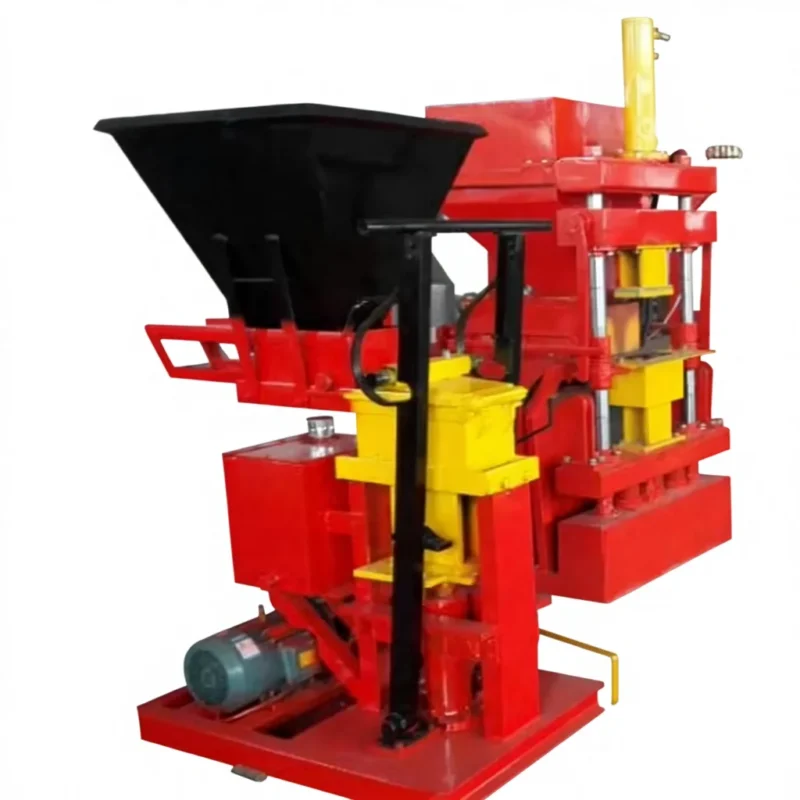
Matched Line Design — every upstream mixer and downstream pallet station is sized to the Eco Brava’s 15-20 second cycle, so the press never idles waiting for material or pallet removal.
Technical Specifications
| Parameter | Value |
|---|---|
| Model | Eco Brava |
| Product Type | Interlocking Clay Brick and Hollow Block Making Machine |
| Machine Power | 5.5 kW electric motor or 12 Hp diesel engine |
| Molding Cycle | 15-20 s (basis not stated in source — confirm block format / material / thickness) |
| Capacity | 1440-1920 pcs / 8 hours (based on 300×150×100 mm interlocking block, 1 pc per mould) |
| Raw Material | Clay, soil, mud, cement, concrete |
| Rated Pressure | 16-20 MPa |
| Machine Weight | 400 kg |
| Overall Dimensions (L×W×H) | 1100 × 750 × 1700 mm |
| Automation Level | Semi-automatic (automatic material feeding, mould pressing and mould lifting) |
| Voltage | According to local voltage |
| Mould Type | Interchangeable modeler wombs for different block forms |
| Standards | CE |
Application Suitability
| Application | Material or Output |
|---|---|
| Small workshop interlocking brick production | Clay and soil mix with cement binder |
| On-site hollow block making for housing projects | Mud or concrete with local aggregate |
| Contractor-run block yard for development sites | Cement-stabilised soil, diesel powered |
| Product range expansion for existing block plants | Interlocking formats alongside standard hollow blocks |
Why "1440 Pieces per Shift" Means Nothing Without the Full Line
A press cycle rate only becomes real throughput when feeding, pallet handling, and curing are matched to it.
I have watched a contractor in Surabaya run an interlocking clay brick making machine production line flat out for four hours, then spend the next three hours moving pallets by hand because nobody specified a stacking station. The press was rated for the output. The line was not. When pallet removal falls behind the 15-20 second cycle, wet bricks sit on the press table, the operator rushes, and block edges chip before they ever reach the curing rack. [NEED_CITE: common throughput losses from unbalanced block line stations]
How the Eco Brava Fits Into a Continuous Block Line
The Eco Brava operates as one station within a coordinated interlocking clay brick making machine production line. Its semi-automatic mould pressing and lifting cycle sets the tempo. Upstream, the mixer and material feeder must deliver a consistent batch every 15-20 seconds. Downstream, pallet removal must clear the press table before the next cycle completes. When any station lags, the entire line slows to match the weakest link.
What Happens When Pallet Handling Is Left Off the Quotation
Pallet handling, stacking, and curing are the stations most often excluded from a block line quotation. The press arrives, the buyer starts producing, and bricks pile up on pallets across the workshop floor. In tropical climates like those across Indonesia and Vietnam, unsheltered pallets left in direct sun cause surface cracking within hours. A curing rack system and pallet return loop keep bricks moving from press to shade in a controlled sequence, protecting surface integrity and maintaining output quality. [NEED_CITE: surface cracking causes in tropical block curing]
Pressure, Vibration, and Mix Design at the Press Station
The 16-20 MPa rated hydraulic pressure on the Eco Brava must be evaluated alongside the buyer’s specific clay or cement mix. Clay-based mixes with high moisture content respond differently to hydraulic compression than lean cement-soil blends. The pressure setting that produces a dense interlocking brick from one aggregate source may leave another mix under-compacted and friable. Pallet size also matters: a pallet chosen without regard to the curing rack spacing and forklift tine width already on site creates handling bottlenecks downstream of the press.
The Cost of Treating the Press as a Standalone Purchase
When a buyer purchases the Eco Brava as a standalone press without specifying the surrounding line, the consequences accumulate. Mould changeover that should take minutes stretches across a shift because no lifting tooling was included. Voltage and control language arrive unconfirmed, and commissioning stalls while an electrician rewires the panel. Pallets ordered separately turn out to be the wrong dimensions for the curing racks already welded on site. Each of these gaps costs production days that no press cycle rating can recover. [NEED_CITE: commissioning delays from unconfirmed electrical specifications]
Why Sourcing the Full Line From One Supplier Matters
Block machinery is the single focus here, so the Eco Brava press, moulds, pallets, and handling equipment are specified as one matched system rather than assembled from separate vendors. Configuration is set against the buyer’s actual mix design and local aggregate, not a catalogue default. Mould design covers the interlocking formats the buyer’s market actually sells, with custom drawings where needed. The automation level is selectable — a buyer can start semi-automatic and add stacking stations later. Installation support includes operator training on the specific line configuration delivered.
Documentation & Verification
- Line layout and capacity calculation stating the 300×150×100 mm interlocking block assumption
- Machine specification sheet with hydraulic pressure and cycle timing by mould type
- Pallet specification matched to curing rack dimensions and forklift capacity
- Hydraulic and electrical schematic showing press connections to mixer and pallet stations
- Voltage, frequency, and PLC display language confirmation before production
- Factory test record on the buyer’s target block format before dispatch
Installation, Commissioning & Support
- Foundation pad sized for the 1100 × 750 mm footprint with vibration isolation
- Dedicated circuit for the 5.5 kW motor or diesel engine mounting frame
- Machine arrives at 400 kg — manageable with standard site forklift for placement
- First-run calibration of the 16-20 MPa pressure against buyer’s clay or cement mix
- Mould changeover training on the interchangeable wombs for format flexibility
- Wear parts list covering hydraulic seals and mould liners for first replacement cycle
What to Prepare Before Requesting a Quotation
Share the block format you intend to produce, the daily output target, and the raw materials available locally — whether clay, soil, or cement-based. Confirm your site voltage, frequency, and preferred control language. If you already have pallets, curing racks, or a forklift on site, send the dimensions so the line can be configured around your existing equipment.
Frequently Asked Questions
Q: How is the 1440-1920 pieces per shift capacity calculated, and which block format does it assume?
A: The capacity figure is based on a 300×150×100 mm interlocking block with one piece per mould and a 15-20 second cycle. If your target format is larger or requires a longer pressing time, the realistic daily output will differ. Always request a capacity calculation stated for your specific block format.
Q: What upstream feeding and mixing equipment must match the Eco Brava cycle time?
A: The mixer and material feeder must deliver a uniform batch every 15-20 seconds to prevent the press from idling. A mixer with insufficient capacity forces the operator to wait between cycles, reducing actual throughput well below the rated press speed.
Q: How do pallet size and material need to be chosen for the existing curing setup?
A: Pallet dimensions must match the curing rack spacing and the forklift tine width already on site. A pallet too wide for the rack wastes curing space, while one too narrow risks bricks falling during transport. Material choice affects pallet weight and moisture resistance in humid climates.
Q: Can the line start semi-automatic and later add stacking stations?
A: Yes. The Eco Brava runs semi-automatic with manual pallet removal, and automatic stacking and cubing stations can be added downstream as production volume grows. Planning the line layout with future upgrade space avoids costly repositioning later.


