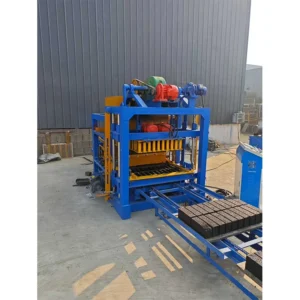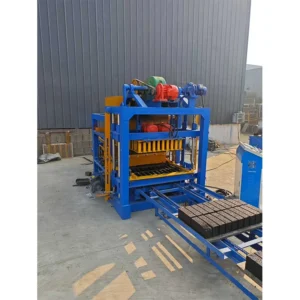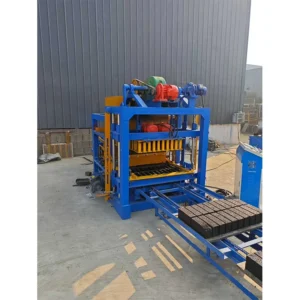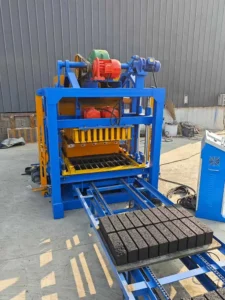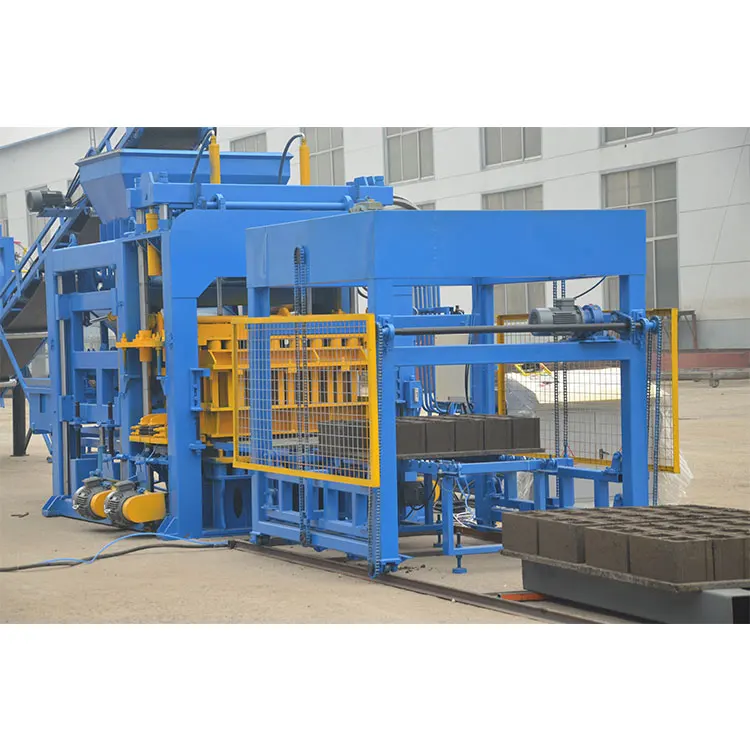
Line Rhythm Alignment — the QT12-15 cycle time is mapped against every upstream and downstream station so the press never waits for a pallet or mixer discharge.
Technical Specifications
| Parameter | Value |
|---|---|
| Model | QT12-15 |
| Product Type | Automatic Concrete Block Making Machine |
| Overall Dimensions (L×W×H) | 9350 × 2520 × 2950 mm |
| Rated Pressure | 21 MPa |
| Main Vibration Form | Platform Vibration |
| Vibration Frequency | 2800–4500 r/min |
| Vibration Acceleration | 15–20 g |
| Exciting Force | 120 kN |
| Fixed Brick Height | 50–200 mm |
| Pallet Size | 1350 × 850 mm |
| Molding Cycle | 15–25 s |
| Storage Hopper Volume | 0.4 m³ |
| Feeding Device Volume | 0.31 m³ |
| Total Power | 50.7 kW |
| Total Weight | 12000 kg |
| Control System | PLC controlled (mechanical hydraulic synthesis) |
| Block Output — Hollow Block (390×190×190 mm, 12 pcs/mould) | 1720–2160 pcs/h, 13700–17200 pcs per 8h day |
| Block Output — Porous Block (240×115×90 mm, 35 pcs/mould) | 5040–6300 pcs/h, 40300–50400 pcs per 8h day |
| Block Output — Standard Block (240×115×53 mm, 62 pcs/mould) | 13100–14800 pcs/h, 105000–119000 pcs per 8h day |
| Frame Structure | Gantry frame type, super steel, shock resistant |
| Mould Material | Manganese steel, carburizing and quenching, cartridge type welding |
| Feeding System | Net wave swing type material feeding device |
| Compressive Strength of Blocks | > 15 MPa |
| Recommended Line Configuration | PL1200 batching machine, JS500 or JS750 mixer, 8m conveyor belt, stacker |
Application Suitability
| Application | Material or Output |
|---|---|
| High-capacity hollow block production | Cement, crushed stone, fly ash mixes on 1350×850 mm pallets |
| Porous and perforated brick manufacturing | Lightweight aggregate and cement blends for thermal insulation formats |
| Standard solid block runs | Dense concrete mixes for load-bearing wall units |
| Paving and interlocking brick production | Fine aggregate surface mixes with high vibration compaction |
| Large-scale building material supply yards | Multi-format output across shifts with quick mould changeovers |
What "15-Second Cycle" Leaves Out When the Rest of the Line Is Ignored
A fast press cycle means nothing if the pallet feeder or mixer cannot keep up.
I once set up an automatic block making machine production line in West Africa where the host press was rated for a 15-second cycle, but the JS500 mixer discharge and belt conveyor could not deliver fresh material within that window. The press sat idle for several seconds every cycle while waiting for the feed shoe to charge. The buyer had paid for high throughput on paper but saw noticeably lower output in practice [NEED_CITE: line synchronization principles in concrete block production]. The lesson is that every automatic block making machine production line must be balanced station by station — batching, mixing, conveying, pressing, pallet return, and stacking — before any capacity claim holds up on the factory floor.
Station-to-Station Beat Matching for the QT12-15
The QT12-15 completes one molding cycle in 15 to 25 seconds depending on block format. That window sets the rhythm the entire automatic block making machine production line must follow. The PL1200 batching machine needs to weigh and discharge into the JS500 or JS750 mixer fast enough so the 8-meter conveyor always has material ready at the storage hopper. If any upstream station lags, the press pauses and daily output drops regardless of the machine’s vibration force or hydraulic pressure rating.
Pallet Circulation as the Real Bottleneck
A 1350 × 850 mm pallet loaded with wet blocks must travel from the press to the curing rack, then return empty and cleaned — all within the same cycle window. If the stacker or rack handler is slower than the press, pallets queue up and the machine stalls. We map the pallet return path, forklift turning radius in the curing aisle, and rack spacing against the pallet dimensions before confirming the automatic block making machine production line layout [NEED_CITE: pallet handling system design for concrete block plants]. This prevents the situation where the buyer discovers after installation that a standard forklift cannot navigate between loaded curing racks.
Decoding the QT12-15 Parameters for Line Planning
The 21 MPa rated pressure and 120 kN exciting force work together to compact the concrete mix — higher vibration acceleration (15–20 g) drives aggregate particles into tighter arrangement while hydraulic pressure holds the mould box steady. This combination determines whether the block exits at the stated compressive strength above 15 MPa. The net wave swing feeding device fills the mould cavity uniformly; uneven feeding causes density variation across the pallet. The 0.4 m³ storage hopper and 0.31 m³ feeding device must refill between cycles, so the conveyor discharge rate must match that volume within the 15–25 second window. A mismatch here causes short fills and weak blocks on one side of the pallet.
The Hidden Cost of an Unbalanced Line
When the mixer or stacker is sized too small, the press runs below its molding cycle and daily output falls short of the quoted figure. Buyers sometimes blame the press, but the real issue is a station upstream or downstream that was never included in the quotation [NEED_CITE: common causes of capacity shortfall in block production plants]. We have seen lines where the curing rack spacing was designed for a different pallet size, forcing the buyer to replace racks or handle pallets manually — exactly the outcome a fully specified automatic block making machine production line is meant to prevent.
Why Source the Full Line Here
Block machinery is our single focus, so the QT12-15 press, moulds, pallets, and handling equipment are specified as one matched system rather than assembled from separate suppliers. We configure the line against the buyer’s actual mix design, local aggregate, and target block format — not a catalogue default. Moulds are designed for the formats the buyer’s market sells, including custom drawings. Automation level is selectable, allowing a buyer to start with semi-automatic pallet handling and add a stacker later. Installation support includes operator training so the crew understands beat timing from day one.
Documentation & Verification
- Line layout drawing with station distances, pallet return loop, and curing rack flow for the QT12-15 configuration
- Capacity calculation sheet stating block format assumed for each throughput figure
- Pallet specification matched to buyer’s curing area dimensions and forklift capacity
- Hydraulic and electrical schematic for the PLC-controlled synthesis system
- Factory test record on buyer’s target block format before dispatch
- Voltage, frequency, and PLC display language confirmation document
Installation, Commissioning & Support
- Foundation plan accounting for the 9350 × 2520 mm footprint and 12000 kg static load of the gantry frame
- Dedicated power circuit for 50.7 kW total draw with voltage and frequency confirmed before production
- Machine shipped in dismantled modules with reassembly sequence and lifting points marked
- First-run parameter setting on buyer’s local aggregate and mix ratio with operator present
- PLC display language and control interface set to buyer’s requirement before dispatch
- Wear parts and mould list provided with reorder codes for manganese steel cartridge-welded moulds
Before You Request a Quote
Tell us the block formats you sell locally and the daily volume you need to hit. Share your available curing area dimensions, existing forklift capacity, and site voltage and frequency so we can confirm pallet size and electrical configuration. If you already operate a mixer or batching station, send the model details so we can calculate whether they match the QT12-15 cycle window.
Frequently Asked Questions
Q: How is the line cycle time balanced so the QT12-15 press is never starved?
A: We build a beat table listing discharge time for the mixer, travel time on the 8-meter conveyor, refill time for the 0.4 m³ hopper, and pallet return speed. Each station is sized so its completion falls within the 15–25 second molding cycle, eliminating idle gaps at the press.
Q: What supporting equipment is included versus sourced locally?
A: The quotation covers the QT12-15 press, PL1200 batcher, JS500 or JS750 mixer, 8-meter conveyor, and stacker as a matched set. Curing racks, forklifts, and site civil works are typically buyer-supplied, and we provide dimension and load specs so local sourcing is straightforward.
Q: How is pallet size confirmed against my curing racks and forklift?
A: The 1350 × 850 mm pallet size drives rack slot width, aisle spacing, and forklift fork dimensions. We ask for your curing area drawing and forklift model early, then adjust rack layout or recommend pallet dimensions that fit your existing infrastructure before production begins.
Q: Can the line be phased over time?
A: Yes. A buyer can start with the QT12-15 press and manual pallet handling, then add the automatic stacker and cubing station in a later phase. The PLC control architecture allows downstream stations to be integrated without replacing the existing press controller.
Q: What happens if my local aggregate differs from standard?
A: We request a sample mix description — aggregate type, maximum particle size, and cement ratio — then adjust vibration frequency within the 2800–4500 r/min range and confirm pressure settings during the factory test so block strength meets the 15 MPa target with your material.