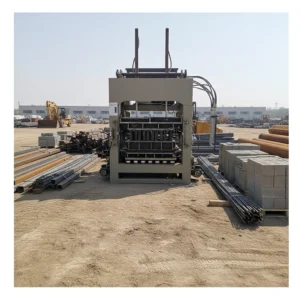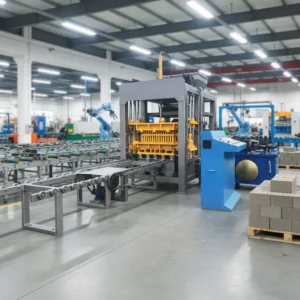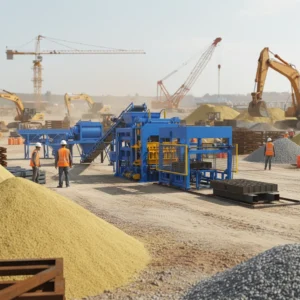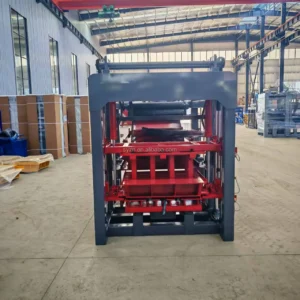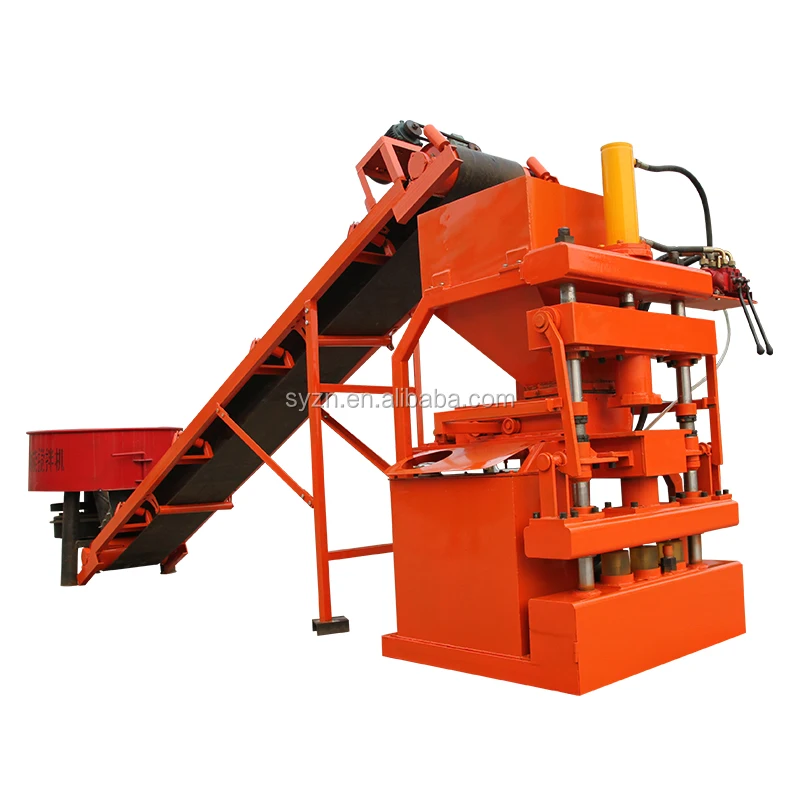
Line Synchronization — the LY1-10 semi-automatic press is specified around its 45-second moulding cycle so every upstream and downstream station is calculated to keep pace, not sold as an isolated machine.
Technical Specifications
| Parameter | Value |
|---|---|
| Model | LY1-10 |
| Product Type | Semi-automatic Clay Brick Making Machine |
| Rated Power | 1.5 kW |
| Molding Cycle | 45 s |
| Output Capacity | 1200–2400 pcs/8hours (basis not stated in source — confirm block format, material, and thickness) |
| Theoretical Productivity | 360 pcs/hour, 2880 pcs/day (based on 300×150×100mm block, 1 pc/mould) |
| Raw Material | Concrete, sand, cement, fly ash, lime, gypsum |
| Net Weight | 400 kg |
| Overall Dimensions (L×W×H) | 1300×1800×2400 mm |
| Vibration System | Bed mould vertical vibration + upper mould compression vibration |
| Voltage | According to local voltage (confirm exact V/Hz before order) |
| Automation Level | Semi-automatic |
Application Suitability
| Application | Material or Output |
|---|---|
| Small-scale workshop block production | Concrete and sand mixes for solid blocks and pavers |
| On-site contractor block manufacturing | Fly ash, lime, and gypsum blends for lightweight bricks |
| Rural housing project supply | Cement and local aggregate for load-bearing hollow blocks |
| First-time plant startup | Low-capital semi-automatic line with manual pallet circulation |
Why the Block Machine Production Line Matters More Than the Press Alone
A press is only as productive as the slowest station feeding or clearing it.
I worked with a buyer in West Africa who purchased a standalone LY1-10 and paired it with an undersized pan mixer. The mixer could not discharge fast enough to meet the 45-second cycle, so the operator spent half the shift waiting for the next batch. The supporting equipment block line bottleneck was invisible on paper because the quotation only listed the press. That gap between quoted capacity and actual daily output is where most first-time plant owners lose money [NEED_CITE: common causes of block plant underperformance in emerging markets].
Matching the Feeder and Mixer to the 45-Second Rhythm
The LY1-10 completes one moulding cycle every 45 seconds. Any raw material feeding and mixing arrangement must deliver a fresh batch to the hopper within that window, or the press sits idle. For a semi-automatic configuration, this typically means a small planetary or pan mixer positioned close enough to gravity-feed the hopper without a conveyor belt, keeping the block machine production line compact and the capital cost contained.
Pallet Circulation: The Station Most Quotations Ignore
Every cycle ejects a loaded pallet that must travel to the curing area and return empty. If the pallet loop is longer than the press can sustain, output drops regardless of how fast the mould closes. The supporting equipment block line must account for pallet count, material, and the distance to the curing yard before the contract is signed [NEED_CITE: pallet circulation planning for semi-automatic block plants].
Reading the Specs That Actually Shape Your Line
The 1.5 kW rated power keeps electrical demand low, which matters when the mixer, feeder, and any conveyor motors are added to the same panel. The 1300×1800×2400 mm footprint defines the minimum bay width; leave clearance on both sides for pallet handlers to pass. The dual vibration system — bed mould vertical vibration combined with upper mould compression vibration — determines block density and surface finish, so the mix design must be tuned to this force profile rather than borrowed from a different machine class. Voltage must be confirmed before the motor is wound; a 50 Hz motor shipped to a 60 Hz market will run overspeed and wear prematurely.
The Cost of Skipping the Line Layout Step
When a buyer orders only the press and sources the mixer, pallets, and curing racks locally, mismatches accumulate quietly. A pallet that is 20 mm too wide jams the feed rails. A curing rack that does not align with the pallet spacing forces workers to restack by hand. These frictions do not show up as a single failure; they erode daily output shift after shift until the plant never reaches the number on the brochure [NEED_CITE: hidden costs of unmatched block line stations].
Why Specify the Full Line From One Source
The LY1-10 is quoted as part of a matched system: the mixer discharge height is set to the hopper inlet, the pallet dimensions are chosen to fit both the press rails and the buyer’s existing curing racks, and the electrical panel is wired for the confirmed local voltage and control language. Factory testing runs the full cycle — feeder, press, and pallet return — so the buyer sees the line operate as a unit before it ships. Installation support covers station spacing and first-run parameter adjustment, not just the press in isolation.
Documentation & Verification
- Line layout drawing showing station sequence from mixer through curing rack
- Capacity calculation sheet stating block format, pallet size, and cycle time assumed
- Voltage, frequency, and control language confirmation signed before production
- Pallet specification matched to buyer’s curing area dimensions and forklift type
- Factory test record running the full 45-second cycle with matched mixer and feeder
Installation, Commissioning & Support
- Bay width of at least 2.5 m accommodates the 1800 mm frame plus pallet handler clearance
- Dedicated 1.5 kW circuit with correct voltage and frequency verified before motor connection
- Machine arrives assembled; only the hopper guard and control arm require on-site bolting
- First-run commissioning tunes vibration duration and feed volume to the buyer’s local aggregate
- Operator training covers mould change procedure and daily vibration plate inspection
- Wear parts list identifies the vibration springs and mould liner as first-replacement items
Before You Request a Quotation
Provide the block format and dimensions you intend to produce, your target daily output, and the raw materials available locally. Confirm your site voltage, frequency, and preferred control panel language. If you already own a mixer, curing racks, or a forklift, share those specifications so the supporting equipment block line is designed around them rather than against them.
Frequently Asked Questions
Q: How is the 1200–2400 pcs/day capacity calculated, and which block format does it assume?
A: That range appears in the source data without a stated block format, material, or thickness, so it must be confirmed before treating it as a guaranteed figure. The theoretical productivity of 2880 pcs/day is based on a 300×150×100mm block at one piece per mould. Always request a capacity sheet that names the exact format and cycle time used in the calculation.
Q: What upstream feeding and mixing equipment is needed to keep the 45-second cycle uninterrupted?
A: A pan or planetary mixer with a discharge rate matched to the hopper volume is essential. The mixer should be positioned to gravity-feed or use a short belt conveyor so that fresh material arrives before each cycle. Undersized mixers are the most common cause of press idle time in semi-automatic block machine production lines.
Q: How do pallet size, material, and circulation count affect line throughput?
A: Pallets must fit the press rails precisely and be numerous enough to cover the distance to the curing yard and back. If the pallet loop is too slow, the press waits. Wood, bamboo, and PVC pallets each have different weight and friction characteristics that influence return speed and worker handling fatigue.
Q: What downstream stacking and curing rack handling is required before blocks leave the press area?
A: In a semi-automatic setup, loaded pallets are typically moved by hand or trolley to curing racks. The rack spacing must match the pallet dimensions so that no restacking is needed. Plan the curing yard distance and pallet return path before the line is installed to avoid bottlenecks.
Q: How is voltage, frequency, and control panel language confirmed before shipment?
A: These details are collected during the inquiry stage and written into the production order. The motor is wound to the confirmed voltage and frequency, and the control panel labels and PLC display are set to the buyer’s language. Changing any of these after production begins causes delays and rework.