
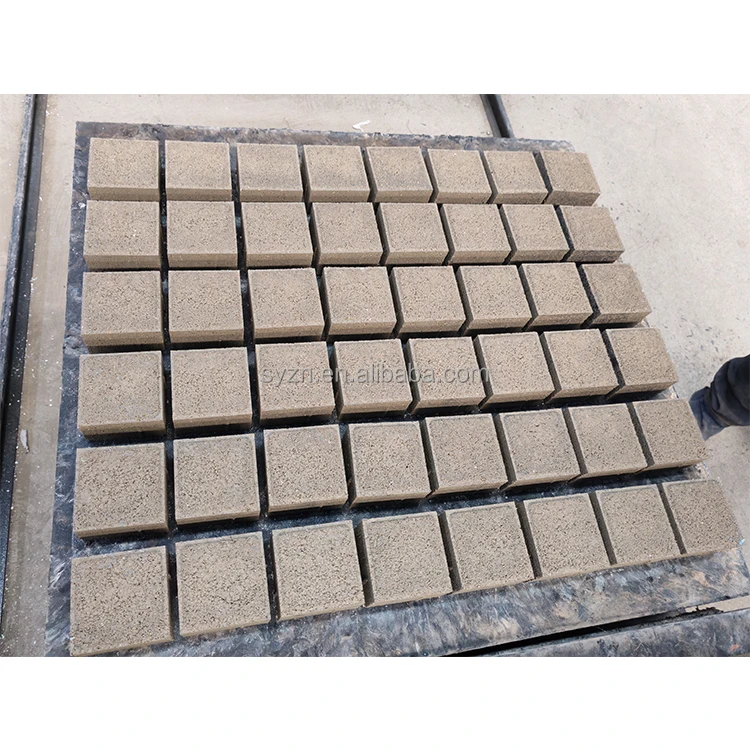
Line-Balanced Configuration — the QTF3-20 stationary block machine production line pairs the press with mixer and conveyor so each station cycle matches and the press never idles waiting for material.
Technical Specifications
| Parameter | Value |
|---|---|
| Model | QTF3-20 |
| Product Type | Stationary Hydraulic Block Making Machine |
| Overall Dimensions (L×W×H) | 4000 × 3500 × 2300 mm |
| Net Weight | 2870 kg |
| Total Installed Power | 17.5 kW |
| Vibration Form | Platform vibration |
| Control System | Semi-automatic electricity box |
| Hydraulic System | Hydraulic drive with non-contact proximity switch monitoring |
| Host Frame Structure | #12 U-bar welded overall frame |
| Material Feeding | Double layer (raw material and color surface material) |
| Vibration Assembly | Vibration motor, vibration table, vibration box, rubber block, spring |
| Standard Line Pairing | JQ350 pan mixer, 8-meter belt conveyor |
| Output Capacity | 4320 pcs/day (basis not stated in source — confirm block format / material / thickness) |
| Compatible Raw Materials | Cement, sand, fly ash, coarse aggregate, slag |
| Mould Compatibility | Hollow brick, interlock brick, color pavers, grass brick, porous brick, standard brick |
Application Suitability
| Application | Material or Output |
|---|---|
| Hollow block production for residential wall construction | Cement, sand, and coarse aggregate blends |
| Interlocking paver manufacturing for driveways and walkways | Crushed stone and cement with color surface layer |
| Grass brick and porous brick for landscaping and drainage | Fly ash, slag, and cement mixtures |
| On-site block production for housing projects | Locally sourced sand and aggregate with cement binder |
| Small-scale paver plant for building material distributors | Multi-format output across standard and custom moulds |
Why the Press Cycle Time Means Nothing Without the Mixer
A block press that finishes its cycle faster than the mixer can deliver fresh batch is simply an expensive timer counting idle seconds.
I learned this the hard way on a project where a QTF3-20 was specified as a standalone unit. The press cycled on schedule, but the JQ350 mixer feeding it could not keep up with the material demand when the operator ran solid block formats. The actual daily output dropped significantly below expectation because the conveyor ran empty between batches. When you evaluate a stationary block machine production line, the cycle time at the press must be reconciled against mixer batch time, conveyor travel speed, and pallet return rate — not quoted in isolation [NEED_CITE: line balancing principles in concrete product manufacturing].
Matching Every Station in the Block Line
The QTF3-20 forms the pressing station of a stationary block machine production line that begins at the raw material hopper and ends at the curing yard. The JQ350 pan mixer delivers a fresh batch to the press hopper via the 8-meter belt conveyor. If the mixer batch cycle is longer than the press consumption rate, the press waits. If the conveyor is too slow, the hopper starves. Each station must be timed so material arrives just as the previous batch completes its vibration and hydraulic compaction cycle.
Double-Layer Feeding and What It Means for Line Flow
The double-layer material feeding system allows the QTF3-20 to handle a base raw material layer and a separate color surface layer within the same cycle. This means the line must supply two distinct material streams to the press — one from the primary mixer for the structural body and a secondary feed for the color face. If the secondary color mixer is absent or undersized, color paver production stalls while the base material keeps flowing. Line configuration must account for both feed paths before the first block is pressed [NEED_CITE: dual-feed requirements in color paver production lines].
How Vibration and Pressure Interact at the Press Station
Platform vibration works together with hydraulic pressure to consolidate the mix inside the mould cavity. The vibration motor and vibration table agitate the material so it fills every corner of the mould, while the hydraulic ram applies downward force to achieve the target density. The non-contact proximity switch monitors hydraulic position without mechanical wear. For the line to produce consistent blocks, the mixer must deliver a uniform moisture content and aggregate gradation every batch — variation in the mix arriving at the press directly affects how vibration and pressure compact the material.
The Cost of Skipping Pallet and Curing Specification
Buyers frequently receive a quotation for the press alone and assume pallets, stacking, and curing logistics are included. When the QTF3-20 arrives and begins producing, blocks sit on pallets that must be moved to a curing area. If the pallet size was not matched to the buyer’s existing forklift tines and curing rack dimensions, the entire output handling becomes a manual bottleneck. Pallets accumulate on the workshop floor, blocking the press discharge side and forcing the operator to pause production [NEED_CITE: pallet handling impact on block plant throughput].
Why This Line Is Configured as a System
The QTF3-20 is not quoted as a standalone press here — it is specified alongside its JQ350 mixer and 8-meter conveyor as a matched stationary block machine production line. Machine, mixer, conveyor, and mould are selected together so cycle times align. The semi-automatic electricity box control gives the operator manual oversight of each station, with room to add automatic pallet feeding or stacking later. The #12 U-bar welded frame provides the rigidity needed for the vibration forces the platform generates, and the double-layer feeding system means color paver capability is built in from the first production run. Configuration is set against the buyer’s actual mix design and target block format rather than a generic catalogue entry.
Documentation & Verification
- Line layout drawing showing QTF3-20, JQ350 mixer, and 8-meter conveyor station positions
- Capacity calculation sheet stating the block format assumed for output figures
- Voltage, frequency, and electricity box control language confirmation before production
- Hydraulic and electrical schematic with proximity switch wiring detail
- Factory test record on buyer’s specified block format before dispatch
- Mould drawing and format list covering hollow, interlock, paver, and grass brick options
Installation, Commissioning & Support
- Foundation pad leveled to 4000 × 3500 mm footprint with anchor bolt recesses for the welded frame
- Dedicated electrical circuit rated for the 17.5 kW total load with correct voltage and phase confirmed
- Belt conveyor aligned to press hopper entry with tension and tracking adjusted on site
- Semi-automatic electricity box commissioned with proximity switch calibration for hydraulic stroke
- Operator training on double-layer feeding sequence and mould change procedure
- Wear parts list covering vibration rubber blocks, springs, and hydraulic seals
What to Include in Your Inquiry
To configure the stationary block machine production line around the QTF3-20 accurately, share the block formats your market sells and the daily output target for each. Include your local aggregate type and typical mix proportions so the mixer and feeding system are sized correctly. Specify your site voltage, frequency, and preferred control panel language to avoid commissioning delays after arrival.
Frequently Asked Questions
Q: How is the output capacity of the QTF3-20 line calculated?
A: The published figure assumes a specific block format, material blend, and wall thickness. Capacity changes when you switch between hollow blocks, solid pavers, and interlocking bricks because each format has a different mould volume and cycle requirement. Request a capacity calculation that states the exact format used as the basis so you can compare it against your production target.
Q: What supporting equipment completes the line around the QTF3-20?
A: The minimum line pairs the press with a JQ350 pan mixer and an 8-meter belt conveyor. For higher output or color paver production, a second mixer for the surface layer and a pallet return system may be added. The configuration depends on which block formats you intend to run and how many pallets your curing area can hold at one time.
Q: How must cycle times match across stations in the production line?
A: The mixer must complete a batch before the press empties its hopper, and the conveyor must deliver material faster than the press consumes it. If any station is slower than the press cycle, the press idles and daily output falls. Line balancing means confirming batch time, conveyor speed, and pallet circulation rate against the press cycle for each block format you plan to produce.
Q: What pallet specification does the QTF3-20 line require?
A: Pallet size must match the mould footprint and the press platen dimensions. Material — wood, steel, or composite — affects weight, durability, and how your forklift handles loaded pallets. The curing area layout and rack spacing must accommodate the chosen pallet size, otherwise blocks pile up on the workshop floor and block the press discharge.
Q: Can the semi-automatic line be upgraded later with automatic stacking?
A: The QTF3-20 semi-automatic electricity box control can accommodate additional automation modules. Automatic pallet feeding, stacking, and cubing stations can be integrated into the line when production volume justifies the investment. The upgrade path depends on the existing line layout and whether sufficient space was allocated around the press discharge side during initial installation.


