
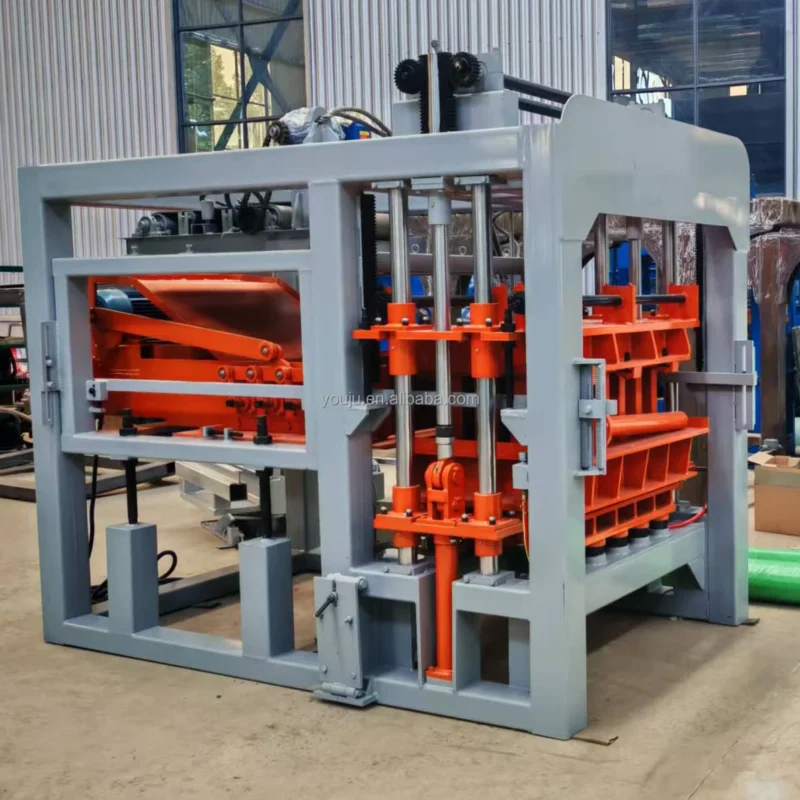
Matched System Configuration — Every station from raw material feeding through stacking is sized to the QT6-15 press cycle, preventing the bottleneck effect where upstream or downstream equipment leaves the main unit waiting.
Technical Specifications
| Parameter | Value |
|---|---|
| Model | QT6-15 |
| Product Type | Hydraulic Block Making Machine |
| Overall Dimensions | 7100×1500×3000 mm |
| Rated Pressure | 21 MPa |
| Main Vibration Form | Platform vibration |
| Vibration Frequency | 4500–5100 r/min |
| Pallet Size | 880×850 mm |
| Moulding Cycle | 15–25 s |
| Overall Power | 31.25 kW |
| Machine Weight | 8700 kg |
| Control System | PLC (language options and brand to be confirmed) |
| Voltage & Frequency | Configurable to target market (basis to be confirmed) |
| Automation Level | Fully automatic |
| Hydraulic Drive | Yes |
| Mould Change Capability | Supports multiple brick formats via mould replacement |
| Raw Material Ratio | Cement 8–10%, Sand 30–40%, Stone 50–60% (approx. 1:4:5) |
| Raw Material Consumption | 150–190 T/day |
| Water Consumption | 3–5% of raw material weight |
| Block Strength (Hollow) | 8–10 MPa |
| Block Strength (Solid) | 10–20 MPa |
| Key Features | Hydraulic drive, platform vibration, PLC-controlled coordination, quick-change mould system |
Application Suitability
| Application | Material or Output |
|---|---|
| Hollow block production for building walls | Crushed stone, sand, and cement mix at 8–10% cement ratio |
| Solid block manufacturing for load-bearing structures | Dense aggregate blend with 10–20 MPa target strength |
| Paving block production for walkways and yards | Fine sand and stone aggregate with high vibration compaction |
| Kerbstone and interlocking brick for road edges | Coarse stone mix with extended vibration cycle |
| Porous brick for permeable surface applications | Graduated aggregate with controlled water content |
Why the Upstream Feeder Dictates Your Real Daily Output
A press that sits idle between cycles because the pallet feeder cannot keep pace is a press you are overpaying for.
I have seen block plants in Shandong where the QT6-15 hydraulic block making machine production line was quoted at a specific cycle time, but the raw material mixer and pallet circulation were never matched to that tempo. The operator ended up waiting for the next pallet, and the actual daily throughput dropped noticeably below the brochure figure [NEED_CITE: block plant cycle time coordination standards]. The mismatch rarely shows up in a single spec sheet — it only appears once every station is running together on the factory floor.
How Line Stations Must Synchronise Around the Press
The QT6-15 operates on a 15–25 second moulding cycle, which means the pallet feeder must deliver a fresh pallet and the stacker must clear the finished one within that same window. When the hydraulic block making machine production line is configured as a single package, each station’s cycle is calculated against the press tempo so the machine never waits. The PLC coordinates the feed, press, and stacker signals in one sequence rather than running them as independent timers.
What Happens When the Mixer Cannot Match the Press
Raw material consumption for this line runs at 150–190 tonnes per day. If the batch mixer delivers material slower than the press consumes it, the hopper level drops and the operator either pauses the cycle or feeds an inconsistent mix — both outcomes hurt block density. A matched hydraulic block making machine production line specifies the mixer capacity and discharge rate against the press throughput so material flow stays continuous [NEED_CITE: concrete batching plant capacity matching guidelines].
Reading the Specs That Actually Determine Block Quality
The 21 MPa rated hydraulic pressure works together with platform vibration at 4500–5100 r/min to compact the concrete mix into a dense, uniform block. Pressure alone would leave voids; vibration alone would not achieve structural strength. The 880×850 mm pallet size is not arbitrary — it must fit the curing racks and forklift tines already in the buyer’s yard. A pallet that is too large for the existing curing area forces a complete rack rebuild before the first block is produced. The 15–25 second moulding cycle range reflects the difference between a simple hollow block and a denser paver format, and the quick-change mould system determines whether switching between those formats takes minutes or an entire shift.
The Hidden Cost of Buying the Press Alone
When a buyer purchases only the QT6-15 without specifying pallet feeding, stacking, and curing rack handling, those functions default to manual labour. I worked on a plant where workers moved wet blocks by hand from the press to the curing area, and the fatigue-related slowdown in the second half of each shift cut daily output far below the calculated figure [NEED_CITE: manual vs automatic pallet handling impact on block plant output]. The quotation looked lower initially, but the labour cost and inconsistency in block handling caused damage rates that erased any savings within the first production run.
Why Sourcing the Full Line from One Supplier Matters
Block machinery is the single focus here, which means the QT6-15 press, moulds, pallets, and handling equipment are specified as one system rather than assembled from separate vendors. Configuration is set against the buyer’s actual mix design and local aggregate, not pulled from a catalogue default. Mould design covers the formats the buyer’s market actually sells, with custom drawings available. Automation level is selectable so a plant can start with semi-automatic pallet handling and add full stacking later. Installation support includes on-site commissioning with operator training so the line runs correctly from the first day.
Documentation & Verification
- Line layout drawing showing all stations from feeder to stacker with capacity stated per block format
- Pallet specification sheet confirming 880×850 mm size, material, and weight against your curing racks
- Hydraulic and electrical schematics with confirmed voltage, frequency, and PLC display language
- Factory test record demonstrating cycle time and block strength with your mix design and local aggregate
- Mould drawing and format list for every block type in your production plan
- Operation and maintenance manual with wear parts list and replacement intervals
Installation, Commissioning & Support
- Foundation pad sized for 7100×1500 mm footprint and 8700 kg static load with vibration isolation
- Dedicated power circuit for 31.25 kW total draw with confirmed voltage and frequency before shipment
- Machine arrives in dismantled sections for container loading with reassembly supervised on site
- First-run commissioning includes PLC parameter tuning for your specific moulding cycle and block format
- Operator training covers mould change procedure, pallet handling sequence, and daily maintenance checkpoints
- Wear parts and hydraulic seal kits listed with reorder quantities and recommended stock levels
What We Need to Size Your Line Correctly
To configure the QT6-15 hydraulic block making machine production line for your plant, share your target block formats with dimensions, your daily output requirement per format, and the local raw materials available including aggregate type and grading. Provide your workshop dimensions, curing area layout, and the forklift model you currently use so pallet size can be matched. Confirm the local voltage, frequency, and the PLC display language your operators need before we begin production.
Frequently Asked Questions
Q: How is daily output calculated per block format on the QT6-15 line?
A: Daily output depends on the block format, moulding cycle, and number of working hours. The line layout document states the capacity for each specific block size — for example, a hollow block and a paver block have different cycle times within the 15–25 second range. We calculate realistic daily figures based on your chosen format, not a generic maximum.
Q: Are pallet feeding, stacking, and curing rack handling included in the quotation?
A: Yes, when the QT6-15 is configured as a complete line, pallet feeding, automatic stacking, and curing rack handling are specified and quoted together. Each station is matched to the press cycle so no bottleneck occurs. If you prefer to start with manual pallet handling, the automation level can be adjusted and upgraded later.
Q: What voltage, frequency, and PLC language is confirmed before shipment?
A: We confirm the exact voltage, frequency, and PLC display language for your market before production begins. This avoids commissioning delays when the machine arrives on site. The control system is set up to your operator’s language preference so training and daily operation proceed without translation barriers.
Q: How do line stations synchronise so the press cycle time is maintained?
A: The PLC coordinates signals between the raw material feeder, pallet feeder, press, and stacker as one sequence. Each station’s cycle is timed against the QT6-15 moulding cycle so material and pallets arrive before the press is ready for them. This prevents idle time and maintains the calculated output rate throughout the shift.
Q: What raw material mix design does the QT6-15 line configuration assume?
A: The standard configuration assumes a cement-to-aggregate ratio of approximately 1:4:5, with 8–10% cement, 30–40% sand, and 50–60% stone. We adjust the mixer settings, vibration frequency, and hydraulic pressure based on your local aggregate characteristics and target block strength to ensure consistent density across every batch.


