
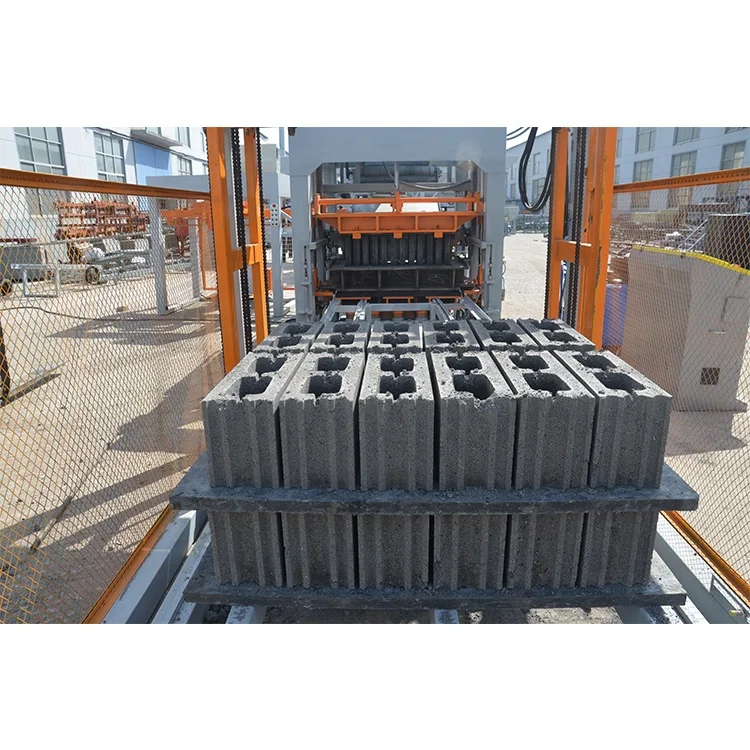
Station-Matched Line Engineering — the QT5-15 is configured as the center of a complete block production line where mixer output, pallet feed rate, and press cycle are calculated together so no station waits on the next.
Technical Specifications
| Parameter | Value |
|---|---|
| Product Type | Fully Automatic Concrete Block Making Machine |
| Model | QT5-15 |
| Overall Dimensions (L×W×H) | 7100×1600×2610 mm |
| Total Weight | 5 T |
| Rated Power | 33.5 kW |
| Control System | PLC control system |
| Moulding Cycle | 15 s |
| Vibration Frequency | 0–60 Hz |
| Vibration Force | 40 kN |
| Pallet Size | 1100×550 mm |
| Mixer Model | JS500 |
| Mould Format | paver, solid block, hollow block, curbstone (changeable by mould swap) |
| Automation Level | Fully automatic |
| Output Capacity — Hollow Block 400×200×200 mm | 5 pcs/mould, 450 pcs/hr, 3600 pcs/8 hr |
| Output Capacity — Hollow Block 400×150×200 mm | 6 pcs/mould, 540 pcs/hr, 4320 pcs/8 hr |
| Output Capacity — Solid Brick 400×100×200 mm | 8 pcs/mould, 720 pcs/hr, 5760 pcs/8 hr |
| Line Equipment Included | block making machine, hydraulic station, PLC control system, pallet feeder, brick conveyor, block sweeper |
| Free Accessories | manual hydraulic trolley, spare parts, tools |
| Raw Materials | crushed stones, sand, cement, dust, fly ash |
Application Suitability
| Application | Material or Output |
|---|---|
| Hollow block production for building walls | Crushed stone, sand, cement, fly ash |
| Solid brick production for load-bearing structures | Sand, cement, stone dust |
| Paving block production for walkways and driveways | Crushed stone, cement, pigment |
| Kerbstone production for road edging | Coarse aggregate, cement |
| On-site block production for housing projects | Locally sourced aggregate and cement |
What Quoted Line Capacity Leaves Out of a Block Production Line Equipment Order
A block production line equipment list that covers only the press ignores the stations that keep it running.
Buyers often discover after delivery that pallet handling, material feeding, and stacking were never part of the quotation. The press sits idle while workers fetch pallets by hand or wait for the mixer to finish a batch. Real daily throughput then falls far short of the number on the datasheet [NEED_CITE: typical line throughput loss from unbalanced station timing]. When specifying a turnkey block making line, every station from raw material feed to cured product handling must be quoted as one connected system.
How Each Station Connects Around the Press
The JS500 mixer is matched to the QT5-15 cycle so that fresh concrete arrives before each press stroke, preventing the machine from waiting on material. The pallet feeder delivers pallets on a timed interval that aligns with the 15-second moulding cycle, keeping the press continuously fed without manual intervention.
Balancing Cycle Times Across the Full Turnkey Block Making Line
If the conveyor moves finished blocks slower than the press ejects them, pallets back up and the line stalls. The brick conveyor and block sweeper included in this block production line equipment package are rated to clear pallets at a rate that matches or exceeds the press output, so no station becomes a bottleneck. Properly balanced cycle times across stations are what separate a theoretical capacity figure from sustained daily throughput [NEED_CITE: principles of cycle time balancing in block production].
Reading the Specifications That Matter for Line Output
Vibration force of 40 kN combined with hydraulic pressure determines the density and strength of every block leaving the press. If pressure and vibration are not matched to the buyer’s mix design, blocks emerge weak or crumble at the edges. The 1100×550 mm pallet size must be checked against the curing rack dimensions and forklift capacity already on site — a mismatch means pallets cannot be stacked in the curing area without rehandling. The PLC control system coordinates the pallet feeder, press, and conveyor timing, so a language option mismatch delays commissioning once the line arrives at the plant.
The Hidden Cost of Skipping Upstream and Downstream Stations
A plant that omits the pallet feeder from the order assigns workers to move pallets manually, adding fatigue and slowing the cycle every time a pallet is late. Without a brick conveyor, freshly pressed blocks must be carried off by hand, and the press pauses between cycles. These gaps in the turnkey block making line accumulate across a shift, turning a rated capacity into a fraction of what the buyer expected [NEED_CITE: labour cost impact of manual pallet handling in block plants].
Why This Block Production Line Equipment Is Quoted as One System
Every station in this block production line equipment package — mixer, pallet feeder, press, conveyor, sweeper — is specified together so cycle times are calculated against one another, not assumed in isolation. The pallet size is selected based on the buyer’s existing curing racks and forklift rather than pulled from a catalogue default. Configuration is set against the buyer’s actual mix design and local aggregate, not a generic material assumption. Mould design covers the formats the buyer’s market actually sells, with custom drawings available. Installation support and operator training are included so the line reaches sustained throughput after commissioning.
Documentation & Verification
- Line layout drawing showing station positions and pallet flow for the QT5-15
- Capacity calculation sheet stating block format assumed for each throughput figure
- Hydraulic and electrical schematic for the 33.5 kW rated power system
- Mould drawing and format list for paver, hollow block, solid brick, and curbstone
- Factory test record run on buyer-specified block format before dispatch
Installation, Commissioning & Support
- Foundation plan based on the 7100×1600 mm machine footprint and 5 T total weight
- Power supply confirmation for 33.5 kW rated system before electrical panel wiring
- PLC display language set to operator preference before the control system ships
- Mixer and press timing calibrated on site during first production run
- Operator training covers mould swap procedure and pallet feeder adjustment
- Wear parts list with hydraulic and vibration component replacement intervals
What to Prepare Before Requesting a Quote
To specify a block production line equipment package that fits your plant, share the block formats your market sells, your target daily output per format, and the local aggregate grading available at your site. Confirm the voltage and frequency at your facility, the PLC language your operators read, and whether your existing curing racks and forklift match standard pallet sizes. If you have upstream or downstream equipment already running, provide its make and throughput rating so the new stations can be balanced to it.
Frequently Asked Questions
Q: How is line capacity calculated and which block format does each figure assume?
A: Each throughput figure on the QT5-15 is stated per block format — for example, 3600 pieces per 8-hour shift is based on 400×200×200 mm hollow blocks at 5 pieces per mould. The capacity calculation document provided with the quotation names the exact format behind every number so you can match it to your production plan.
Q: How are cycle times balanced between stations so no part of the line waits?
A: The JS500 mixer batch time, pallet feeder interval, and conveyor speed are all calculated against the 15-second moulding cycle of the QT5-15. Each station is rated to complete its task within or faster than the press cycle, preventing any single station from holding up the next.
Q: Which stations are included in the quotation and which are optional?
A: The block production line equipment quotation covers the block making machine, hydraulic station, PLC control system, pallet feeder, brick conveyor, and block sweeper as standard. Additional stations such as automatic stacking or curing rack handling can be added based on the automation level you choose.
Q: How is pallet size selected against the curing area and handling equipment?
A: The 1100×550 mm pallet is checked against the dimensions of your curing racks and the fork spacing of your existing forklift before the order is confirmed. If your site uses a different pallet size, the feeder and press bed are adjusted accordingly so pallets move through the line without modification.
Q: What voltage, frequency, and PLC language are confirmed before shipping?
A: Before production begins, the buyer confirms the local voltage and frequency supply as well as the preferred PLC display language. These details are documented in the electrical schematic and control configuration sheet so the line can be commissioned without rewiring or software changes after arrival.



