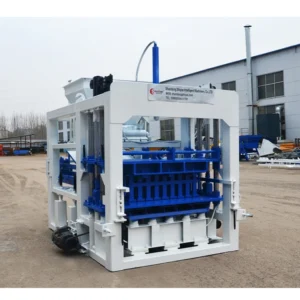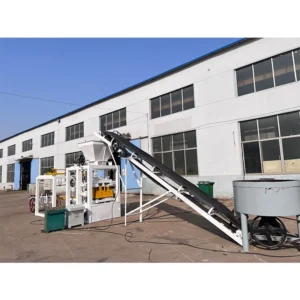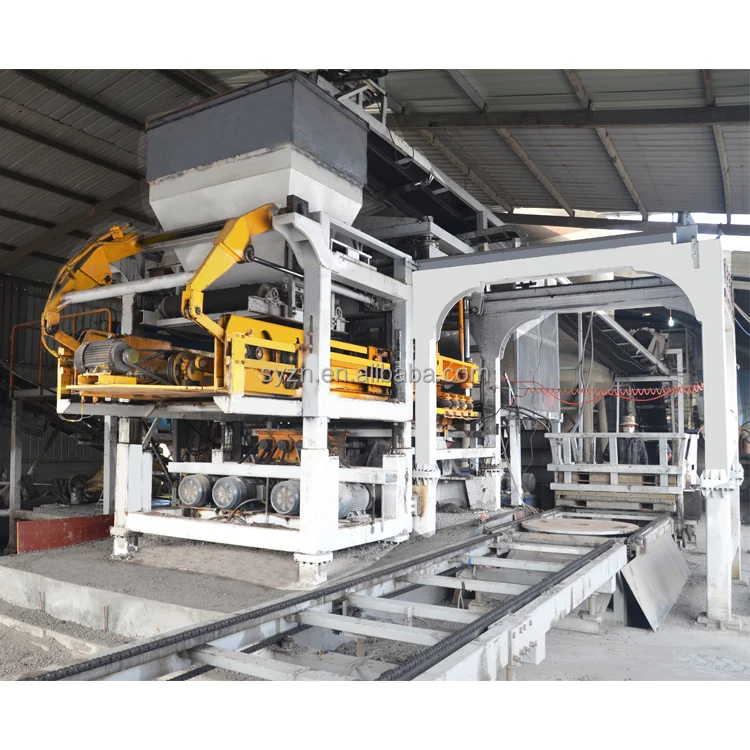
Line Synchronization Expertise — Every station from material feed to curing rack is cycle-matched to the QT18-15 press so that throughput is governed by actual block format, not a single catalogue figure.
Technical Specifications
| Parameter | Value |
|---|---|
| Model | QT18-15 |
| Product Type | Fully Automatic Pallet-free Block Making Machine |
| Brick Height Range | 50–300 mm |
| Stacking Height | 0–1200 mm |
| Vibration Form | Platform vibration |
| Vibration Frequency | 2800–4500 r/min |
| Vibration Power | 60 kW |
| Hydraulic System Power | 59 kW |
| Driving Method | Hydraulic |
| Demolding Method | Vibration combined with hydraulic extraction |
| Molding Cycle | 15–25 s (basis to be confirmed by block format and material) |
| Control System | PLC with person-machine conversation interface |
| Automation Level | Fully automatic, pallet-free stacking directly after moulding |
| Pallet Size | 1350×1350×120 mm (source value — verify against pallet-free configuration) |
| Applied Products | Concrete blocks, hollow blocks, solid blocks, pavers, interlocking blocks, curbstone, colored pavers |
| Raw Materials | Crushed stone, sand, cement, fly ash, gravel, slag, dust |
| Key Features | Direct stacking up to 1200 mm, full line PLC coordination, hydraulic-vibration combined demolding |
Application Suitability
| Application | Material or Output |
|---|---|
| Hollow block production for wall construction | Crushed stone, sand, cement, fly ash blends |
| Solid block manufacturing for load-bearing structures | Gravel, cement, and slag-based mixes |
| Interlocking paver and colored paver lines | Fine aggregate with pigment and cement |
| Kerbstone and curb production for road projects | Coarse aggregate with high cement ratio |
| On-site block supply for housing developments | Locally sourced sand and crushed stone |
What "15–25 Second Cycle" Actually Means for Your Daily Output
The molding cycle only holds when every upstream and downstream station keeps pace.
A block making machine production line rated at a 15–25 second cycle sounds fast on paper, but if the mixer cannot deliver a fresh batch every cycle, or the stacking station is still placing the previous layer, the press sits idle. I have walked through plants in Southeast Asia where the press was spec’d perfectly but the raw material feed ran at half the required rate — the entire line bottlenecked before the first week was out. The cycle number must be tied to a specific block format, mix design, and the supporting equipment feeding and clearing the press. [NEED_CITE: importance of line balance in block production]
Matching Every Station to the Press Beat
A turnkey block production line built around the QT18-15 press starts with raw material batching and mixing that delivers a consistent, metered charge within the press cycle window. The PLC person-machine interface coordinates feed timing, vibration onset, hydraulic pressure application, and demolding sequence across every station. When the mixer discharge, press cycle, and stacking movement are all governed by one control logic, the line runs as a single system rather than a collection of independent machines waiting on each other.
Where the Pallet-Free Stacking Advantage Shows Up
Eliminating pallet circulation removes an entire loop of equipment — pallet return conveyors, rack loaders, and the curing rack footprint they demand. Freshly moulded blocks are lifted and stacked directly up to 1200 mm, then transferred by forklift to the curing area. This simplifies the plant layout and removes a common failure point where pallet jams halt the entire block making machine production line. The trade-off is that stacking speed must match or exceed press output, which is why the stacking station is sized against the shortest expected cycle for the formats you plan to run. [NEED_CITE: pallet-free vs pallet-based block line comparison]
Reading the Specs Against Your Actual Block Format
The platform vibration at 2800–4500 r/min works with 60 kW of vibration power and 59 kW of hydraulic pressure to compact the mix and extract the block in one motion. Higher frequency suits finer aggregate and thinner-walled hollow blocks, while lower frequency with longer dwell produces denser solid blocks from coarser crushed stone. The 50–300 mm brick height range covers most standard formats, but cycle time shifts noticeably between a 200 mm hollow block and a 60 mm paver — the PLC allows the operator to store and recall profiles for each format rather than resetting manually every mould change.
The Cost of a Line That Was Never Balanced
When supporting equipment is quoted separately or omitted entirely, the buyer inherits the integration problem. A mixer that is too small starves the press; a stacking unit that is too slow backs up the demolding station. I have seen plants where the curing rack handling was added as an afterthought, and blocks sat on the stacking station for minutes because no forklift schedule was planned. Each of these mismatches converts a theoretically fast line into one that runs well below its rated capacity, and the fault is never found in the press itself. [NEED_CITE: common causes of block line underperformance]
Why Sourcing the Full Line from One Source Matters
Block machinery is the single focus here, which means the QT18-15 press, moulds, stacking unit, and material handling are specified as one matched system. The configuration is set against your actual mix design and local aggregate, not pulled from a catalogue default. Mould design covers the formats your market sells, with custom drawings available. Automation level is selectable so you can commission semi-automatic and add stacking or cubing modules later. Installation includes operator training so the PLC profiles and maintenance intervals are understood from day one.
Documentation & Verification
- Line layout showing station spacing and cycle time handoff for your chosen block format
- Machine specification sheet covering vibration, hydraulic, and PLC parameters
- Mould drawing and format list matching your target product range
- Voltage, frequency, and PLC display language confirmation before production
- Factory test record running the full line together, not the press in isolation
- Packing photographs and customs documentation for export shipment
Installation, Commissioning & Support
- Foundation plan sized to the QT18-15 vibration load and 60 kW vibration power requirement
- Dedicated electrical circuit confirmed for combined 119 kW vibration and hydraulic load
- Machine arrives dismantled for container loading; reassembly sequence documented
- PLC language and person-machine interface set to operator preference before dispatch
- On-site commissioning covers full line cycle tuning across your primary block format
- Wear parts list with hydraulic seals and mould liner replacement intervals defined
- Operator training on mould change procedure and stacking height adjustment up to 1200 mm
Getting a Quotation That Matches Your Plant
Send your target block format and dimensions, expected daily volume, and the local aggregate you plan to use. Confirm your site voltage and frequency, the PLC display language your operators need, and the curing area layout you already have in place. If you are integrating into an existing plant, note the upstream and downstream equipment already running so the line can be matched at the handoff points.
Frequently Asked Questions
Q: How is daily output calculated across different block formats?
A: Each format has its own molding cycle within the 15–25 second range depending on block height, wall thickness, and mix design. Daily output is calculated by multiplying the per-cycle yield of that specific format by the number of operating hours, accounting for mould change and maintenance pauses. We provide a capacity sheet tied to your chosen formats, not a single generic number.
Q: What supporting equipment is included in the line quotation?
A: The quotation covers raw material feeding, mixing, the QT18-15 press, pallet-free stacking, and the PLC coordination between every station. Curing area handling is discussed based on your site layout. Each station’s cycle time is verified against the press so no handoff point becomes a bottleneck during production.
Q: How is the line configured for my local aggregate?
A: We ask for your local crushed stone grading, sand type, and cement brand before finalizing vibration frequency and hydraulic pressure settings. The PLC stores mix-specific profiles so operators switch between recipes without manual recalibration. This prevents the common issue where a machine set for one aggregate produces weak blocks with another.
Q: What are the factory area and utility requirements?
A: The QT18-15 line requires adequate space for raw material storage, the press and stacking station, and forklift circulation to the curing area. Combined electrical load for vibration and hydraulic systems is approximately 119 kW plus mixer and conveyor motors. Water consumption and foundation load details are provided in the line layout document before installation begins.
Q: How does pallet-free stacking work with my existing curing setup?
A: Blocks are stacked up to 1200 mm directly after moulding and moved by forklift to your curing area without pallets or racks. We confirm your forklift capacity and curing zone dimensions during layout planning so the stacking height and transfer route match what you already have on site, avoiding the need for new curing infrastructure.