
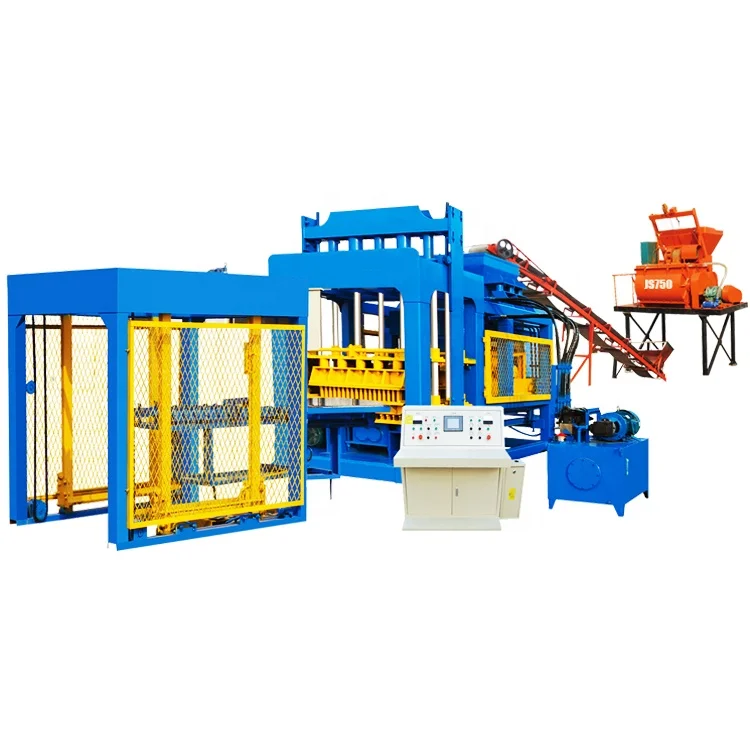
Line-Synchronized Throughput — the QT12-15 block production line turnkey QT12-15 configuration ensures that every station from batching to cubing matches the press cycle, preventing bottlenecks that leave the host machine idle.
Technical Specifications
| Parameter | Value |
|---|---|
| Model | QT12-15 |
| Product Type | Fully Automatic Stationary Block Making Machine |
| Rated Power | 44.58 kW |
| Voltage & Frequency | According to buyer’s local voltage (basis to be confirmed) |
| Control System | PLC with fault diagnosis system |
| Overall Dimensions (L×W×H) | 9350 × 2520 × 2950 mm |
| Net Weight | 11000 kg |
| Hydraulic Pressure | 16–21 MPa |
| Main Vibration Form | Platform Vibration |
| Vibration System | Synchronization vibration with variable frequency |
| Pallet Size | 1300 × 900 mm |
| Cycle Time (Hollow Block 400×200×200mm) | 20–25 s (12 pcs/mould) |
| Cycle Time (Porous Block 240×115×90mm) | 15–20 s (30 pcs/mould) |
| Cycle Time (Standard Block 240×115×53mm) | 15–17 s (60 pcs/mould) |
| Output Capacity (Hollow Block) | 21600 pcs/day (based on 400×200×200mm, 12 pcs/mould, 20–25s cycle) |
| Output Capacity (Porous Block) | 72000 pcs/day (based on 240×115×90mm, 30 pcs/mould, 15–20s cycle) |
| Output Capacity (Standard Block) | 144000 pcs/day (based on 240×115×53mm, 60 pcs/mould, 15–17s cycle) |
| Raw Materials | Crushed stone, sand, cement, dust, fly ash, gravel, slag |
| Automation Level | Fully automatic |
| Warranty | 1 year (excluding wearing parts) |
Application Suitability
| Application | Material or Output |
|---|---|
| Hollow block production for commercial and residential walls | Crushed stone, sand, cement, fly ash blends |
| Solid block manufacturing for load-bearing structures | Gravel, sand, cement mixes |
| Paving block and colored paver runs for walkways and plazas | Fine aggregate with pigment additives |
| Interlocking block and curbstone forming | Slag, dust, cement combinations |
| Porous block production for permeable surface applications | Graded aggregate with controlled cement ratio |
Why "Pieces per Day" Means Nothing Without the Line Around It
A block press only produces when a pallet is in position and the mixer has delivered the next batch.
I once watched a plant owner take delivery of a high-capacity stationary press, only to find that pallets were being returned by hand because the quotation stopped at the machine itself. The press sat idle for seconds between every cycle while workers scrambled to feed boards back into the line. That block production line turnkey QT12-15 gap between quoted capacity and actual output is where most first-time buyers lose money [NEED_CITE: common causes of block plant underperformance]. The cycle time of 20–25 seconds per mould is only achievable when upstream material feeding and downstream pallet handling keep exact pace.
How Stations Connect Around the Press
The QT12-15 operates on a 1300 × 900 mm pallet datum. Every piece of supporting equipment — from the pallet feeder at the press inlet to the stacker at the outlet — must be dimensioned and timed to that pallet size. If the pallet return conveyor runs slower than the press cycle, boards pile up at the wet stacking station and the operator is forced to hold the press. A block production line turnkey QT12-15 layout maps each station’s throughput against the press cycle so the line flows without interruption.
Balancing Mixer Output with Press Demand
The raw material feeding system on this line uses a dedicated storage and dispensing arrangement designed to maintain feeding accuracy across batches. When the mixer discharges a batch, it must arrive at the press hopper before the current charge is exhausted. If the mixer is undersized relative to the QT12-15 cycle rate, the press starves and daily output drops. Line integration means specifying mixer capacity, conveyor speed, and hopper volume as a single calculation rather than ordering each piece independently [NEED_CITE: block line mixer sizing principles].
Reading the Specs That Actually Affect Line Design
Hydraulic pressure in the 16–21 MPa range works together with the platform vibration system to compact the mix into dense, uniform blocks. The vibration operates at variable frequency — lower during material feeding to distribute the mix evenly, higher during compaction to achieve target strength. This two-stage vibration pattern means the feeding station must deliver material at a consistent rate; uneven feeding disrupts the low-frequency distribution phase and produces density variation across the block face. The 9350 × 2520 × 2950 mm footprint of the press alone determines minimum bay width, but the full line footprint extends considerably when pallet circulation, curing racks, and stacking equipment are positioned around it. Pallet specification matters at the line level: the 1300 × 900 mm boards must match the fork spacing on the buyer’s existing forklift and the slot dimensions of the curing racks already on site. Mismatched pallets force a buyer to replace an entire inventory of boards or reconfigure rack shelving before the line can run.
When Line Stations Are Missing from the Quotation
A buyer who receives a quotation covering only the press, mould, and a basic pallet stack will face hidden costs the moment the machine arrives. Manual pallet handling limits actual output well below the rated cycle capacity. Wet blocks stacked by hand on the floor consume curing space inefficiently and increase breakage during the first days of curing [NEED_CITE: block curing and handling losses in manual plants]. These costs never appear on the original quotation but show up every shift as lost production and damaged inventory.
What Makes This Line Configuration Different
Block machinery as a single focus means the QT12-15 is specified alongside its pallet feeder, stacker, and curing rack handler as one matched system. The line layout states the block format assumed at each station, so a buyer knows the hollow block throughput and the paver throughput as separate, honest figures. Mould design covers the formats the buyer’s market actually sells, including custom drawings when standard formats do not match local demand. Automation level is selectable, allowing a plant to start with semi-automatic pallet handling and add automatic stacking later. Installation support extends to balancing every station’s cycle against the press so the line runs at quoted capacity from the first day.
Documentation & Verification
- Line layout and capacity calculation stating the block format assumed for each station
- Machine specification sheet covering hydraulic pressure, vibration frequency, and PLC configuration
- Pallet specification matched to buyer’s curing rack dimensions and forklift capacity
- Voltage and control language confirmation signed off before production begins
- Factory test record demonstrating cycle time on the buyer’s chosen block format
- Hydraulic and electrical schematic for integration with plant-level infrastructure
Installation, Commissioning & Support
- Foundation plan sized to the 9350 × 2520 mm press footprint plus pallet circulation path
- Power supply matched to the 44.58 kW rated draw with dedicated circuit for hydraulic station
- PLC fault diagnosis system configured in buyer’s chosen display language before dispatch
- Pallet return conveyor aligned to 1300 × 900 mm boards and tested with buyer’s curing racks
- Operator training covering mould change procedure and variable frequency vibration settings
- Wear parts list covering hydraulic seals, vibration springs, and pallet contact surfaces
What to Include in Your Inquiry
To size a complete line around the QT12-15, share your target block format, daily output requirement, and the raw materials available locally. Include your site dimensions, existing forklift capacity, and local voltage and frequency so every station can be matched before the quotation is issued.
Frequently Asked Questions
Q: How is the QT12-15 cycle time balanced with upstream mixer output and downstream stacking speed?
A: Each station in the line is calculated against the press cycle — 20–25 seconds for a 400×200×200mm hollow block. The mixer discharge rate, pallet feeder indexing speed, and stacker lift cycle are all set so the press never waits for material or pallets between cycles.
Q: What pallet size is specified and how does it match existing site equipment?
A: The standard pallet is 1300 × 900 mm. Before the line is finalized, this dimension is checked against your curing rack slots and forklift fork spacing. If your existing equipment uses a different board size, the pallet specification and all handling stations are adjusted accordingly.
Q: Which line stations are included in the quotation and which remain the buyer’s scope?
A: The quotation specifies every station from raw material feeding through to stacking and curing rack handling. Items that remain buyer scope, such as curing area construction or external power supply, are listed separately so there are no surprises on arrival.
Q: How is voltage, frequency, and PLC language confirmed before production?
A: A confirmation document listing your local voltage, frequency, and preferred PLC display language is signed off before the machine enters production. This prevents commissioning delays caused by incompatible electrical supply or unreadable control screens.
Q: What is the process for factory testing the complete line before shipment?
A: The press and its connected stations are assembled and run at the factory using a block format agreed with the buyer. Cycle times, pallet indexing, and stacking sequences are recorded in a test report that ships with the machine.


