
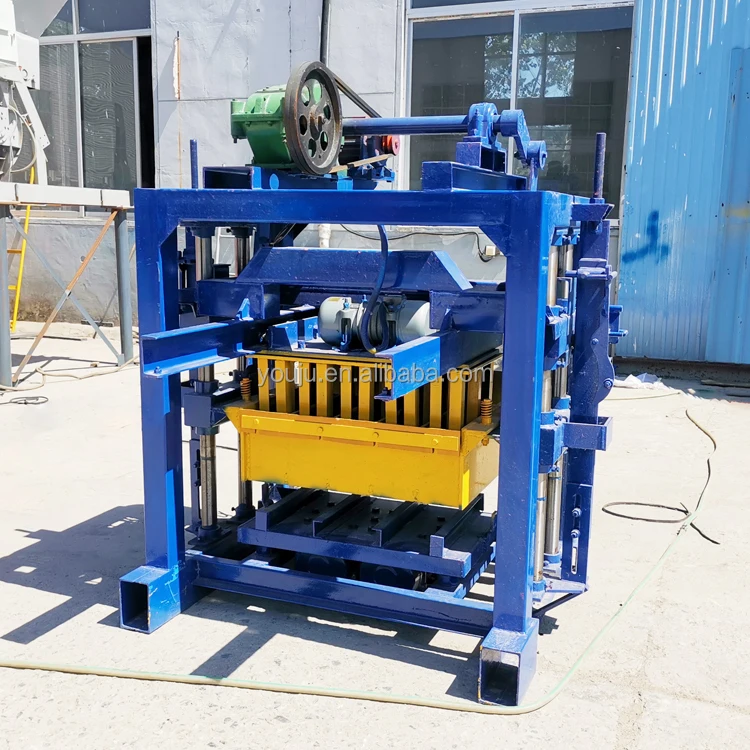
Matched System Design — The QTJ4-40 press is specified alongside mixer, pallet feeder and curing rack handling so no station in the semi-automatic concrete block making machine production line waits on the next cycle.
Technical Specifications
| Parameter | Value |
|---|---|
| Product Type | Semi-Automatic Concrete Block Making Machine |
| Model | QTJ4-40 |
| Vibration Form | Platform Vibration |
| Vibration Frequency | 2800 r/min |
| Pallet Size | 850×450 mm |
| Overall Dimensions (L×W×H) | 1350×1460×1800 mm |
| Machine Weight | 1 T |
| Factory Area Required | 200 m² |
| Labor Requirement | 1–3 people |
| Mould Features | Top die push and pull, automatic scraper |
| Automation Level | Semi-automatic (manual pallet handling) |
| Capacity (400×200×200mm hollow block, 4 pcs/mould) | 2880 pcs/8h |
| Capacity (400×150×200mm block, 5 pcs/mould) | 4000 pcs/8h |
| Capacity (225×112.5×60mm interlocking brick, 9 pcs/mould) | 7200 pcs/8h |
| Raw Material Ratio (stated) | Cement 8–10%, sand 30–40%, stone 50–60% |
| Compatible Raw Materials | Concrete, cement, fly ash, crushed stone, sand, dust, gravel, slag |
| Control System | (basis to be confirmed) |
| Hydraulic Pressure | (basis to be confirmed) |
| Voltage & Frequency | (basis to be confirmed) |
Application Suitability
| Application | Material or Output |
|---|---|
| Hollow block production for residential walls | Crushed stone, sand, cement at 1:4:5 approximate ratio |
| Solid block manufacturing for load-bearing structures | Gravel, cement, fly ash blends |
| Interlocking brick forming for paving and landscaping | Fine sand, stone dust, cement |
| Paver and colored paver runs for driveways and walkways | Pigmented concrete mixes with fine aggregate |
| Kerbstone production for road and curb projects | Coarse aggregate with higher cement content |
What "Pieces per Shift" Leaves Out of a Block Line Quote
Capacity means nothing until you know which block format and which supporting stations the number assumes.
A buyer receives a press-only quotation showing a headline output figure, signs the order, and then discovers pallets must be moved by hand, stacking was never discussed, and the curing rack layout does not match the pallet size on the machine. The semi-automatic concrete block making machine production line then becomes a collection of bottlenecks rather than a continuous flow. [NEED_CITE: common causes of block plant commissioning delays in developing markets]
Press Placement Within the Full Line
The QTJ4-40 sits at the centre of a block production setup where raw material feeding, mixing, pallet supply and output handling must all keep pace with a 2800 r/min platform vibration cycle. When the mixer discharge interval is longer than the press cycle, the mould sits empty and daily output drops. Line layout work starts from the press cycle time and works outward to each station.
Pallet Flow and Curing Area Coordination
Every cycle consumes one 850×450 mm pallet, and that pallet must travel from the press to the curing area and back. If the curing rack spacing, forklift fork width and pallet dimensions do not align, workers spend time repositioning blocks instead of feeding the next pallet. A semi-automatic concrete block making machine production line that ignores pallet logistics creates hidden labor costs [NEED_CITE: pallet handling impact on block plant labor allocation].
Reading the Specification Sheet Against Real Output
The capacity figures — 2880 hollow blocks, 4000 standard blocks, or 7200 interlocking bricks per eight-hour shift — each assume a specific mould and cycle. A plant that primarily sells 400×200×200mm hollow blocks should size the mixer, pallet inventory and curing space around 2880 pieces, not the higher interlocking brick number. Honest capacity calculation prevents overspending on upstream equipment that the press cannot keep up with.
Vibration, Pressure and Mix Design Interplay
Platform vibration at 2800 r/min compacts the concrete mix inside the mould, while the top die push-pull mechanism forces material into corners. The stated raw material ratio of roughly one part cement to four parts sand to five parts stone is a starting point. Local aggregate moisture, fines content and particle shape all shift the ideal water-to-cement ratio. When a buyer switches to a locally available sand with higher clay content without adjusting the mix, cycle times lengthen and block strength falls. Matching vibration force and hydraulic pressure to the actual mix is what separates a line that runs at rated output from one that underperforms.
Semi-Automation as a Starting Configuration
The QTJ4-40 ships in a semi-automatic state where pallet handling is manual. This keeps initial investment lower and allows a first-time plant owner to learn the press rhythm before committing to automatic stacking and cubing. Because the press itself does not change, a buyer can later add an automatic pallet return conveyor and stacker without replacing the core machine. The upgrade path preserves the original semi-automatic concrete block making machine production line investment while reducing labor as output volume grows.
The Hidden Cost of Skipping Line Integration
When supporting equipment is sourced separately, cycle times rarely match. A mixer that discharges every ninety seconds feeds a press that cycles every forty, leaving the press idle for half its shift. Pallets ordered from a different supplier arrive in a size that does not fit the curing racks already on site. Voltage and control language arrive wrong, delaying commissioning while an electrician rewires the panel. These mismatches are not visible in a press-only quote but surface immediately during the first production run [NEED_CITE: block line integration mismatches reported by plant operators].
Why Source the Full Line From One Supplier
Block machinery is our single focus, so the QTJ4-40, its moulds, pallets and handling equipment are specified as one matched system. Configuration is set against the buyer’s actual mix design, local aggregate and target block format rather than a catalogue default. Mould design covers the formats the buyer’s market actually sells, including custom drawings. Automation level is selectable, allowing a start at semi-automatic with a clear upgrade path. Installation support includes operator training so the line runs correctly from day one.
Documentation & Verification
- Line layout drawing showing station spacing and pallet flow path for 850×450 mm pallets
- Capacity calculation sheet stating the block format and cycle time assumed per product
- Mould drawing and format list covering hollow, solid, interlocking and paver options
- Pallet specification matched to buyer’s curing rack dimensions and forklift fork width
- Factory test record on buyer’s target block format before dispatch
- Voltage, frequency and control language confirmation sheet signed before production
Installation, Commissioning & Support
- Foundation plan sized to the QTJ4-40 footprint of 1350×1460 mm with anchor bolt locations
- Power supply checklist confirming voltage, frequency and dedicated circuit rating before arrival
- Pallet inventory recommendation based on 850×450 mm size and shift-length curing rotation
- Mixer discharge timing matched to press cycle during on-site commissioning
- Operator training covering mould change procedure and top die push-pull adjustment
- Wear parts list with first-replacement intervals for scraper blades and vibration mounts
What to Prepare Before Requesting a Line Quote
Share the block formats you sell most, your target daily output per format, and the raw materials available locally including sand type and aggregate grading. Confirm the voltage and frequency at your site, the control language your operators read, and the forklift and curing space you already have. This information lets us configure a semi-automatic concrete block making machine production line that arrives ready to run.
Frequently Asked Questions
Q: How is line capacity calculated per block format, and how do I match the line to my best-selling product?
A: Each capacity figure — 2880, 4000 or 7200 pieces per eight-hour shift — is tied to a specific mould and block dimension. We build the capacity calculation around the format that represents the majority of your sales, then size the mixer output, pallet quantity and curing rack count to that number so no station bottlenecks the press.
Q: Which supporting stations are included, and where do cycle times need to match?
A: The line covers raw material feeding, mixing, pallet supply, the QTJ4-40 press and output handling. Mixer discharge interval must be shorter than the press cycle so the mould never waits. Pallet return speed must keep pace with pressing so the next cycle starts without delay.
Q: Can I start with semi-automatic pallet handling and add automatic stacking later?
A: Yes. The QTJ4-40 press remains the same whether pallets are moved by hand or by conveyor. Adding an automatic stacker and pallet return system later reduces labor without replacing the press, preserving the original semi-automatic concrete block making machine production line investment.
Q: How are pallet size and material chosen against my curing area and forklift?
A: The standard 850×450 mm pallet must fit your existing curing rack spacing and forklift fork width. We confirm both dimensions before the line is finalized, then recommend pallet material — wood, bamboo or composite — based on your climate and curing duration to avoid warping.
Q: What voltage, frequency and control language do I need to confirm before the line is built?
A: Provide your site voltage, phase and frequency in writing so the motor and control panel are wired correctly. Confirm the language for any PLC display or indicator labels. This avoids rewiring and reprogramming delays once the semi-automatic concrete block making machine production line arrives on site.


