
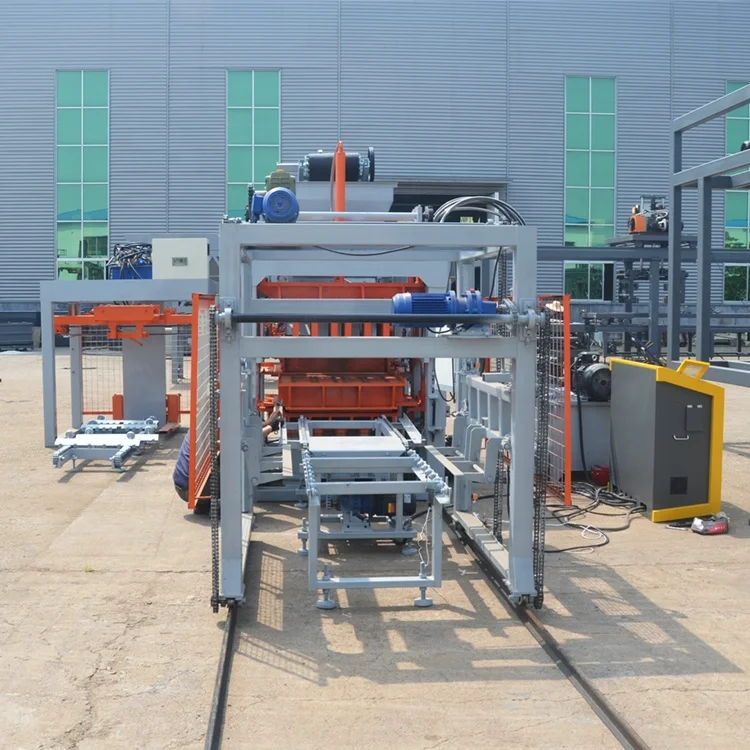
Complete Line Block Making Machine — The QT6-15 hydraulic block press is specified as part of a coordinated block production line where every station from raw material feeding through to curing rack handling is balanced to the press cycle.
Technical Specifications
| Parameter | Value |
|---|---|
| Product Type | Hydraulic Block Making Machine |
| Model | QT6-15 |
| Overall Dimensions (L×W×H) | 8200×1700×2950mm |
| Total Mass | 7T |
| Overall Power | 37kW |
| Control System | PLC (Programmable Controller) with touch screen |
| Vibration Form | Platform Vibration |
| Vibration Frequency | 0-60Hz |
| Vibration Force | 45kN |
| Moulding Mode | Automatic load, vibration moulding |
| Demolding Method | Hydraulic |
| Pallet Size | 880×850mm |
| Molding Cycle | 15-20s |
| Recommended Factory Area | 1200m² |
| Block Compressive Strength | >15 MPa |
| Output (400×200×200mm Hollow Block) | 1080-1440 pcs/hour (8640-11520 pcs/8hr) |
| Output (400×150×200mm Hollow Block) | 1440-1920 pcs/hour (11520-15360 pcs/8hr) |
| Output (240×115×53mm Solid Brick) | 5760-7680 pcs/hour (46080-61440 pcs/8hr) |
| Output (200×100×60mm Rectangular Paver) | 2160-2880 pcs/hour (17280-23040 pcs/8hr) |
| Output (225×112.5×60mm Zigzag Paver) | 2160-2880 pcs/hour (17280-23040 pcs/8hr) |
| Voltage & Frequency | (basis to be confirmed — depends on buyer’s local grid) |
| Hydraulic Pressure | (basis to be confirmed — depends on block format and mix design) |
| Mould Change Time | (basis to be confirmed — depends on block format) |
| Stacking Method | (basis to be confirmed — depends on automation level selected) |
Application Suitability
| Application | Material or Output |
|---|---|
| Hollow block production (load-bearing and non-load-bearing) | Crushed stone, sand, cement, fly ash |
| Solid brick production | River sand, quarry dust, cement blends |
| Rectangular and zigzag paving bricks | Fine aggregate and cement with colour pigment |
| Blocks from industrial waste | Fly ash, slag and recycled aggregate with reduced cement dosage |
| On-site block production for construction projects | Locally sourced aggregate matched to available raw materials |
Why "Pieces per Hour" Tells Only Part of the Story for Your Block Production Line
A press cycle time means nothing when the pallet feeder, mixer or stacker runs slower than the press itself.
When a turnkey block making equipment quotation lists only the press capacity, the buyer often discovers after installation that pallet handling and stacking were never included. Workers end up moving wet blocks by hand while the press sits idle waiting for the next pallet. The real daily output then falls well below the number on the contract. I have seen this pattern repeat on projects across Southeast Asia — the press is rated for one volume, but the line around it was never designed to keep up. [NEED_CITE: common bottlenecks in block production line balancing]
Matching Every Station to the QT6-15 Press Cycle
A block production line built around the QT6-15 starts with raw material feeding and mixing sized to deliver fresh batch to the hopper before the press calls for it. The 880×850mm pallet size is fixed upfront so the pallet feeder, curing racks and forklift fleet all work to the same dimension. When any one station lags, the 15-20 second molding cycle stretches and hourly output drops.
Where Turnkey Block Making Equipment Gaps Show Up First
The gaps usually appear at the back end of the line. If stacking and curing rack handling are left manual, finished blocks pile up beside the press and operators slow the machine to avoid pallet jams. A balanced turnkey block making equipment specification lists every station — feeding, mixing, pallet return, stacking and curing — with cycle times that match or exceed the press speed. [NEED_CITE: block plant layout and station synchronization requirements]
Reading the Specs Through a Production Line Lens
The QT6-15 operates with a 45kN vibration force on a platform vibration system, and the 0-60Hz adjustable frequency lets the operator tune vibration to the specific mix design and block format in use. The 37kW overall power rating covers the press alone; the full line power draw depends on which supporting stations are included. The PLC control with touch screen manages the automatic loading and vibration moulding sequence, but it can also communicate with upstream batching and downstream stacking modules when the line is fully integrated. The 880×850mm pallet is large enough for multi-cavity moulds, which directly affects how many blocks are produced per cycle. The recommended 1200m² factory area accounts for press footprint, pallet circulation paths and curing rack storage.
What Happens When Stations Are Sized Independently
When the mixer is chosen for price rather than batch-to-cycle matching, the press waits between loads and the 15-20 second cycle advantage disappears. Pallet material matters too — lightweight pallets warp under continuous vibration and cause uneven block height across the mould cavity. [NEED_CITE: pallet material selection for concrete block production] I once visited a site where the buyer sourced pallets locally without confirming thickness tolerance, and half the blocks came out with uneven faces. The pallet feeder had to be recalibrated, costing days of lost production.
Why This Approach to Line Configuration
The QT6-15 is supplied as part of a matched system, not as a standalone press. Machine, mould, pallet and handling equipment are specified together so cycle times align across every station. Configuration starts from the buyer’s actual mix design and local aggregate, not a catalogue default. Moulds are designed for the specific hollow block, solid brick and paver formats the buyer’s market demands. Automation level is selectable — a buyer can begin with semi-automatic pallet handling and add automatic stacking later. Installation includes operator training so the team understands line balancing from day one.
Documentation & Verification
- Line layout drawing with capacity calculated per block format for the QT6-15
- Machine specification sheet confirming pallet size and vibration settings
- Mould drawing and format list matching your target product range
- Hydraulic and electrical schematic for local maintenance team reference
- Voltage, frequency and PLC display language confirmation before production
- Factory test record run on buyer-specified block format before dispatch
Installation, Commissioning & Support
- Foundation plan based on the 8200×1700mm footprint and 7T operating mass
- Dedicated power circuit rated for the 37kW overall draw plus supporting equipment load
- Machine dismantling for container loading with reassembly guidance on site
- First-run commissioning with vibration frequency and hydraulic pressure set to your mix
- Operator training covering PLC touch screen controls and mould change procedure
- Wear parts and mould list supplied with recommended replacement intervals
What We Need to Specify Your Line
To size a block production line around the QT6-15, share the block formats you plan to produce and the daily volume target for each. Tell us about your local raw materials — aggregate type, sand source and cement availability — along with your existing curing area dimensions and forklift fleet. Confirm the local voltage and frequency so the PLC and motor specifications are locked before production begins.
Frequently Asked Questions
Q: How is line capacity calculated, and which block format does each figure assume?
A: Every output figure in the QT6-15 specification states the block format it applies to — for example, 1080-1440 pieces per hour is based on the 400×200×200mm hollow block. The line capacity calculation extends this to an eight-hour shift and factors in pallet circulation speed, mixer batch delivery and stacking rate so no station becomes a bottleneck.
Q: What supporting equipment is included beyond the press itself?
A: A complete line configuration covers raw material feeding, mixing, pallet feeding, automatic stacking and curing rack handling. Each station is selected to match or exceed the QT6-15 press cycle so the machine is never left waiting. The quotation lists every station with its own cycle time for your review.
Q: How do pallet size and material affect curing area and forklift requirements?
A: The QT6-15 uses an 880×850mm pallet, and this dimension drives the curing rack spacing, stacking height and forklift fork width. Confirming pallet material early prevents warping under vibration and ensures compatibility with the buyer’s existing handling equipment and curing area layout.
Q: How is voltage, frequency and PLC language confirmed before shipping?
A: Before production starts, we confirm the buyer’s local voltage, frequency and preferred PLC display language in writing. This avoids commissioning delays on arrival and ensures the touch screen interface is readable for the local operator team from the first day of operation.
Q: What is the upgrade path from semi-automatic to full stacking automation?
A: The QT6-15 line can start with semi-automatic pallet handling and manual stacking, then add automatic stacking and cubing modules later. The PLC control system supports these additions without requiring a full control replacement, so the upgrade integrates into the existing line layout.



