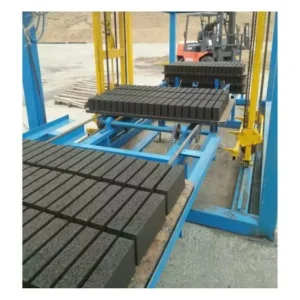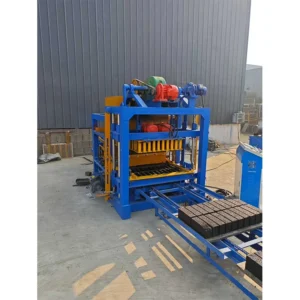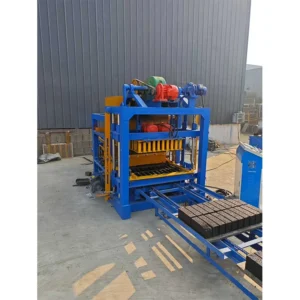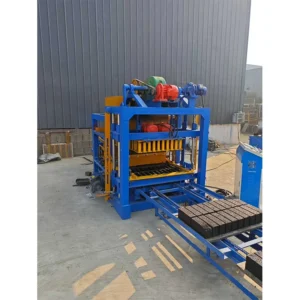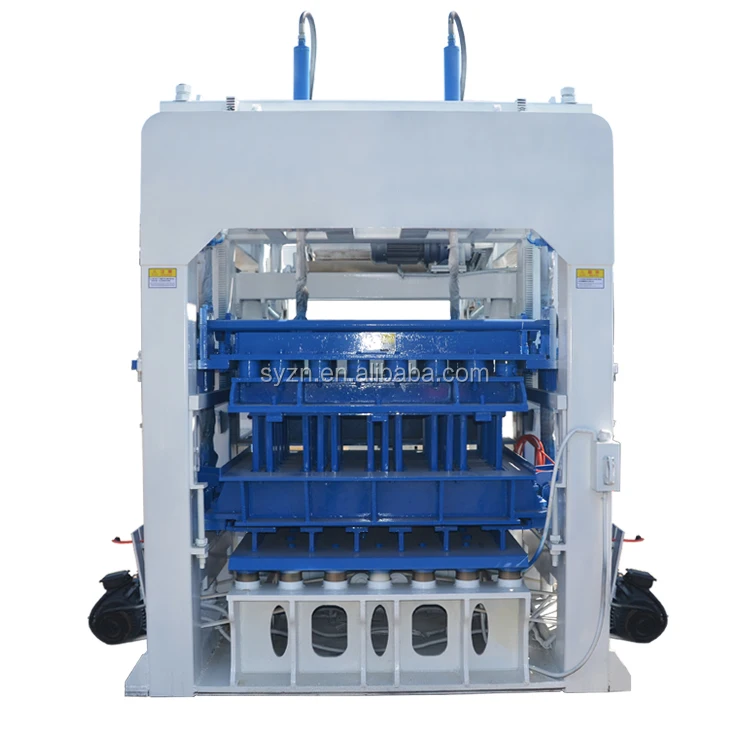
Matched Line Integration — the QT10-15 is quoted as a coordinated system where pallet feed, raw material delivery, press cycle and hydraulic response are timed together so the press is never starved or bottlenecked by an upstream station.
Technical Specifications
| Parameter | Value |
|---|---|
| Product Type | Automatic Hydraulic Block Making Machine |
| Model | QT10-15 |
| Control System | PLC control cabinet |
| Hydraulic System | Independent integrated hydraulic station |
| Vibration Mode | Vertical station mode resonance, automatic FM-AM |
| Mould Change System | Simple mould replacement for multi-format production |
| Automation Level | Automatic |
| Pallet Feed | Pallet feed machine included |
| Raw Material Feed | Storage hopper and conveyor included |
| Assembly State | Complete line with pallet feed, press, hopper, conveyor, hydraulic unit, PLC cabinet |
| Output Capacity (400×200×200 mm hollow block) | 1,800–2,400 pcs/hour (14,400–19,200 pcs/8hr) |
| Output Capacity (400×150×200 mm hollow block) | 2,160–2,880 pcs/hour (17,280–23,040 pcs/8hr) |
| Output Capacity (240×115×53 mm solid brick) | 8,928–11,160 pcs/hour (71,424–89,280 pcs/8hr) |
| Output Capacity (200×100×60 mm paving block) | 5,184–6,480 pcs/hour (41,472–51,840 pcs/8hr) |
| Output Capacity (225×112.5×60 mm paving block) | 4,032–5,040 pcs/hour (32,256–40,320 pcs/8hr) |
| Cycle Time (hollow block) | 15–20 s |
| Cycle Time (paving block) | 20–25 s |
| Moulds per Cycle (400×200×200 mm) | 10 pcs |
| Moulds per Cycle (400×150×200 mm) | 12 pcs |
| Moulds per Cycle (240×115×53 mm) | 62 pcs |
| Moulds per Cycle (200×100×60 mm) | 27 pcs |
| Moulds per Cycle (225×112.5×60 mm) | 24 pcs |
| Warranty | 1 year (excluding spare parts) |
| Rated Power | (basis to be confirmed) |
| Voltage & Frequency | (basis to be confirmed) |
| Pallet Size | (basis to be confirmed) |
| Overall Dimensions | (basis to be confirmed) |
| Net Weight | (basis to be confirmed) |
| Hydraulic Pressure | (basis to be confirmed) |
| Vibration Force | (basis to be confirmed) |
Application Suitability
| Application | Material or Output |
|---|---|
| Hollow block production | Crushed stone, sand, cement and fly ash aggregates for 400×200×200 mm and 400×150×200 mm formats |
| Solid brick production | Fine aggregate and cement mixes for 240×115×53 mm standard bricks |
| Paving block production | Graded aggregate and cement for 200×100×60 mm and 225×112.5×60 mm interlocking pavers |
| Multi-cellular brick production | Lightweight aggregate blends for partition and infill formats |
| On-site housing project production | Local aggregate sourced near construction sites for high-volume block runs |
Why Catalog Capacity Numbers Mislead Block Plant Buyers
A quoted cycle rate means nothing unless the feeding, pressing and pallet return stations can all sustain it simultaneously.
I once watched a QT10-class line sit idle for seconds every cycle because the mixer discharge could not keep pace with the press demand. The automatic block making machine production line was rated for high throughput, but the raw material station had been specified for a different aggregate density. The buyer had paid for capacity the rest of the line could not deliver [NEED_CITE: block line station synchronization standards]. When the entire system is not quoted as one matched set, the weakest station defines the real output.
How Station Synchronization Prevents Press Starvation
The QT10-15 automatic block making machine production line connects the storage hopper, conveyor, pallet feed machine and press under a single PLC control cabinet. Each station receives timed signals so material arrives at the mould cavity and a fresh pallet is in position before the press completes its current cycle. This coordination removes the micro-delays that accumulate across an eight-hour shift and quietly erode daily output.
What the Independent Hydraulic Station Actually Protects
The hydraulic station on this line is physically isolated from the press frame and vibration table. In block plants where the press runs fifteen to twenty second cycles continuously, vibration fatigue and dust infiltration are the primary causes of hydraulic seal failure. Mounting the integrated hydraulic station away from the vibration source keeps oil cleanliness and seal life within design tolerances across long production runs [NEED_CITE: hydraulic system isolation in vibrating machinery].
Reading the Capacity Table Without Being Misled
The output figures for this automatic block making machine production line are stated per block format with corresponding mould counts and cycle times. A hollow block at 400×200×200 mm runs 10 pieces per cycle in 15 to 20 seconds, while a 240×115×53 mm solid brick runs 62 pieces per cycle in the same window. The difference in hourly output between formats is substantial, which is why a capacity discussion must begin with the specific block the buyer intends to produce. Vibration mode switches automatically between FM and AM depending on the mould installed, adapting resonance to the cavity geometry rather than forcing every format through a single vibration profile.
The Cost of Treating the Press as a Standalone Purchase
Buyers who spec the press alone and source pallets, feeders and stackers separately often discover that pallet dimensions do not match the curing rack spacing or the forklift already on site. Pallets arrive in the wrong size, the feed machine jams at the transfer point, and the curing area cannot accept the output arrangement [NEED_CITE: pallet sizing and curing area compatibility]. These mismatches are not visible in a press-only quotation but become expensive once the line is running.
Why the Line Approach Works for This Machine Class
The QT10-15 is configured against the buyer’s actual mix design and target block format rather than a catalogue default. The raw material feed station is sized for the specific aggregate density and moisture content the plant will use, not a generic test material. Mould design covers the formats the buyer’s market actually sells, including custom drawings where standard moulds do not match local building codes. The automation level is selectable — a buyer can start with semi-automatic pallet handling and upgrade the stacking and cubing stations later without replacing the press. Factory testing runs the complete line as an integrated system before dismantling for shipment, so station timing is verified under load rather than assumed.
Documentation & Verification
- Line layout drawing showing station spacing and pallet flow path for your chosen block format
- Capacity calculation sheet stating output per block format with cycle time assumptions
- Hydraulic and electrical schematic confirming voltage, frequency and PLC display language
- Factory test record documenting full line run with your specified mould and pallet size
- Mould drawing and format list matching your target product range
- Packing photographs verifying all line stations ship complete before container loading
Installation, Commissioning & Support
- Foundation plan detailing load points for the press, hopper and pallet feed machine based on QT10-15 weight distribution
- Dedicated electrical circuit spec confirming voltage and frequency before the PLC cabinet is wired
- On-site assembly sequence starting with the press frame, then connecting conveyor and pallet return stations
- First-run commissioning with your local aggregate to verify cycle time and block density across all formats
- Operator training covering PLC navigation, mould change procedure and daily hydraulic station inspection
- Wear parts list for hydraulic seals, vibration springs and mould liners with recommended replacement intervals
What We Need to Configure Your Line
Share the block formats your market demands, the local aggregate type and gradation you plan to use, and your target daily output per format. We also need your existing pallet dimensions and curing rack layout, plus the voltage and frequency at your site so the PLC cabinet and hydraulic station are wired correctly before dispatch.
Frequently Asked Questions
Q: How is the line capacity calculated, and which block format does each output figure assume?
A: Every output figure for the QT10-15 is tied to a specific block format, mould count per cycle and cycle time range. For example, 400×200×200 mm hollow blocks run 10 pieces per cycle at 15–20 seconds. We provide a capacity calculation sheet that states the assumed format so you can compare quoted throughput against your actual product mix.
Q: How do the feeding, pressing and pallet handling stations synchronize to avoid the press waiting?
A: The PLC control cabinet sends timed signals to the storage hopper conveyor and pallet feed machine so material and pallets arrive before the press completes its current cycle. This coordinated timing is verified during factory testing with the full line running under load, not just the press in isolation.
Q: What voltage, frequency and PLC language options are confirmed before shipment?
A: Voltage, frequency and PLC display language are confirmed during the quotation stage and documented on the electrical schematic. The PLC cabinet is wired and labelled to your site specification before the factory test, so no rewiring or reprogramming is needed after arrival.
Q: Which supporting stations are included in the line quotation and which are optional?
A: The standard QT10-15 line includes the press, pallet feed machine, storage hopper, conveyor, independent hydraulic station and PLC cabinet. Automatic stacking, curing rack handling and cubing stations can be added based on your automation level preference and confirmed during the configuration proposal.
Q: What is the installation sequence and how are line stations commissioned together on site?
A: Installation begins with the press frame and hydraulic station, followed by conveyor and pallet feed alignment. Commissioning runs the complete line with your local aggregate and target mould to verify cycle times, block density and station synchronization under actual production conditions.