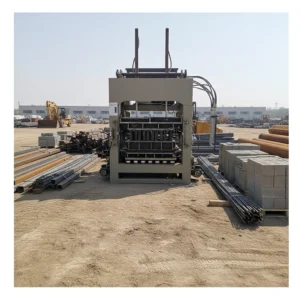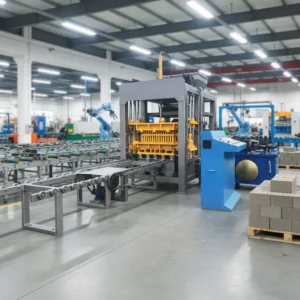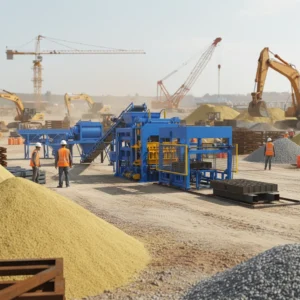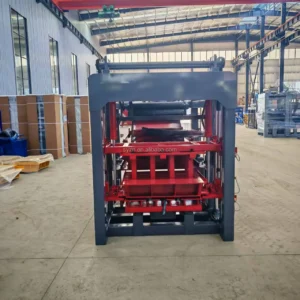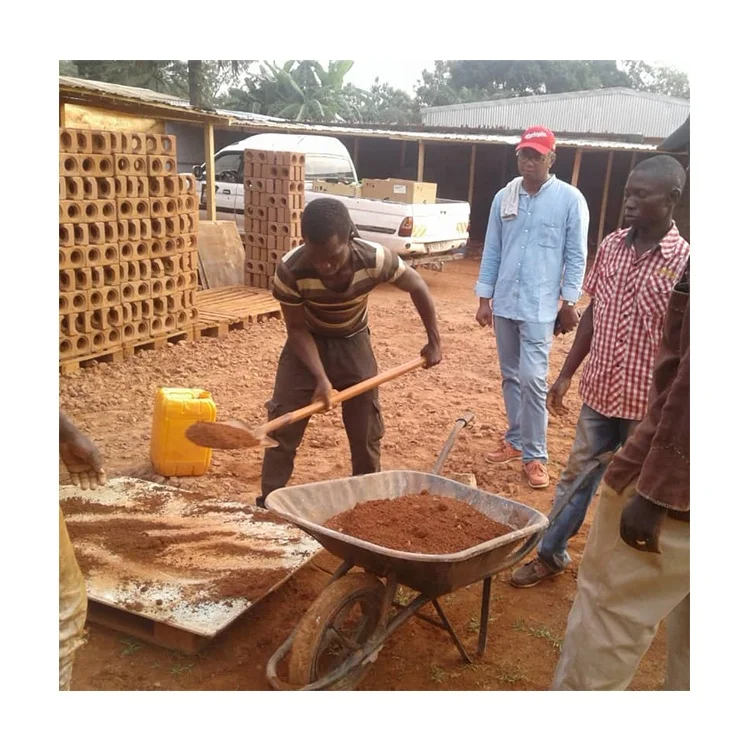
Matched Line Flow — Every station from raw material mixing to curing rack handling is sized against the LY2-10 press cycle so the machine runs without waiting for upstream feed or downstream pallet clearance.
Technical Specifications
| Parameter | Value |
|---|---|
| Model | LY2-10 |
| Product Type | Clay Interlocking Brick Making Machine |
| Machine Power | 7.5 kW |
| Molding Cycle | 10 s |
| Capacity | 6,000 pcs / 8 h (basis not stated in source — confirm block format, material and thickness) |
| Bricks per Mould | 2 (source inconsistency noted — verify against mould drawing) |
| Raw Material Compatibility | Clay, soil, earth, mud, concrete, cement, fly ash |
| Automation Level | Semi-automatic |
| Overall Dimensions | 1,300 × 1,800 × 2,400 mm |
| Key Features | Interlocking brick formats, semi-automatic pallet handling, multi-material compatibility |
Application Suitability
| Application | Material or Output |
|---|---|
| Small to medium interlocking brick plants | Clay and soil blended with cement or lime binder |
| On-site housing project production | Local earth and mud with stabilizer additive |
| Existing block producers adding interlocking format | Fly ash or concrete mix adapted to current batching setup |
| Rural infrastructure block supply | Soil-cement blends sourced from project excavation material |
Why the Mixer Often Becomes the Real Bottleneck in a Clay Interlocking Brick Making Machine Production Line
The press sets the tempo, but the mixer decides whether that tempo is sustained across an eight-hour shift.
A clay interlocking brick making machine production line rated at a ten-second cycle means the press expects a fresh batch of prepared material every ten seconds. In practice, many buyers discover that their mixer cannot keep pace with this rhythm, especially when working with heavy clay that requires longer blending time. The press then sits idle, and the quoted daily output drops noticeably. I have walked onto sites in Latin America where the press operator was simply waiting for the next batch, and the line was producing well below what the cycle time suggested [NEED_CITE: typical mixer-to-press throughput mismatch in small brick lines].
Matching Upstream Feed to a Ten-Second Press Cycle
The clay interlocking brick making machine production line built around the LY2-10 demands a mixer that can deliver a homogeneous batch within the molding window. A pan mixer or twin-shaft mixer sized to the press volume ensures that clay, soil and binder are blended thoroughly before each cycle call. When the mixer undershoots on capacity, the press operator compensates by shortening the mix time, which leads to uneven material consistency and variable brick density across the shift.
Downstream Pallet Flow and Curing Coordination
On the output side, semi-automatic operation means pallets are handled manually between the press and the curing area. The curing rack layout must match the daily output volume so that freshly pressed bricks move off the pallet line before the next cycle completes. If the curing area is undersized or the pallet return loop is too long, the press again waits — this time for an empty pallet. Planning pallet quantity, curing rack spacing and forklift route as part of the line scope prevents this downstream choke point [NEED_CITE: pallet circulation requirements for semi-automatic block lines].
Reading the Specifications Beyond the Cycle Time
The 7.5 kW motor rating indicates the press is designed for moderate compaction force, which suits clay and soil-cement mixes rather than dense concrete aggregates. The ten-second molding cycle is achievable when the material is pre-mixed to the correct moisture content and fed consistently. Overall dimensions of 1,300 × 1,800 × 2,400 mm place the LY2-10 within a compact footprint, meaning the line can be arranged in a single-bay workshop without requiring a dedicated plant building. Semi-automatic configuration keeps initial investment contained while leaving room to add automatic stacking and pallet feeding as production volume grows.
What Happens When Line Stations Are Specified Separately
Buyers who source the press, mixer, pallet system and curing racks from different suppliers often find that the interfaces do not align. Pallet dimensions may not match the press table, the mixer discharge height may not reach the feed hopper, and the curing rack spacing may be incompatible with the pallet size in use. These mismatches surface only during commissioning, when rework is costly and the project timeline is already under pressure [NEED_CITE: equipment interface mismatches in multi-supplier block lines].
Why the Line Approach Works Here
The LY2-10 is specified as part of a coordinated system rather than a standalone press. Raw material feeding, mixing, pallet handling and curing rack layout are sized against the same cycle assumption, so each station keeps pace with the press. Mould options for different interlocking brick formats are matched to the press tonnage and cycle capability. Voltage, frequency and control language are confirmed before production begins, avoiding commissioning delays at the site. The semi-automatic starting point allows buyers to add automatic pallet feeding and stacking later without replacing the press itself.
Documentation & Verification
- Line layout drawing showing station spacing and material flow for the LY2-10 configuration
- Capacity calculation stating the brick format, mix design and moisture content assumed
- Pallet specification matched to curing rack dimensions and forklift capacity at site
- Voltage, frequency and control language confirmation sheet signed before dispatch
- Factory test record on buyer-specified clay or soil mix before shipment
Installation, Commissioning & Support
- Foundation plan based on 1,300 × 1,800 mm footprint and 7.5 kW power draw
- Dedicated circuit specification for 7.5 kW motor with correct voltage and frequency
- Mixer and feed hopper positioned to match LY2-10 charge height and cycle timing
- First-run parameter setting on buyer’s local clay or soil sample at site
- Operator training covering mould change, pallet handling and daily maintenance routines
- Wear parts list with mould and hydraulic seal reorder references for ongoing supply
What to Include in Your Inquiry
To size the clay interlocking brick making machine production line correctly, share your target brick format and the daily volume you need to sustain. Provide a sample or description of your local clay or soil type along with the binder you plan to use. Confirm your site voltage, frequency and preferred control display language so that electrical and control systems are built to match before the line leaves the factory.
Frequently Asked Questions
Q: How is the 6,000 pcs/8h capacity verified and which block format does it assume?
A: The stated capacity is listed without specifying the brick format, material mix or thickness used during testing. Before confirming the line layout, we run a capacity calculation based on your target interlocking brick size and local material to establish a realistic daily output figure tied to actual production conditions.
Q: Which upstream mixer and material feeder are matched to the LY2-10 cycle time?
A: The mixer is selected to deliver a full batch within the ten-second press cycle, accounting for your specific clay moisture content and binder ratio. The feeder is sized to keep the mixer charged continuously so that neither station becomes the bottleneck during sustained production.
Q: Is pallet feeding, stacking and curing rack handling included or quoted separately?
A: The line scope covers pallet specification, curing rack layout and material flow coordination as part of the matched system. Pallet quantity and curing rack configuration are confirmed against your available curing area and existing forklift capacity before the quotation is finalized.
Q: What voltage, frequency and control display language are confirmed before dispatch?
A: These parameters are confirmed during the quotation stage and documented on a signed specification sheet. The electrical system and control interface are built to your site requirements so that commissioning proceeds without rewiring or reprogramming delays.
Q: Can the line start semi-automatic and add automatic stacking later?
A: The LY2-10 semi-automatic configuration is designed with an upgrade path. Automatic pallet feeding and stacking modules can be added to the existing line layout when production volume justifies the investment, without requiring a press replacement or major foundation modification.