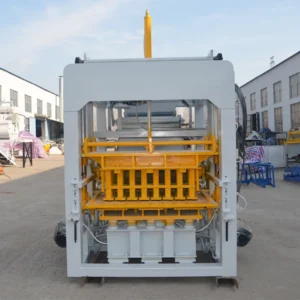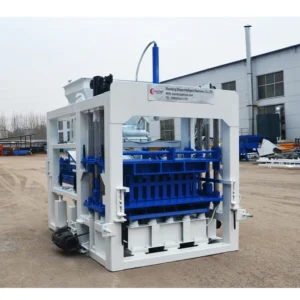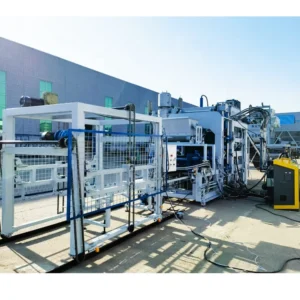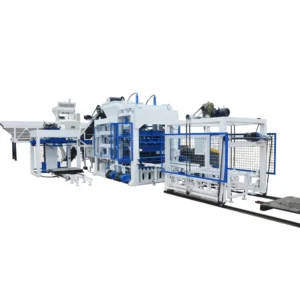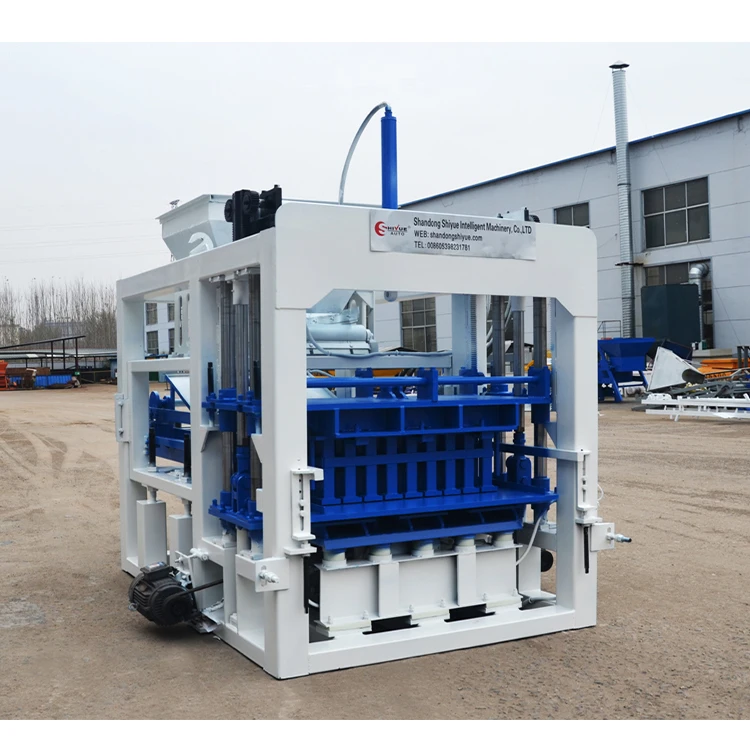
Matched Line Configuration — every station from raw material feeding to curing rack handling is timed against the QT5-15 press cycle so no bottleneck shifts the daily output.
Technical Specifications
| Parameter | Value |
|---|---|
| Model | QT5-15 |
| Product Type | Cement Interlocking Brick Making Machine |
| Overall Dimensions (L×W×H) | 7400×1950×2800 mm |
| Vibration Frequency | 0-60 Hz |
| Vibration Form | Platform Vibration |
| Vibration Force | 80 kN |
| Moulding Mode | Automatic loading, vibration moulding |
| Pallet Size | 1100×550 mm |
| Molding Cycle | 15-20 s (hollow block / solid brick); 20-25 s (paving brick) |
| Overall Power | 32 kW |
| Total Mass | 5000 kg |
| Demolding Method | Hydraulic |
| Factory Area Required | 1000 m² |
| Control System | PLC with touch screen interface |
| Voltage & Frequency | Configurable to target market standard (basis to be confirmed) |
| Hydraulic System | Independent integrated hydraulic station |
| Block Compressive Strength | >15 MPa |
| Raw Material Compatibility | Fly ash (up to 70%), slag, gangue, sand, crushed stone, cement, water |
| Output — Hollow Block 400×200×200 mm | 900-1200 pcs/h, 7200-9600 pcs/8hr (basis: 5 pcs/mould, 15-20s cycle) |
| Output — Hollow Block 400×150×200 mm | 1080-1440 pcs/h, 8640-11520 pcs/8hr (basis: 6 pcs/mould, 15-20s cycle) |
| Output — Solid Brick 240×115×53 mm | 5760-7680 pcs/h, 46080-61440 pcs/8hr (basis: 32 pcs/mould, 15-20s cycle) |
| Output — Rectangular Paving Brick 200×100×60 mm | 3600-4500 pcs/h, 28800-36000 pcs/8hr (basis: 25 pcs/mould, 20-25s cycle) |
| Output — Zigzag Paving Brick 225×112.5×60 mm | 2304-2880 pcs/h, 18432-23040 pcs/8hr (basis: 16 pcs/mould, 20-25s cycle) |
| Mould Format Options | Hollow block, solid brick, rectangular paving brick, zigzag interlocking paving brick |
| Automation Level | Automatic (PLC-controlled pallet feeding, material feeding, vibrating, demoulding) |
| Warranty | 1 year (whole machine, excluding spare parts) |
Application Suitability
| Application | Material or Output |
|---|---|
| Block production plants | Hollow blocks and solid bricks from fly ash, slag, sand, crushed stone and cement |
| Construction contractors producing on-site | Interlocking pavers and hollow blocks using locally available aggregate |
| Concrete product manufacturers expanding formats | Rectangular and zigzag paving bricks alongside standard block lines |
| Housing and development project contractors | High-volume solid brick and hollow block output from site-batched raw materials |
What "9600 Blocks per Shift" Leaves Out of the Conversation
A headline capacity number means nothing when the pallet return loop and stacking station are not part of the same quotation.
I have watched plants in the Middle East receive a press rated for a respectable cycle time, only to discover the supplier quoted the host machine alone. Wet blocks sat on pallets at the end of the conveyor while workers scrambled to carry them to the curing yard by hand. The press kept cycling, but the real daily output dropped to a fraction of the brochure figure. That gap between quoted capacity and actual tonnage is almost always a line integration problem, not a press problem [NEED_CITE: common causes of block plant output shortfall in project commissioning reports]. When planning an automatic block machine production line, the conversation must start with the slowest station, not the fastest.
Synchronising Upstream Batching with the Press Cycle
The QT5-15 completes a moulding cycle in 15-20 seconds for hollow blocks and solid bricks, extending to 20-25 seconds for paving formats. The upstream mixer must discharge a fresh batch within that same window, or the press sits idle waiting for material. On a matched automatic block machine production line, the batching plant capacity, mixer volume, and belt conveyor speed are all calculated backward from the press cycle, not selected from a catalogue default.
Pallet Flow as the Hidden Bottleneck
Each cycle consumes one 1100×550 mm pallet. Over an eight-hour shift producing hollow blocks, that translates to several thousand pallet movements through the press, the wet-block transfer station, and the curing rack. If the pallet return conveyor cannot keep pace, the press halts. Specifying the pallet circulation loop — including rack capacity, forklift route, and curing area footprint — before finalising the press order is the difference between a line that runs and one that stalls every twenty minutes.
Reading the Specification Sheet with a Line Builder’s Eye
The 80 kN vibration force and 0-60 Hz variable frequency on the QT5-15 platform determine how densely the mix is compacted inside the mould. Denser compaction yields higher block compressive strength — listed here above 15 MPa — but only when the mix design and local aggregate are matched to that force range. The independent integrated hydraulic station sits apart from the vibration zone, protecting seals and valves from the dust and shock that degrade block press hydraulics over time. An 1100×550 mm pallet size must align with the curing racks and forklift tines already on site; ordering a press without confirming that alignment leads to pallets stacked on the ground and a curing area that cannot absorb the output. The 32 kW total power draw requires a dedicated circuit with the correct voltage and frequency — details that must be confirmed in writing before the machine enters production [NEED_CITE: voltage and frequency standards by export market].
The Cost of a Line That Was Never a Line
When supporting equipment is left out of the quotation, the buyer sources mixers, pallet feeders, and stackers separately. Those components arrive with different control logic, different cycle assumptions, and no single supplier responsible for the gaps between them. Commissioning stretches from days into weeks. Spare parts lists do not cross-reference. The result is an automatic block machine production line in name only — a collection of standalone machines that each work fine on their own but cannot hold a steady rhythm together [NEED_CITE: integration challenges in multi-supplier block plant projects].
Why This Line Is Specified as One System
Block machinery is the single focus here, so the QT5-15 press, its moulds, pallets, and handling equipment are specified together rather than assembled from separate vendors. The configuration is set against the buyer’s actual mix design and target block format, not a catalogue default. Mould design covers the formats the buyer’s market actually sells, including custom drawings when standard formats do not match local demand. The automation level is selectable, allowing a buyer to start with the automatic press and pallet feed, then add stacking and cubing later. Installation support includes operator training on the PLC sequence so the crew understands the timing logic, not just the buttons.
Documentation & Verification
- Line layout drawing with capacity calculation stated per block format, not a single blanket number
- Machine specification sheet covering vibration force, pallet size, and hydraulic station ratings
- Mould drawing and format list for every block type included in the order
- Pallet specification matched to curing area dimensions and forklift capacity on site
- Voltage, frequency, and PLC display language confirmed in writing before production
- Factory test record on the buyer’s target block format before dispatch
Installation, Commissioning & Support
- Foundation plan sized to the 7400×1950 mm machine footprint and 5000 kg mass
- Dedicated power circuit for the 32 kW total load at confirmed voltage and frequency
- Dismantling and reassembly sequence documented for container shipment and site erection
- PLC touch screen commissioning with cycle timing verified against each mould format
- Operator training on the automatic pallet feed, vibration, and hydraulic demoulding sequence
- Wear parts and mould list supplied with recommended replacement intervals
What to Prepare Before Requesting a Quote
To size the supporting stations around the QT5-15, share the target block formats and the daily output you need for each one, along with the raw materials you can source locally and their proportions. Confirm the voltage and frequency at your site, the PLC language your operators read, and the dimensions of the curing area you plan to use. If you already have pallets, mixers, or forklifts in place, send their specifications so the line layout accounts for what is already there.
Frequently Asked Questions
Q: How is the line capacity calculated per block format, and which format does the headline figure assume?
A: Every output figure is tied to a specific block dimension, mould cavity count, and cycle time. For example, 7200-9600 pieces per eight-hour shift applies to 400×200×200 mm hollow blocks at five pieces per mould and a 15-20 second cycle. The quotation lists capacity per format so you can compare against your actual product mix, not a single optimistic number.
Q: Which supporting stations are included in the quotation and which are buyer-supplied?
A: The proposal itemises raw material feeding, mixing, pallet feeding, stacking, and curing rack handling as separate line items. Each station is included or clearly marked as buyer-supplied, so nothing is missing when commissioning starts. This prevents the common situation where the press arrives but the pallet return loop does not.
Q: How do pallet size and material affect the curing area layout and the forklift I already have?
A: The 1100×550 mm pallet must fit your existing curing rack slots and match your forklift tine spacing. If your racks are sized for a different pallet, wet blocks cannot be stored efficiently, and output piles up on the factory floor. Pallet material — wood, bamboo, or composite — also affects weight and lifespan, which changes how many pallets you need in circulation.
Q: What voltage, frequency, and PLC language options are available, and how are they confirmed?
A: The electrical system is configurable to the target market standard. Voltage, frequency, and PLC display language are confirmed in writing before the machine enters production. This avoids the situation where a press arrives with a 380 V motor in a 440 V market or a control screen in a language the operators cannot read.
Q: How does the press cycle time align with upstream mixer output and downstream stacking speed?
A: The 15-25 second moulding cycle sets the pace for the entire automatic block machine production line. The mixer must discharge a full batch within that window, and the stacker must clear cured pallets fast enough to keep the return loop moving. Each station is specified against that cycle so no single point creates a backlog during a full shift.