
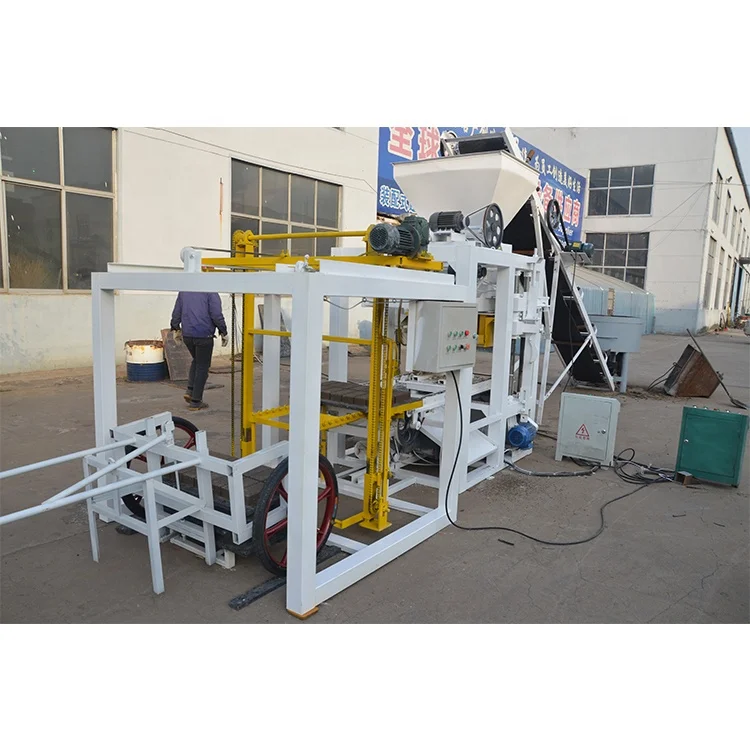
Integrated Line Matching — The QTJ4-24 block making machine production line is specified with upstream mixer discharge and downstream pallet handling timed to its 24–26s molding cycle, so no station sits idle.
Technical Specifications
| Parameter | Value |
|---|---|
| Model | QTJ4-24 |
| Product Type | Semi-Automatic Concrete Block Making Machine |
| Overall Dimensions (L×W×H) | 3600×1700×2560mm |
| Pallet Size | 850×450mm |
| Molding Cycle | 24–26s |
| Overall Power | 11.95kW |
| Vibration Force | 45kN (2×3kW lower + 2×1.5kW upper vibrators) |
| Total Mass | 2T |
| Molding Method | Mechanical |
| Raw Materials | Cement, sand, stone aggregates |
| Automation Level | Semi-automatic with spiral material distribution |
| Reducer | 350-type for mold lifting |
| Control System | PLC or manual (basis to be confirmed) |
| Voltage & Frequency | Configurable to site (basis to be confirmed) |
| Mould Format | Hollow, solid, interlocking, paving (basis to be confirmed) |
| Warranty | 1 year for whole machine (excluding spare parts) |
Application Suitability
| Application | Material or Output |
|---|---|
| Hollow block production for residential walls | Cement, sand and crushed stone aggregate |
| Solid block manufacturing for load-bearing structures | Cement and coarse sand mix |
| Interlocking brick forming for paving and landscaping | Cement, fine sand and stone dust |
| Paving block production for walkways and yards | Cement, sand and graded stone |
Why the Pallet Question Decides Your Real Daily Output
If pallet handling is not in the quotation, your quoted cycle rate is fiction.
I have stood on sites across East Africa where a block making machine production line was rated at a certain cycle speed, but the buyer never received a pallet feeder or stacking station. Workers pulled pallets by hand, carried them to a curing yard fifty metres away, and the press spent half its shift waiting. The 24–26s cycle became irrelevant because the downstream rhythm was broken [NEED_CITE: common causes of block plant downtime in developing markets]. Before you sign anything, confirm which stations sit before and after the press, and whether their timing matches.
Matching Upstream Mixing to the Press Cycle
A stationary block machine turnkey setup only works when the mixer discharges at a rate the QTJ4-24 can absorb. The spiral material distribution on this press feeds uniformly across the mold cavity, but it still depends on a steady supply from the mixer. If the mixer batch is too slow, the press idles. If the batch is too fast, material sits and begins to set before pressing. We calculate the mixer batch size and discharge interval against the 24–26s molding cycle and the specific block format you are running, so both stations keep the same beat.
Downstream Pallet Flow and Curing Area Alignment
The 850×450mm pallet size on this machine is not arbitrary. It must match the curing rack dimensions and the forklift tines already in your yard. We have seen plants where the pallet size was chosen from a catalogue default, and the buyer’s existing forklift could not lift a full rack [NEED_CITE: pallet and forklift compatibility in block plants]. Before we confirm the pallet specification, we check your curing area layout and handling equipment so that freshly pressed blocks move straight to curing without a secondary transfer.
Vibration Force and Block Density Across Formats
The 45kN vibration force comes from four vibrators — two 3kW units below and two 1.5kW units above the mold. Upper and lower vibration together compact the mix from both directions, which matters when you switch between a tall hollow block and a thin paving block. Lower vibration alone tends to leave the top face under-compacted. The mechanical molding method holds this force steady cycle after cycle, so block density stays consistent as long as the mix design and aggregate grading remain within the range the line was configured for.
Reading the Specs That Actually Matter
The 350-type reducer on the mold lifting mechanism is sized for continuous production line duty, not intermittent workshop use. A smaller reducer overheats and wears prematurely when the mold lifts every 24–26 seconds across a full shift. The 11.95kW overall power draw tells your electrician what dedicated circuit the press needs — running it on a shared supply with the mixer causes voltage dips that affect vibration consistency. The 2T total mass means the foundation must be a cured concrete pad, not compacted earth, otherwise vibration energy dissipates into the ground instead of compacting the block.
What Happens When Stations Are Not Specified Together
A buyer in South Asia once replaced only the press in an existing line. The new machine had a different pallet size from the old one, so none of the curing racks fit. The pallet feeder jammed because the new pallets were slightly thicker. The line was down for weeks while new pallets were sourced and the feeder was re-adjusted [NEED_CITE: risks of replacing a single station without line audit]. When you replace a press, the pallet size, feeder adjustment, and stacking station all need to be re-verified against the new machine.
Why Specify the Full Line Here
Block machinery is our single focus, so the QTJ4-24 is never quoted as a standalone press. The machine, mold, pallet and handling stations are specified as one matched system. We set the configuration against your actual mix design and local aggregate, not a catalogue default. Molds are designed for the formats your market sells, including custom drawings if your region uses a non-standard block size. The automation level is selectable — you can start with semi-automatic pallet handling and add automatic stacking later. Installation support includes operator training on the complete line, not just the press.
Documentation & Verification
- Line layout with capacity calculation stating the assumed block format per output figure
- Pallet specification sheet matched to your curing rack and forklift dimensions
- Hydraulic and electrical schematic for your electrician to integrate into existing line control
- Voltage, frequency and PLC display language confirmation before production begins
- Factory test record on your specified block format before dispatch
- Operation and maintenance manual covering all stations in the line
Installation, Commissioning & Support
- Cured concrete foundation required to support the 2T machine mass and 45kN vibration without energy loss
- Dedicated electrical circuit rated for the 11.95kW total power draw, separate from the mixer supply
- Machine arrives with mold lifting reducer pre-assembled; pallet feeder and stacking stations shipped flat for on-site assembly
- Commissioning includes cycle timing verification between mixer discharge, press, and pallet removal stations
- Operator training covers mold change procedure and spiral material distribution adjustment per block format
- Wear parts list provided with recommended replacement intervals for vibrators and reducer components
What We Need to Size Your Line
Send us the block format you sell most — hollow, solid, interlocking or paving — along with your target daily output and the raw materials available locally. We also need your existing pallet size if you have one, your curing yard dimensions, and the voltage and frequency at your site. With that, we build the block making machine production line layout and match every station to the QTJ4-24 cycle.
Frequently Asked Questions
Q: How is line capacity calculated and which block format is assumed?
A: Every output figure we quote states the block format, dimensions, and mix it assumes. A 400×200×200mm hollow block and a 200×100×60mm paving block have very different cycle counts per hour. We calculate daily capacity from the 24–26s molding cycle, the number of cavities per mold for your chosen format, and realistic shift hours with pallet handling time included.
Q: How do upstream and downstream cycle times match the press?
A: The mixer batch size and discharge interval are set so that a fresh mix arrives at the spiral feeder just as the previous cycle completes. Downstream, the pallet removal rate is matched to the same 24–26s beat. If any station is slower, the press waits and your actual output drops below the calculated figure.
Q: What pallet size is specified and why does it matter?
A: The standard pallet for this machine is 850×450mm, but we confirm this against your curing rack spacing and forklift tine width before finalizing. A mismatch means you either cannot stack pallets on your existing racks or need to buy a new forklift — both are avoidable if caught during line planning.
Q: Which supporting stations are included in the quotation?
A: Our standard line quotation covers the mixer, pallet feeder, the QTJ4-24 press, and basic stacking equipment. Automatic stacking and cubing are optional upgrades. We make clear which stations are included and which are optional so there are no surprises when the line is assembled on site.


