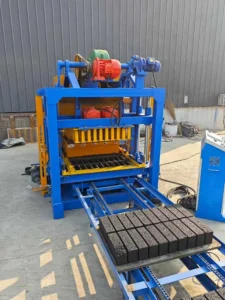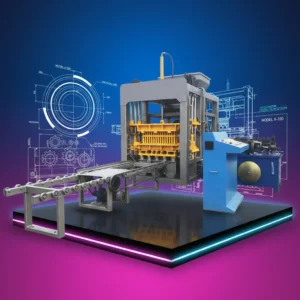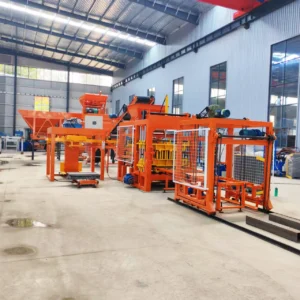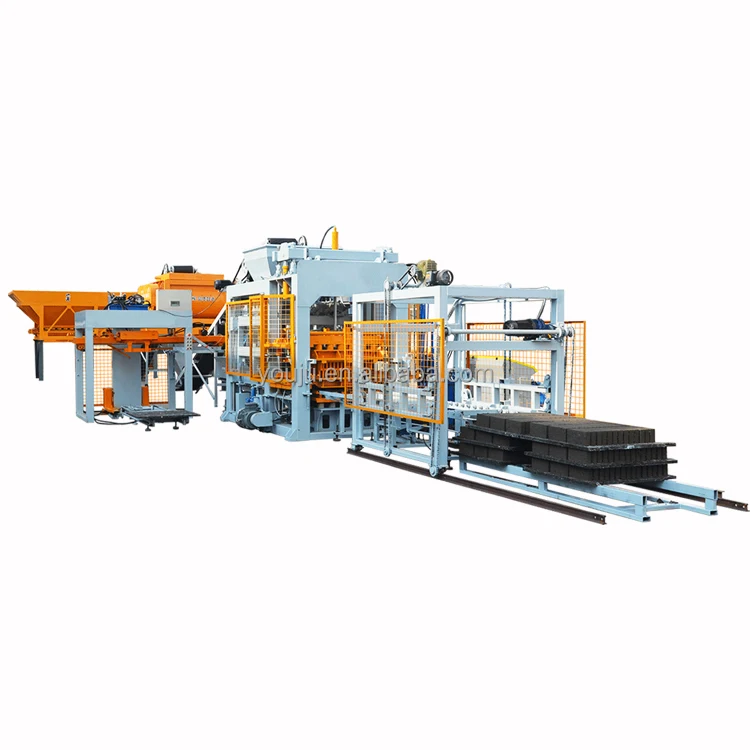
Matched System Design — Every station from raw material batching through stacking is specified around the QT8-15 press cycle, preventing upstream bottlenecks that leave the molding unit idle.
Technical Specifications
| Parameter | Value |
|---|---|
| Model | QT8-15 |
| Product Type | Fully Automatic Interlocking Concrete Block Making Machine |
| Control System | PLC (Programmable Controller) with touch screen HMI |
| Overall Dimensions (L×W×H) | 8300 x 1860 x 3000 mm |
| Vibration Form | Platform Vibration |
| Vibration Frequency | 2800–4500 RPM |
| Rated Power | 37 kW |
| Pallet Size | 950 x 900 mm |
| Molding Cycle | 15–25 s (20–25 s with color feeder) |
| Brick Height Range | 50–200 mm |
| Hydraulic System | Independent integrated hydraulic station |
| Output Capacity | 1912 pcs/hr based on 400×200×200 mm hollow block, 8 pcs/mold |
| Output Capacity | 4320 pcs/hr based on 240×115×90 mm standard block, 18 pcs/mold |
| Output Capacity | 4625 pcs/hr based on 200×100×60 mm paving block, 28 pcs/mold |
| Block Strength | Comprehensive strength up to 15 MPa |
| Automation Level | Fully Automatic |
Application Suitability
| Application | Material or Output |
|---|---|
| Hollow block production for building walls | Fly ash, slag, river sand, gravel, and cement |
| Paving block manufacturing for municipal projects | Crushed stone and cement with color face layer |
| Kerbstone and slope-protecting block molding | Industrial waste aggregates blended with cement |
| Interlocking brick production for housing projects | Local sand and gravel with cement binder |
| Porous and grass block production for landscaping | Permeable aggregate mixes with cement |
Why the Mixer Matters More Than the Press Itself
A block machine without a correctly sized mixer and batching system produces below its rated cycle capacity every single shift.
I have seen this exact scenario play out on multiple sites across West Africa and South Asia. A contractor purchases a high-output automatic block making machine production line, ships it to site, and then watches the operator stand idle because the upstream mixer cannot deliver fresh concrete fast enough to match the press cycle. The rated output on paper assumes continuous material supply; the actual daily throughput drops noticeably when stations are not synchronized [NEED_CITE: synchronization of concrete batching and block press cycle times]. This is not a machine defect — it is a line configuration gap that could have been resolved before shipment.
Raw Material Feeding and Batching Alignment
The QT8-15 operates on a 15 to 25-second molding cycle, meaning the batching machine and mixer must deliver a consistent batch within that window. When the automatic block making machine production line includes a correctly sized batching unit and mixer, the storage hopper above the press remains charged, and the cycle proceeds without pause. The independent integrated hydraulic station is isolated from dust and vibration generated at the mixing station, preserving hydraulic reliability over extended production runs.
Pallet Flow and Downstream Handling
After pressing, wet blocks on 950 x 900 mm pallets must move to the curing area without delay. The pallet feed machine and conveyor in this line are configured to match the press discharge rate so pallets do not queue at the press exit. If the curing area and forklift on site are not compatible with the selected pallet dimensions, blocks pile up on the floor and get damaged before they ever reach the curing rack [NEED_CITE: pallet handling logistics in concrete block plants]. This downstream mismatch is one of the most common reasons a block plant underperforms against its rated capacity.
How Vibration and Pressure Interact at the Press
The platform vibration system operates between 2800 and 4500 RPM, working together with the hydraulic system to compact the concrete mix into the mold. Higher vibration frequency improves consolidation for fine aggregate mixes, while lower frequencies suit coarser materials. The PLC touch screen HMI allows the operator to adjust cycle parameters, but these settings only deliver consistent block strength when the raw material feed composition remains stable batch after batch. If the local aggregate grading shifts without a corresponding adjustment to vibration duration or pressure, block density and compressive strength will vary across the production run.
The Hidden Cost of Underspecifying the Line
When a buyer orders only the press without confirming the supporting equipment, several problems emerge after commissioning. The mixer may be too small to keep up, forcing the press operator to run at half speed. Pallet handling done manually adds labor and slows discharge. The curing rack layout may not accommodate the pallet size, requiring a forklift change or curing area redesign. Each of these issues costs time and money on site — costs that a complete line specification at the quotation stage would have avoided entirely [NEED_CITE: total installed cost versus press-only quotation in block machinery].
Why Procurement Should Cover the Entire Line
This line is specified as one matched system: the batching machine, mixer, conveyor, pallet feed, press, and stacking equipment are selected so their individual cycle times align with the QT8-15 molding rate. Configuration starts from the buyer’s local aggregate and mix design, not a catalogue default, so the vibration and pressure settings match the material actually available on site. Mould options cover hollow block, standard block, paving block, and kerbstone formats, with custom mould design available for formats the local market demands. Pallet size is confirmed against the buyer’s existing curing area and forklift capacity before production begins. Voltage, frequency, and PLC display language are verified during the quotation phase to prevent commissioning delays once the equipment arrives [NEED_CITE: pre-shipment electrical verification for exported industrial machinery].
Documentation & Verification
- Line layout drawing with capacity calculation per block format
- Machine specification sheet with hydraulic and electrical schematics
- Mould drawing and format list for all ordered block types
- Pallet specification matched to curing area and forklift
- Voltage and control language confirmation record before production
- Factory test record on buyer’s block format before dispatch
Installation, Commissioning & Support
- Foundation plan based on 8300 x 1860 mm footprint and dynamic vibration loads
- Dedicated power circuit for 37 kW rated load with confirmed voltage and frequency
- Hydraulic station filled and bled on site before first press cycle
- PLC touch screen language set and cycle parameters loaded per block format
- Operator training on mould change procedure and vibration frequency adjustment
- Wear parts list covering hydraulic seals and vibration platform components
Before You Request a Quote
To configure the automatic block making machine production line around your actual site conditions, share your target block formats and daily output requirement, the local raw materials available including aggregate type and grading, and your existing curing area dimensions and forklift capacity. If you have a specific voltage supply and preferred PLC display language, include those details so the electrical and control package is confirmed before production starts.
Frequently Asked Questions
Q: How do line stations synchronize so the press cycle time is not bottlenecked?
A: Each station — batching, mixing, pallet feeding, pressing, and stacking — is timed against the QT8-15 molding cycle of 15 to 25 seconds. The mixer output rate and conveyor speed are selected so the storage hopper stays charged, and the pallet feed machine delivers empty pallets at the press discharge rate, preventing idle time between cycles.
Q: Is the mixer, batching machine, and stacker included in the quotation?
A: Yes, when ordered as a complete line. The quotation covers raw material feeding, mixing, pallet handling, the press itself, and stacking equipment. Each component is sized to match the press throughput so no single station limits the overall output of the production line.
Q: How is pallet size chosen relative to existing curing infrastructure?
A: The 950 x 900 mm pallet dimension is confirmed against your curing rack spacing and forklift fork width before production. If your existing curing area uses a different pallet size, the line configuration adjusts accordingly so blocks move from press to curing without requiring new handling equipment on site.
Q: Can automation be scaled from semi-automatic to full stacking later?
A: The line supports phased automation. A buyer can start with manual pallet handling and add automatic stacking and cubing equipment later. The PLC control system accommodates both configurations, and the upgrade involves adding hardware modules rather than replacing the existing control cabinet.
Q: What electrical confirmation happens before shipment?
A: Voltage, frequency, and PLC display language are confirmed during the quotation phase and documented before production begins. The factory test includes a powered run with the buyer’s specified electrical parameters, and the confirmation record is included in the shipping documentation to prevent commissioning delays.