
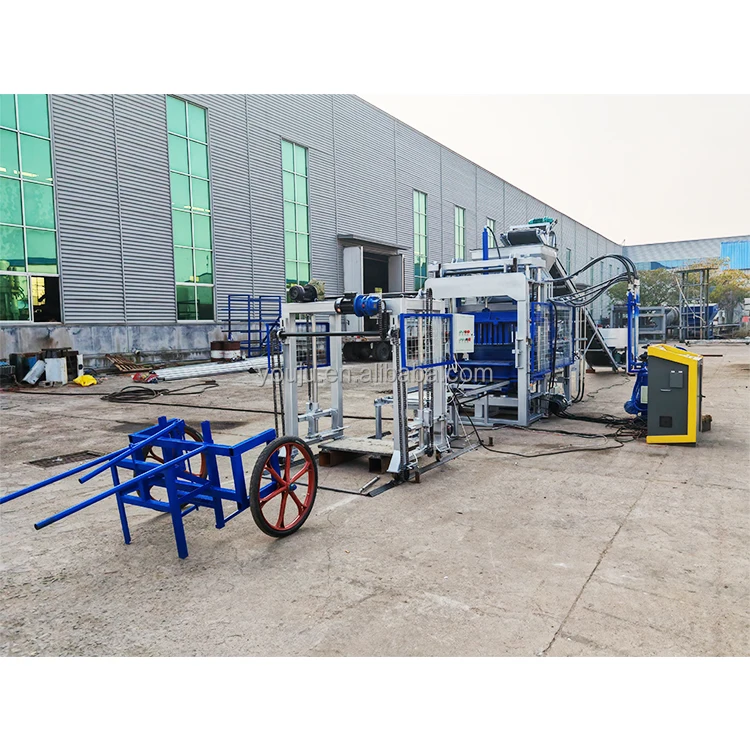
Line Synchronization Expertise — The QT4-15 hydraulic block machine is configured as the central press station within a balanced block production line, where each upstream and downstream station must align to its 15-20 second molding cycle for consistent daily output.
Technical Specifications
| Parameter | Value |
|---|---|
| Model | QT4-15 |
| Product Type | Hydraulic Block Making Machine |
| Molding Cycle | 15-30s (basis not stated in source — confirm block format / material / thickness) |
| Pallet Size | 900×500mm |
| Vibration Type | Platform vibration |
| Vibration Frequency | 50-70Hz |
| Product Height Range | 50-220mm |
| Overall Power | 24.5kW (rated or peak not specified) |
| Demolding Method | Hydraulic pressure demolding |
| Control System | PLC controlled |
| Hydraulic System | Integrated hydraulic pressure demolding |
| Compressive Strength of Blocks | More than 15 MPa |
| Automation Level | Automatic (machinery, electric, hydraulic and vibrating system coordinated) |
| Mould Format Capability | Hollow block, paver brick, solid brick (via mould change) |
| Assembly State | Fully assembled |
| Raw Material Compatibility | Fly ash, slag, gangue, sand, water, crushed stone, cement |
| Output Capacity (400×200×200mm hollow block, 4 pcs/mould) | 900-1200 pcs/h at 15-20s cycle |
| Output Capacity (400×150×200mm hollow block, 5 pcs/mould) | 1080-1440 pcs/h at 15-20s cycle |
| Output Capacity (400×100×200mm hollow block, 8 pcs/mould) | 1440-1920 pcs/h at 15-20s cycle |
| Output Capacity (200×100×60mm paver, 16 pcs/mould) | 2880-3840 pcs/h at 15-20s cycle |
| Output Capacity (240×115×53mm solid brick, 28 pcs/mould) | 5930-6720 pcs/h at 15-20s cycle |
Application Suitability
| Application | Material or Output |
|---|---|
| Mid-to-small scale block production plants | Crushed stone, sand, and cement mixes for structural hollow blocks |
| Hollow block manufacturing for construction | Fly ash, slag, and gangue blended with cement for load-bearing and partition blocks |
| Interlocking brick and paver production | Fine aggregate and cement for surface-grade paving formats |
| Solid brick production | Dense aggregate mixes for high-compressive solid formats |
| Industrial residue utilization | Fly ash and slag incorporated into block mixes for waste reduction |
What "Rated Output per Hour" Leaves Out About Your Block Production Line Equipment
The press cycle alone does not determine your daily output — every station around it must match that tempo or the line stalls.
I once spent four days on a project site in Jordan watching a QT4-15 sit idle because the mixer discharged too slowly and the pallet feeder could not keep pace. The press was rated for a certain throughput based on a 400×200×200mm hollow block at a 15-20 second cycle, but the actual daily count fell noticeably short. When we re-timed the batching scale signals and the PLC handshake between the mixer and the press, the block production line equipment finally ran as a single unit instead of a collection of mismatched stations [NEED_CITE: line synchronization standards for concrete block plants].
Synchronizing the Mixer, Pallet Feeder, and Press Cycle
The QT4-15 completes a molding cycle in 15-30 seconds depending on block format and mix design. Every supporting station — raw material batching, mixing, pallet feeding, and product stacking — must deliver within that window. If the mixer takes 45 seconds to discharge a batch that the press needs every 20 seconds, the press waits. The block production line equipment must be specified so that each station’s throughput equals or exceeds the press demand, not the other way around.
Pallet Circulation as the Hidden Bottleneck
With a 900×500mm pallet size, each pallet must travel from the press to the curing area and back within the line cycle. If the curing rack spacing does not match that pallet dimension, or if the forklift used to move racks is undersized, pallets pile up at the press exit. The block machine supporting equipment specification must account for the curing area layout and material handling assets already on site, not just the press itself [NEED_CITE: pallet handling and curing rack design for block plants].
Reading the Specs That Matter for Line Integration
The 24.5kW overall power draw determines the electrical supply requirement for the entire line segment around the press, not just the machine itself. The PLC-controlled coordination system manages pallet feeding, material feeding, vibration, and hydraulic demolding as timed sequences — each station’s start signal depends on the previous station’s completion sensor. Platform vibration at 50-70Hz combined with integrated hydraulic demolding produces the compressive strength exceeding 15 MPa, but only when the mix arrives at the right moisture and the pallet is positioned within tolerance. The 50-220mm product height range means the line must accommodate different mould heights without manual recalibration of upstream feeders at every changeover.
The Cost of Stations That Do Not Talk to Each Other
When the pallet feeder operates on its own timer rather than responding to the press PLC signal, pallets arrive too early or too late, causing misfeeds that crack green blocks or jam the demolding stroke. On sites I have visited, mismatched block production line equipment leads to operators manually intervening at every cycle, which defeats the purpose of an automatic line. The result is a plant that technically runs but produces well below the press rating, with block quality varying from pallet to pallet [NEED_CITE: automation integration challenges in concrete product manufacturing].
Why Source the Full Line from One Configuration Point
Block machinery as a single focus means the QT4-15 press, its moulds, pallets, and handling stations are specified as one matched system rather than assembled from separate suppliers. The line configuration is set against the buyer’s actual mix design, local aggregate, and target block format instead of a catalogue default. Mould design covers the formats the buyer’s market actually sells, including custom drawings when standard formats do not fit. Automation level is selectable, allowing a buyer to start with semi-automatic pallet handling and upgrade to full stacking and cubing later. Installation support includes operator training so the crew understands how each station’s timing affects the next.
Documentation & Verification
- Line layout and capacity calculation stating the block format assumed at each station
- Machine specification sheet with pallet size and power draw for electrical planning
- Mould drawing and format list confirming cycle times per product type
- Hydraulic and electrical schematic for integration with existing conveyors and mixers
- Voltage, frequency, and PLC display language confirmation before production
- Factory test record on the buyer’s target block format before dispatch
Installation, Commissioning & Support
- Foundation must support the fully assembled QT4-15 weight and vibration loads at 50-70Hz frequency
- Dedicated electrical circuit sized for 24.5kW overall power draw plus upstream mixer and downstream stacker loads
- Machine arrives fully assembled; pallet feeder and stacking stations connect via PLC signal cables on site
- First run includes timing verification between mixer discharge, pallet feed, press cycle, and stacking sequence
- Operator training covers mould change procedure across hollow block, paver, and solid brick formats
- Wear parts list provided with hydraulic seal and vibration motor specifications for local sourcing
What to Include in Your Inquiry
Provide the block formats your market requires, the daily output target per format, and the raw materials available locally including aggregate gradation. Confirm the voltage and frequency at your site along with the preferred PLC display language. Share your curing area dimensions and forklift capacity so pallet size and rack handling can be matched to your existing infrastructure.
Frequently Asked Questions
Q: How do I verify that each station in the line can keep up with the press cycle time?
A: Request a line layout that states the cycle time at each station — mixer discharge, pallet feed, press mold, and stacking — against the block format you plan to produce. The QT4-15 press cycle varies between 15-30 seconds depending on format and mix, so every upstream and downstream station must be rated to deliver within that window. Any station slower than the press becomes the line bottleneck.
Q: What pallet size and material should I specify for integration with my existing curing setup?
A: The QT4-15 uses a 900×500mm pallet. Before ordering, measure your curing rack shelf spacing and confirm your forklift’s fork width and load capacity. If your racks were built for a different pallet dimension, either the racks or the pallet specification must change. Bamboo, PVC, and steel pallet options each affect block surface finish and curing weight differently.
Q: How should raw material feeding and mixing be configured to supply the press without interruption?
A: The mixer must discharge a full batch within the press cycle time so the material hopper never runs empty mid-cycle. Specify the mixer capacity and discharge speed alongside the QT4-15 press demand per format. Batching scales should communicate with the PLC so material proportions stay consistent across shifts and raw material moisture variations.
Q: Can I start with a semi-automatic line around the QT4-15 and upgrade later?
A: Yes. The automation level is selectable, so you can begin with manual pallet handling and add automatic stacking and cubing stations as production volume justifies the investment. The PLC-controlled system supports this upgrade path because the signal architecture for pallet feed and product removal is already in place from the initial configuration.
Q: What voltage, frequency, and control language must be confirmed before the press arrives?
A: Confirm your site voltage and frequency before the QT4-15 enters production, as the electrical system is built to match. The PLC display language should also be specified at order stage so operators can read alarms and cycle parameters in their working language from day one. Late confirmation delays commissioning after the machine arrives on site [NEED_CITE: electrical standards for industrial machinery by export market].


