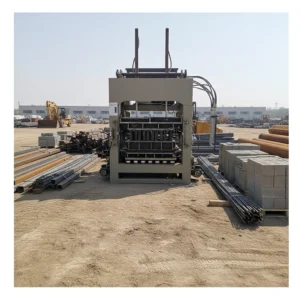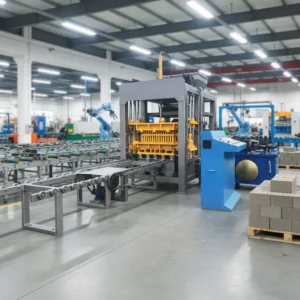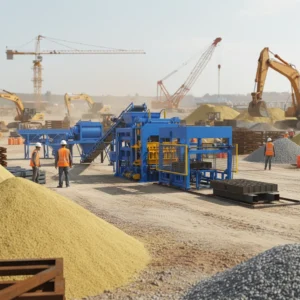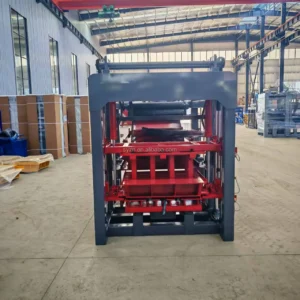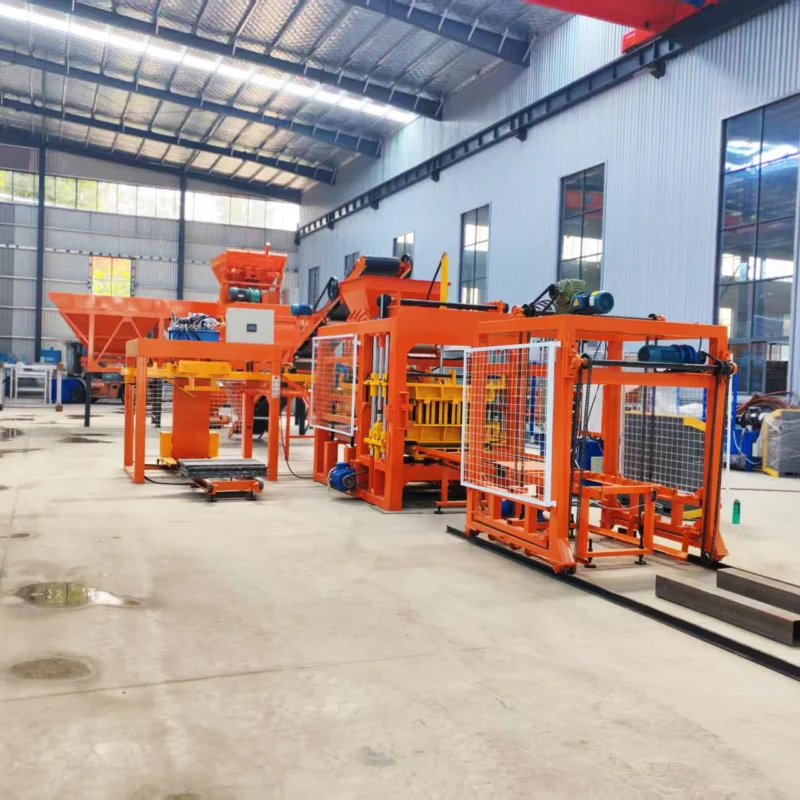
Matched System Design — the QT6-15 press, mixer, pallet feeder, and stacker are specified as one synchronized Hydraulic Block Making Machine production line rather than sourced from separate vendors.
Technical Specifications
| Parameter | Value |
|---|---|
| Model | QT6-15 |
| Product Type | Hydraulic Block Making Machine |
| Overall Dimensions (L×W×H) | 8200×1700×2950 mm |
| Total Mass | 7 T |
| Overall Power | 37 kW |
| Hydraulic System | Independent integrated hydraulic station |
| Vibration Form | Platform vibration |
| Vibration Frequency | 0–60 Hz |
| Vibration Force | 45 kN |
| Pallet Size | 880×850 mm |
| Moulding Mode | Automatic load, vibration moulding |
| Demolding Method | Hydraulic |
| Control System | PLC with touch screen and fault diagnosis |
| Molding Cycle | 15–20 s (basis not stated in source — confirm block format, material, and thickness) |
| Output: Hollow Block 400×200×200 mm | 1080–1440 pcs/hour, 8640–11520 pcs/8hr |
| Output: Hollow Block 400×150×200 mm | 1440–1920 pcs/hour, 11520–15360 pcs/8hr |
| Output: Solid Brick 240×115×53 mm | 5760–7680 pcs/hour, 46080–61440 pcs/8hr |
| Output: Rectangular Paver 200×100×60 mm | 2160–2880 pcs/hour (cycle 20–25 s), 17280–23040 pcs/8hr |
| Output: Zigzag Paver 225×112.5×60 mm | 2160–2880 pcs/hour (cycle 20–25 s), 17280–23040 pcs/8hr |
| Raw Material Adaptability | Waste ash, slag, cement |
| Block Compressive Strength | More than 15 MPa (source value — verify against manufacturer catalog) |
| Factory Area | 1200 m² |
| Standards | CE (mentioned in company profile documentation scope, source value — verify against manufacturer catalog) |
Application Suitability
| Application | Material or Output |
|---|---|
| Hollow block production for wall construction | Crushed stone, sand, cement, and waste ash blends |
| Solid brick manufacturing for load-bearing structures | Cement and slag-based mixtures |
| Rectangular paving brick for walkways and yards | Aggregate and cement at standard paver thickness |
| Zigzag interlocking paver for driveways | Cement-bound aggregate with interlocking mould profile |
| Non-bearing concrete block for partition walls | Lightweight ash and cement combinations |
Why Mixer and Stacker Throughput Decide Your Real Daily Output
A press rated at 1080–1440 hollow blocks per hour (based on 400×200×200 mm format) produces nothing if the mixer feeds too slowly or the stacker jams every third pallet.
I have watched a fully automatic Hydraulic Block Making Machine production line lose nearly half its shift output because the mixer discharge gate could not keep pace with a 15-second press cycle. The operator kept hitting the pause button, waiting for the next batch to arrive. The stacker downstream was idling just as often, because pallets backed up at the press exit when the curing rack shuttle fell behind. The press itself never broke down — the bottleneck was everywhere except the press. That pattern repeats on sites where the quotation covered only the main machine. [NEED_CITE: synchronization requirements between mixer discharge rate and press cycle time in block production]
How the QT6-15 Fits Into a Balanced Line
The QT6-15 molding cycle of 15–20 seconds (depending on block format and thickness) sets the heartbeat for every upstream and downstream station. The mixer must discharge a full batch within that window, the pallet feeder must present a clean pallet before the press opens, and the stacker must clear the loaded pallet before the next cycle completes. A Hydraulic Block Making Machine production line only performs when all three stations match the press rhythm — not exceed it, not lag behind it.
Pallet Flow and Curing Area Coordination
The 880×850 mm pallet size determines not only which blocks the press can form but also how many pallets fit on a standard curing rack and which forklift can handle them. If the curing area is too small or the forklift mast cannot reach the top rack level, loaded pallets pile up on the floor beside the stacker. I have seen curing bottlenecks force operators to slow the press down manually just to avoid pallets stacking on the ground where blocks get damaged before they cure. [NEED_CITE: pallet handling logistics and curing space planning in concrete block plants]
Reading the Specs That Matter for Line Balance
The independent integrated hydraulic station sits apart from the main frame vibration, which means hydraulic valve response stays consistent even during high-frequency platform vibration at 0–60 Hz. The 45 kN vibration force must be matched to the mix design: too much force on a lean cement mix causes surface cracking, while too little on a stiff mix leaves voids inside the block. The PLC fault diagnosis system monitors pressure and cycle completion at each station, flagging upstream or downstream delays before the operator notices a pile-up. The 37 kW overall power rating must be confirmed against the buyer’s site transformer capacity, especially when the mixer and stacker motors start under load simultaneously with the press.
What Happens When Line Stations Are Quoted Separately
When the mixer, pallet feeder, and stacker arrive from different suppliers, no single party owns the throughput calculation. The mixer vendor quotes batch capacity per hour but does not know the press cycle. The stacker vendor quotes lifts per minute but has never seen the pallet dimensions or block weight. The buyer becomes the integration engineer on site, troubleshooting timing mismatches that should have been resolved before the machines shipped. Delays from these mismatches often surface only after the line is bolted to the floor and the concrete foundation has cured. [NEED_CITE: multi-vendor integration challenges in block production line projects]
Why Buyers Specify the Full Line Here
The machine, mould, pallet, and handling equipment are configured as one system with a single capacity calculation stated per block format. Configuration starts from the buyer’s actual mix design and local aggregate, not a catalogue default. Moulds are designed for the formats the buyer’s market actually sells, including custom drawings when standard options do not match. Automation level is selectable so a buyer can begin with semi-automatic pallet handling and add stacking later. Installation and commissioning include operator training on the full line, not just the press.
Documentation & Verification
- Line layout drawing with station-by-station throughput matched to the QT6-15 molding cycle
- Capacity calculation sheet stating the exact block format assumed for each output figure
- Pallet specification sheet listing size, material, and load rating per pallet
- Hydraulic and electrical schematics for integration with site utilities
- Voltage, frequency, and PLC display language confirmation signed before production
- Factory test record on the buyer’s selected block format before dispatch
Installation, Commissioning & Support
- Foundation plan based on the 8200×1700 mm press footprint and 7 T total mass
- Dedicated power circuit for the 37 kW overall load including mixer and stacker startup surge
- Machine dismantling for container loading with reassembly sequence documented on arrival
- PLC touch screen configured in the buyer’s operating language before commissioning begins
- Operator training covering mould change procedure and hydraulic station maintenance intervals
- Wear parts and mould list supplied with reorder lead times for local planning
What to Include in Your Inquiry
Provide the block formats your market sells, your target daily output per format, and the raw materials available locally including aggregate type and cement grade. Confirm your site voltage, frequency, and preferred PLC display language. Share your curing area dimensions and the forklift model you already have on site so the pallet specification and rack layout can be matched before the line is built.
Frequently Asked Questions
Q: How do I verify that the mixer, pallet feeder, and stacker can keep up with the QT6-15 cycle time?
A: Request a line throughput calculation that states the cycle time per block format and shows the required discharge rate, pallet feed speed, and stacking speed for each station. Every station must be rated to complete its task within the press cycle window for the slowest format you plan to produce.
Q: What pallet size and material should I choose for my curing area?
A: The standard 880×850 mm pallet must fit your curing rack spacing and your existing forklift capacity. Share your rack dimensions and forklift model so the pallet material and thickness can be selected to handle wet block weight without warping during the curing cycle.
Q: Which line stations are included in the quotation and which are optional?
A: The standard quotation covers the press, hydraulic station, PLC, and pallet specification. Raw material feeding, mixing, automatic stacking, curing rack handling, and cubing are configured based on your automation level preference and quoted with matching throughput ratings.
Q: How are voltage and PLC language confirmed before shipment?
A: A voltage and control confirmation document is signed during the order stage listing your site voltage, frequency, and preferred PLC display language. The factory test then runs the PLC in that language to verify all fault diagnosis messages display correctly before dispatch.
Q: What factory area and layout does a complete line around the QT6-15 require?
A: The press alone needs a 1200 m² area, but the full line including mixer, curing racks, and stacking zone requires additional space depending on your daily output target and curing duration. A line layout drawing is provided showing each station footprint and material flow path.