
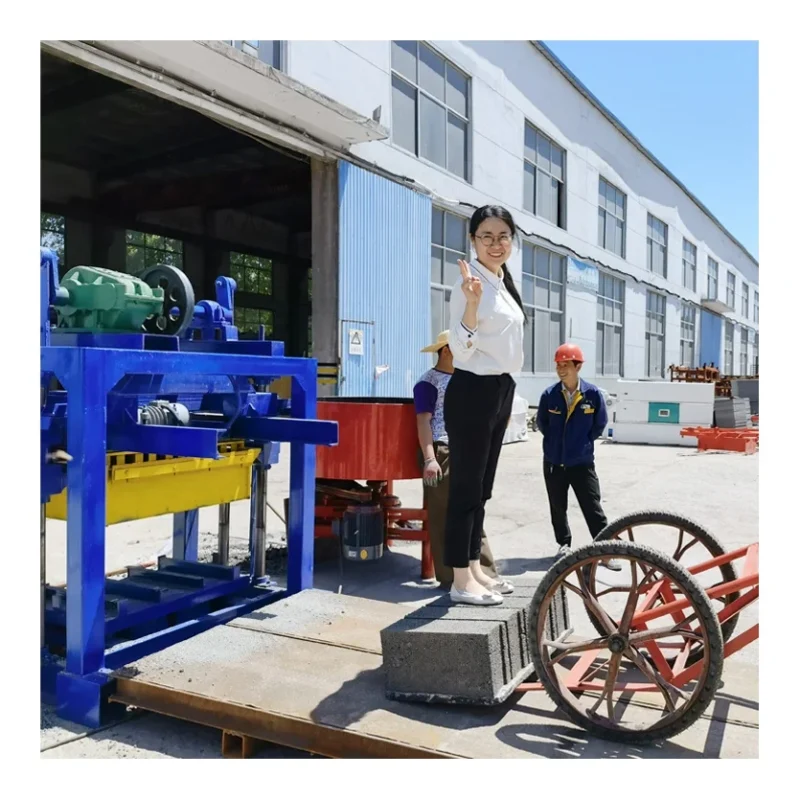
Matched Line Design — The QTJ4-40 stationary block making machine is specified here with its mixer, pallet circuit and curing-area handling sized to the actual block format you sell, not a catalogue default that leaves stations waiting.
Technical Specifications
| Parameter | Value |
|---|---|
| Model | QTJ4-40 |
| Product Type | Stationary Block Making Machine |
| Overall Dimensions (L×W×H) | 1350 x 1460 x 1800 mm |
| Pallet Size | 850 x 450 mm |
| Rated Power | 9.5 kW |
| Vibration Frequency | 2800 RPM |
| Vibration Force | 35 kN |
| Vibration Method | Table vibration feeding, fluctuation vibration molding |
| Control System | Electrical control and mechanical interworking |
| Assembly State | Stationary, small platform type |
| Mixer Recommendation | Vertical type 350 |
| Lubrication | 35# gear oil (mixer), engine oil (host machine) |
| Output Capacity | 2880 pcs/day (basis not stated in source — confirm block format / material / thickness) |
| Voltage & Frequency | Requires three-phase four-wire supply with 100A leakage protector; exact voltage and frequency configurable to site |
Application Suitability
| Application | Material or Output |
|---|---|
| Hollow concrete block production | Crushed stone, sand, cement and water mixed on-site |
| Paver block production | Fine aggregate with cement for surface-grade paving formats |
| Solid cement block production | Standard concrete mix for load-bearing and partition walls |
| Small-scale block plant operation | Workshop-level output with vertical mixer and manual pallet handling |
| On-site construction block production | Locally sourced aggregate with three-phase power available at project location |
Why the Mixer-Press-Pallet Circuit Decides Your Real Output
A block press only runs as fast as the slowest station feeding or clearing it.
Quoted daily figures often assume a block format and cycle rhythm that the surrounding line cannot sustain. When the vertical type 350 mixer finishes a batch just as the QTJ4-40 completes its molding stroke, pallets arrive on time and the press never idles. When the mixer undershoots or the pallet return loop falls behind, the stationery block making machine production line stalls and that 2,880 pcs/day figure becomes unreachable regardless of press speed [NEED_CITE: cycle-time matching between mixer output and press stroke].
Sizing Each Station to the QTJ4-40 Cycle
The stationary block making machine production line starts with raw material feeding into the vertical type 350 mixer, which must deliver a fresh batch within the press molding cycle. The 850 x 450 mm pallet size governs both the mould format range and how many pallets must circulate between the press and the curing area. Electrical control and mechanical interworking coordinate the table vibration feeding and molding stroke, reducing faulty-operation damage during pallet transfer.
How the Line Connects Beyond the Press
After molding, pallets carrying wet blocks move to the curing rack area where space and forklift reach must accommodate the 850 x 450 mm footprint. Pallets then return empty to the press infeed. If the curing area is undersized or the pallet return relies on a single worker covering too much distance, the press waits. Specifying the complete stationary block making machine production line means confirming that pallet quantity, curing rack spacing, and return path are all dimensioned against the actual cycle time for your target block format [NEED_CITE: pallet circuit sizing for small-scale block plants].
Reading the QTJ4-40 Specs Against Real Production
The 35 kN vibration force combined with table vibration feeding and fluctuation vibration molding determines how densely the concrete mix compacts inside the mould cavity. Denser compaction produces stronger blocks but requires a mix design whose aggregate grading and moisture content suit this vibration profile. The 2800 RPM vibration frequency sets the rhythm at which particles settle, and matching that rhythm to your local crushed stone or sand source is what keeps block strength consistent batch after batch.
The 9.5 kW rated power covers both the vibration motor and the mechanical interworking controls. A three-phase four-wire supply with a 100A leakage protector is required, meaning the electrical installation must be confirmed before the machine ships. The 1350 x 1460 x 1800 mm overall dimensions define the platform footprint, but the working line extends further once you include mixer placement, raw material staging, and pallet circulation paths.
The Cost of Specifying the Press Alone
When a buyer orders only the QTJ4-40 without confirming mixer capacity, pallet quantity, or curing rack layout, the line arrives incomplete. Workers hand-carry pallets because the return loop was never planned. The mixer runs continuously but cannot keep pace, so the press idles between cycles. Voltage arrives mismatched to the 9.5 kW motor, delaying commissioning while a transformer is sourced locally [NEED_CITE: common commissioning delays from unconfirmed voltage and frequency].
Why This Line Configuration Works
Block machinery is our single focus, so the QTJ4-40 is never quoted as a standalone press. The mixer, pallet specification and curing handling are proposed together against your target block format and local aggregate. Configuration is set against the mix design you can actually source, not a laboratory default. Pallet size and material are chosen to match the curing area and forklift you already operate. Voltage, frequency and control language are confirmed before production starts, so the machine commissions on arrival rather than weeks later. Mould and wear part availability is verified at quotation stage, ensuring first replacements are on hand when needed.
Documentation & Verification
- Line layout drawing showing QTJ4-40 station positions, mixer placement and pallet return path
- Capacity calculation stating the specific block format and mix assumed for daily output
- Pallet specification matched to your curing rack spacing and forklift capacity
- Voltage, frequency and control language confirmation sheet signed before production
- Factory test record on your target block format with vibration and compaction data
- Wear parts and mould list with first-replacement availability dates
Installation, Commissioning & Support
- Flat, solid foundation required for the 1350 x 1460 mm platform footprint with anchor bolt provisions
- Three-phase four-wire supply with 100A leakage protector installed before machine arrival
- Vertical type 350 mixer positioned within reach of the QTJ4-40 infeed to sustain cycle rhythm
- 35# gear oil and engine oil lubrication points mapped during commissioning walk-through
- Electrical and mechanical interworking system tested on your block format before handover
- Operator training covering mould change, pallet handling and daily maintenance intervals
What We Need to Size Your Line
Tell us the block format you sell most — hollow, solid, or paver — along with the wall thickness or dimensions your market demands. Share your local aggregate type and any existing mixer or curing area so we can confirm whether the vertical type 350 and 850 x 450 mm pallet fit your site. Confirm your three-phase voltage and frequency, plus the language you need on the electrical control interface, so the stationary block making machine production line ships ready to run.
Frequently Asked Questions
Q: How is the 2,880 pcs/day capacity calculated and which block format does it assume?
A: That figure is published without stating the block format, material or thickness it assumes. Before quoting, we calculate daily output against your specific block dimensions and local mix design, then size the vertical type 350 mixer and pallet circuit to sustain that real number rather than a catalogue claim.
Q: What supporting equipment completes the line around the QTJ4-40?
A: The stationary block making machine production line includes the vertical type 350 mixer for raw material batching, pallets sized at 850 x 450 mm for mould support and curing transport, and a pallet return path between the press and curing racks. Each station is matched to the press cycle so no point bottlenecks the output.
Q: What site preparation is needed before the QTJ4-40 arrives?
A: A flat, solid foundation must be poured to support the 1350 x 1460 x 1800 mm platform. A three-phase four-wire electrical supply with a 100A leakage protector must be installed. Space for raw material staging beside the vertical type 350 mixer and a clear pallet return path to the curing area are also required.
Q: How do pallet size and material affect my curing area and forklift?
A: The 850 x 450 mm pallet defines how many blocks cure per rack level and whether your existing forklift can handle the loaded pallet weight. We confirm pallet material — wood, bamboo or composite — against your curing climate and handling equipment so the circuit works from press to rack and back.
Q: How are voltage, frequency and control language confirmed before shipment?
A: The QTJ4-40 requires a three-phase supply, and exact voltage and frequency vary by export market. We collect your site electrical specification and preferred control interface language during the quotation stage, document the confirmed values, and build to those parameters so commissioning proceeds without electrical rework on arrival.


