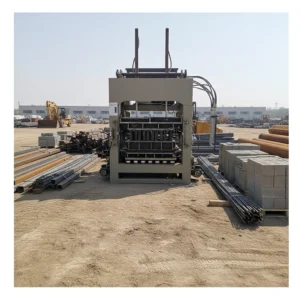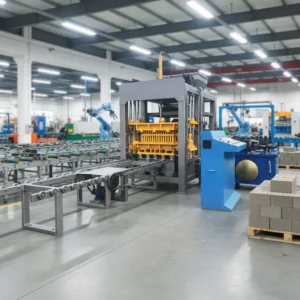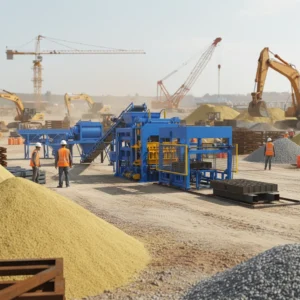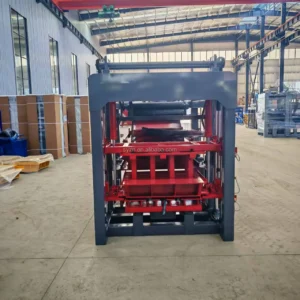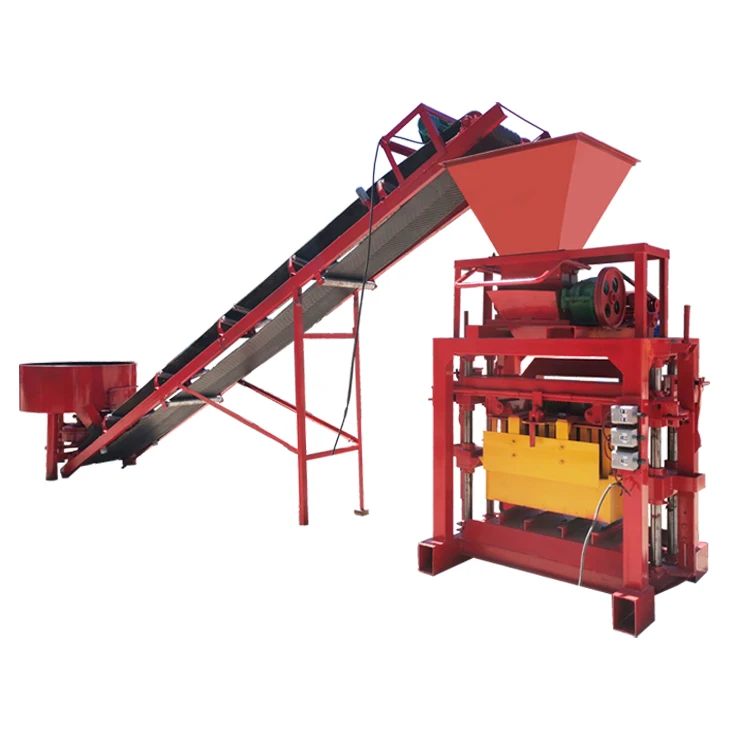
Matched line layout — the QTJ4-35 semi-automatic press is specified alongside its JQ350 mixer, pallet return path and curing footprint so every station keeps pace with the 35-second molding cycle instead of leaving the host machine idle.
Technical Specifications
| Parameter | Value |
|---|---|
| Product Type | Semi-Automatic Concrete Block Making Machine |
| Model | QTJ4-35 |
| Overall Dimensions (L×W×H) | 1350×1460×1800 mm |
| Molding Cycle | 35 s |
| Vibration Frequency | 2800 r/min |
| Exciting Force | 30 KN |
| Total Power | 11.15 kW |
| Mixer Model | JQ350 |
| Pallet Size | 850×450×20 mm |
| Total Weight | 1500 KG |
| Frame Construction | Four-lead channel steel stand |
| Applied Products | Concrete hollow block (8 inch, 6 inch), solid brick |
| Output Capacity | 408 pcs/hr based on 400×200×200 mm hollow block, 4 pcs/mould |
| Output Capacity | 510 pcs/hr based on 400×150×200 mm hollow block, 5 pcs/mould |
| Output Capacity | 2100 pcs/hr based on 240×115×53 mm solid brick, 18 pcs/mould |
Application Suitability
| Application | Material or Output |
|---|---|
| Small-scale hollow block plant | Crushed stone, sand, cement, fly ash producing 8-inch and 6-inch blocks |
| On-site construction block manufacturing | Local aggregate and cement for project-specific hollow and solid formats |
| Entrepreneur first block plant | Low-investment semi-automatic setup producing solid bricks and hollow blocks |
| Existing producer adding formats | Solid brick and hollow block added to range without full line rebuild |
What the 35-Second Cycle Does Not Tell You About Line Output
A press cycle only becomes real daily throughput when the mixer, pallet return and curing rack can keep up.
I have watched lines stall because the JQ350 mixer was swapped for a smaller unit to save budget, and the press sat waiting for material every third cycle. The QTJ4-35 block machine production line only reaches its rated output when every upstream and downstream station is timed to the same beat. Miss one station and the headline cycle number means very little at the end of a shift. [NEED_CITE: block production line cycle time synchronization]
How the Stations Connect Around the Press
The QTJ4-35 sits at the center of the line, but its 35-second cycle is only achievable if the JQ350 mixer delivers a fresh batch within that same window and the pallet feeding station returns a clean, cured pallet in time. When I lay out this line, I start from the press cycle and work outward, matching each station’s rated speed to that rhythm.
Where the Line Actually Bottlenecks
In most semi-automatic setups the bottleneck is not the press itself but the pallet return loop. An operator manually moving pallets to the curing area and bringing empty ones back sets the real pace. If the curing racks are positioned too far from the press, or the pallet size does not match the rack spacing, the operator cannot keep up and the QTJ4-35 block machine production line runs below its rated capacity. [NEED_CITE: semi-automatic block line pallet handling constraints]
Reading the Specs Against Your Block Format
The vibration force of 30 KN at 2800 r/min determines how densely the mix is compacted in the mould, which directly affects block strength and surface finish. The four-lead channel steel stand keeps the mould aligned during vibration so that blocks stay dimensionally consistent across a run. Pallet size at 850×450×20 mm must be checked against your curing rack slot width and your forklift tine spacing before the line is built. The total power draw of 11.15 kW including the mixer tells you what dedicated circuit you need at the site, not just what the press alone pulls.
The Cost of Skipping the Line Layout
Buyers who order the press alone and source the mixer and pallet handling locally often find that the stations do not synchronize. A mixer with a slower discharge rate leaves the press idle, while a pallet size that differs from the mould base plate means blocks cannot be formed at all. These mismatches show up only after the equipment arrives, and fixing them on site takes far longer than confirming the layout on paper. [NEED_CITE: block machine line integration mismatch]
Why Sourcing the Full Line Together Matters
Block machinery is our single focus, so the QTJ4-35 press, JQ350 mixer, pallet specification and handling stations are configured as one system rather than assembled from separate suppliers. We set the configuration against your actual mix design and local aggregate, not a catalogue default. Mould design covers the formats your market sells, with custom drawings available. The semi-automatic level means you can start with manual pallet handling and add automatic stacking later as volume grows. Line layout drawings show each station connection before production begins. [NEED_CITE: block machinery single-supplier line integration]
Documentation & Verification
- Line layout drawing showing station connections and cycle time match for the QTJ4-35
- Capacity calculation sheet stating the block format assumed for each output figure
- Pallet specification confirming 850×450×20 mm size, material and quantity in scope
- Voltage, frequency and control language confirmation documented before production
- Factory test record on your specified block format before dispatch
- Operation and maintenance manual with wear parts and mould list
Installation, Commissioning & Support
- Foundation plan sized to the 1350×1460 mm press footprint and 1500 KG operating weight
- Dedicated circuit rated for the 11.15 kW total line load including JQ350 mixer
- Press and mixer shipped assembled with pallet station flat-packed for container loading
- On-site commissioning includes cycle timing verification across all stations
- Operator training covers mould change procedure and vibration force adjustment
- Wear parts list with reorder codes for vibration motor and mould liner
What We Need to Configure Your Line
Send us the block formats your market sells and the daily volume you need to hit. Tell us what raw materials are available locally, including aggregate type and gradation. Confirm your site voltage and frequency, the language your operators need on the control panel, and the curing rack and forklift dimensions you already have on site.
Frequently Asked Questions
Q: How is daily output calculated when the line includes mixer feed rate and pallet return time?
A: The press cycle of 35 seconds gives a theoretical rate, but real daily output depends on the JQ350 mixer discharge speed and how fast an operator can return empty pallets from the curing area. We calculate capacity per block format with these stations included, not just the press alone.
Q: Which supporting stations are included in the quotation and which are optional?
A: The standard scope covers the QTJ4-35 press, JQ350 mixer and pallet specification. Pallet feeding conveyors, stacking stations and curing rack systems can be added. We confirm which stations are included before quotation so nothing arrives without a matching upstream or downstream unit.
Q: How do I confirm the pallet size matches my existing curing racks and forklift?
A: The standard pallet is 850×450×20 mm. We need your curing rack slot width and forklift tine spacing to confirm compatibility. If your existing racks use a different dimension, we adjust the pallet and mould base plate together so blocks form correctly and fit your curing area.
Q: Can the line be upgraded from semi-automatic to automatic stacking later?
A: Yes. The QTJ4-35 block machine production line can start with manual pallet handling and add an automatic stacker as your volume grows. We leave space in the line layout and specify the pallet return path so the upgrade does not require repositioning the press or mixer.