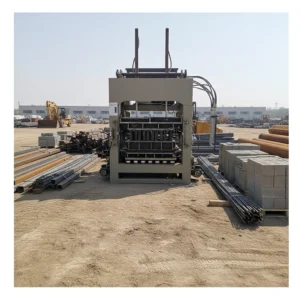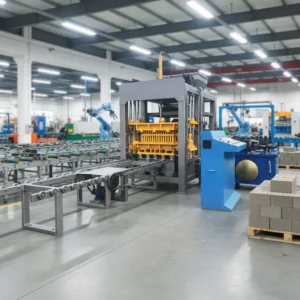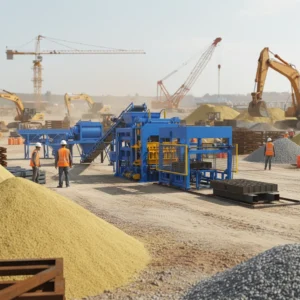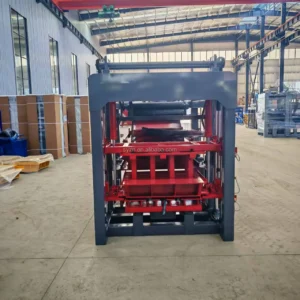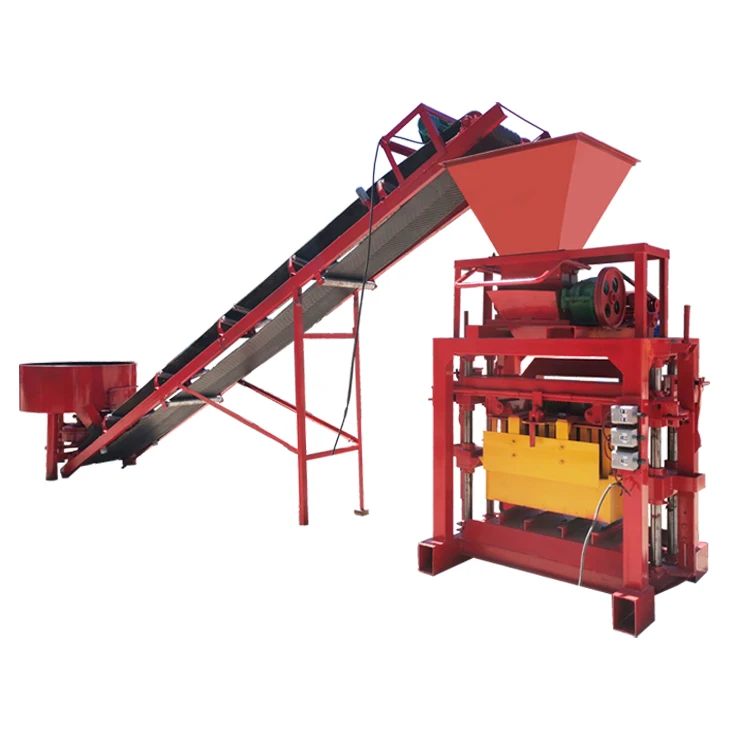
Matched Line Pacing — the QTJ4-35 Semi-Automatic Block Making Machine production line is configured so mixer batch size, pallet feed rhythm, and stacking capacity all track its 35-second molding cycle, preventing any station from idling.
Technical Specifications
| Parameter | Value |
|---|---|
| Product Type | Semi-Automatic Concrete Block Making Machine |
| Model | QTJ4-35 |
| Overall Dimensions (L×W×H) | 1350×1460×1800 mm |
| Molding Cycle | 35 s |
| Vibration Frequency | 2800 r/min |
| Exciting Force | 30 kN |
| Total Power | 11.15 kW |
| Mixer Model | JQ350 |
| Pallet Size | 850×450×20 mm |
| Net Weight | 1500 kg |
| Frame Construction | Four-lead channel steel stand |
| Mould Compression | Upper mould and bottom mould compression |
| Automation Level | Semi-automatic |
| Applied Products | Concrete hollow blocks (8 inch, 6 inch), solid brick |
| Raw Materials | Crushed stones, sand, cement, dust, fly ash |
| Output Capacity (400×200×200 mm hollow block) | 4 pcs/mould, 408 pcs/hr, 3264 pcs/8hr |
| Output Capacity (400×150×200 mm hollow block) | 5 pcs/mould, 510 pcs/hr, 4080 pcs/8hr |
| Output Capacity (240×115×53 mm solid brick) | 18 pcs/mould, 2100 pcs/hr, 17000 pcs/8hr |
| Standards | CE declaration where applicable (basis not stated in source — confirm with manufacturer) |
Application Suitability
| Application | Material or Output |
|---|---|
| Small to medium block production plants | Hollow blocks and solid bricks from crushed stone, sand, cement, and fly ash |
| On-site block production for construction contractors | 8-inch and 6-inch hollow blocks using locally sourced aggregates |
| Entrepreneur-led first block plants | Solid brick and hollow block formats with semi-automatic pallet handling |
| Development and housing project contractors | Daily output targets matched to site conditions and available curing space |
| Existing producers adding a new format line | Hollow block and solid brick runs alongside current operations |
What the QTJ4-35 Cycle Time Reveals About Your Full Line
A 35-second press cycle is only as productive as the slowest upstream or downstream station feeding it.
When a Semi-Automatic Block Making Machine production line quotes output per hour, buyers often assume the entire line sustains that rhythm. In practice, mixer discharge delays, pallet shortages, or manual stacking bottlenecks quietly erode daily throughput. I have watched lines where the press sat idle for several seconds each cycle simply because the JQ350 mixer had not finished its batch or the operator was still clearing cured pallets from the rack area. The QTJ4-35 completes a mould every 35 seconds, which means every supporting station — from raw material feeding through curing rack handling — must be sized to that same tempo [NEED_CITE: typical cycle time losses in semi-automatic block lines].
Mixer-to-Press Feed Synchronization
The JQ350 mixer paired with the QTJ4-35 delivers a batch volume calibrated to fill one mould per discharge. Because the press cycles every 35 seconds, the mixer must complete its blend and discharge within that window to avoid starvation. If the raw material feed configuration — whether manual wheelbarrow loading or a belt conveyor — cannot keep the JQ350 hopper replenished, the Semi-Automatic Block Making Machine production line loses rhythm and output drops below the rated capacity figures.
Pallet Circulation and Curing Area Alignment
Every 35 seconds, a loaded pallet exits the press and must travel to the curing area. The 850×450×20 mm pallet dimension governs not only the press table but also the curing rack spacing, forklift tine width, and stacking height. If the curing area is undersized relative to daily output, pallets pile up on the floor and the operator spends time searching for empty pallets rather than feeding the press. A balanced Semi-Automatic Block Making Machine production line accounts for pallet return time from curing back to the feed station [NEED_CITE: pallet circulation planning for block plants].
Vibration and Compression Interaction
The 30 kN exciting force at 2800 r/min works in tandem with upper-and-lower mould compression to compact the mix into a dense block. This dual action means the mix design — the ratio of crushed stone, sand, cement, and fly ash — must be consistent batch after batch. If the mixer produces uneven blends, the vibration force cannot compensate, and block strength varies across the day’s output.
What Happens When Line Stations Are Mismatched
When a buyer sources the press from one supplier and the mixer or pallet system from another, cycle times rarely align without on-site adjustment. I have seen lines where a faster mixer overloaded the press hopper, causing spillage, while a slower pallet handler left the operator manually dragging boards into position. The result is a Semi-Automatic Block Making Machine production line that technically works but never reaches its documented capacity because one station is always waiting on another [NEED_CITE: integration issues in multi-supplier block lines].
Why Sourcing the Full Line From One Source Matters
Block machinery as a single focus means the QTJ4-35, its JQ350 mixer, pallet specification, and handling stations are specified as one matched system. Configuration is set against the buyer’s actual mix design and local aggregate rather than a catalogue default. Mould design covers the formats the buyer’s market sells, with custom drawings available. Automation level is selectable, allowing a start at semi-automatic with a defined upgrade path. Installation support includes operator training so the crew understands why each station’s rhythm matters.
Documentation & Verification
- Line layout drawing showing QTJ4-35 station positions, pallet flow path, and curing area footprint
- Capacity calculation document stating which block format each hourly and daily figure assumes
- Pallet specification sheet confirming 850×450×20 mm size, material, and quantity included
- Voltage, frequency, and control language confirmation to avoid commissioning delays
- Factory test record on buyer’s selected block format before dispatch
- Hydraulic and electrical schematic matching the as-built line configuration
Installation, Commissioning & Support
- Foundation pad leveled to support the 1500 kg QTJ4-35 frame and four-lead channel steel stand
- Dedicated power circuit rated for 11.15 kW total draw with confirmed voltage and frequency
- Mixer JQ350 positioned for gravity or belt discharge directly into the press hopper
- First-run mould adjustment and vibration tuning on buyer’s local aggregate mix
- Operator training covering 35-second cycle pacing, mould change procedure, and pallet handling rhythm
- Wear parts list covering hydraulic seals and vibration motor bearings for initial stock
Before You Request a Quote
To size a Semi-Automatic Block Making Machine production line that actually sustains its rated output, share your target block formats and the daily volume you need for each. Include your local raw materials — specifically which aggregates and cement type are available — along with your site’s voltage, frequency, and the curing area dimensions you can allocate. If you already own forklifts or pallet racks, note their specifications so the pallet size and rack layout align from day one.
Frequently Asked Questions
Q: How is the daily output of the QTJ4-35 line calculated, and which block format is assumed?
A: Each output figure is tied to a specific block format. For the 400×200×200 mm hollow block, the line produces 4 pieces per mould at a 35-second cycle, yielding 408 pieces per hour and 3264 pieces over an 8-hour shift. Different formats such as the 400×150×200 mm hollow block or the 240×115×53 mm solid brick have their own per-mould counts and corresponding hourly and daily totals.
Q: What supporting equipment is included versus optional in the line quotation?
A: The standard quotation covers the QTJ4-35 press, JQ350 mixer, and pallet specification. Upstream raw material feeding systems, downstream stacking stations, and curing rack handling equipment can be included or quoted separately depending on the buyer’s automation preference and existing site infrastructure.
Q: How must pallet size and curing rack layout be coordinated with the press cycle?
A: The 850×450×20 mm pallet must clear the press, travel to curing, and return within the 35-second cycle window to maintain continuous production. Curing rack spacing, forklift capacity, and floor area must accommodate the total pallet count required for a full day’s output plus return buffer.
Q: What raw material feed configuration keeps the 35-second cycle uninterrupted?
A: The JQ350 mixer must discharge a complete batch into the press hopper every 35 seconds. Upstream feeding — whether by conveyor, skip hoist, or manual loading — must replenish the mixer within that same window so neither the mixer nor the press experiences a starvation delay.