
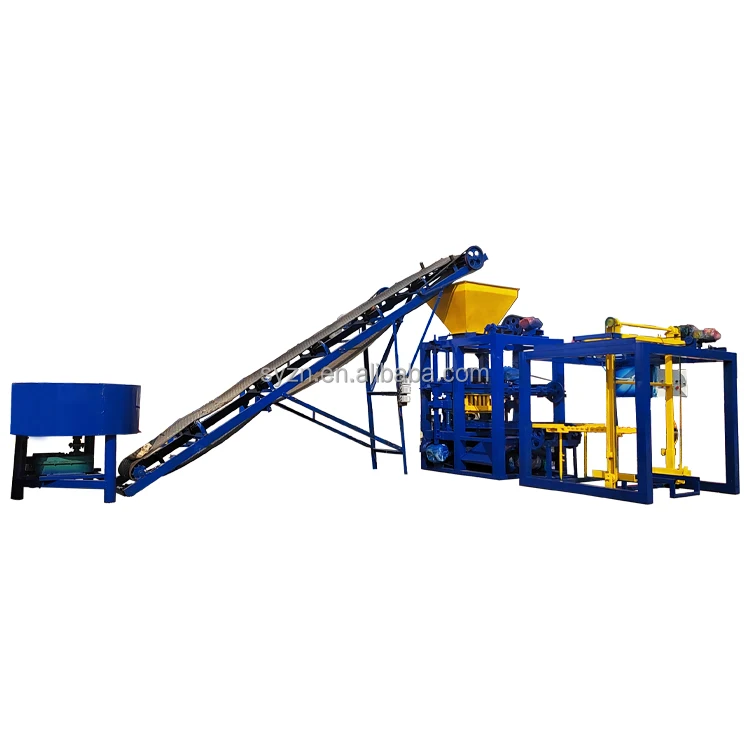
System-Matched Configuration — The QTJ4-24 block machine production line is specified against your actual mix design, local aggregate, and curing footprint rather than shipped as a catalogue default.
Technical Specifications
| Parameter | Value |
|---|---|
| Model | QTJ4-24 |
| Product Type | Semi-Automatic Cement Block Making Machine |
| Overall Dimensions (L×W×H) | 3600×1700×2560 mm |
| Pallet Size | 850×450 mm |
| Molding Cycle | 24-26 s (basis not stated in source — confirm block format / material / thickness) |
| Overall Power | 11.95 kW |
| Vibration Force | 45 kN |
| Total Mass | 2 T |
| Molding Method | Mechanical |
| Raw Materials | Cement, sand, stone |
| Reducer Type (Mold Lifting) | 350-type |
| Vibration Configuration | 2×3 kW lower vibrators + 2×1.5 kW upper vibrators |
| Material Distribution | Full-automatic spiral |
| Automation Level | Semi-automatic |
| Voltage & Frequency | Configurable (basis to be confirmed) |
| Control System | To be confirmed with buyer |
| Warranty | 1 year for the whole machine (excluding spare parts) |
Application Suitability
| Application | Material or Output |
|---|---|
| Hollow block production for masonry walls | Cement, sand, crushed stone aggregate |
| Interlocking brick production for paving | Cement, graded sand, fine stone |
| Solid block production for load-bearing structures | Cement, coarse aggregate, sand |
| Paving brick production for walkways and yards | Cement, sand, stone dust |
Why Pallet Handling Defines Your Real Daily Output
The press cycle means nothing if pallets are not circulating fast enough to keep it running.
Many quotations for a QTJ4-24 block machine production line list only the press station, leaving pallet feeding, block stacking, and curing rack handling as an afterthought. When the operator has to pull wet pallets off the machine by hand and carry them to the curing area, the 24-26 second molding cycle stretches into something far slower. We have seen semi-automatic lines lose meaningful portions of their theoretical throughput simply because nobody planned the pallet return path or sized the curing rack inventory to match a full shift [NEED_CITE: pallet circulation planning for semi-automatic block lines].
Synchronizing the Upstream Feed with the Press Cycle
The full-automatic spiral material distribution on the QTJ4-24 is designed to keep the mold cavity filled without manual shoveling at the hopper. But the spiral can only deliver what the mixer discharges. If your mixer batch size and discharge rate do not align with the press consumption over a shift, the hopper runs dry mid-cycle and the operator stands idle. Specifying the QTJ4-24 block machine production line means matching the mixer output, the spiral feed rate, and the press cycle as one continuous chain.
Pallet Size as a Line-Wide Constraint, Not a Press Spec
The 850×450 mm pallet dimension dictates the spacing of every curing rack slot, the fork width of the loader moving wet blocks, and the conveyor width returning empty pallets to the press. A pallet chosen in isolation from the curing yard layout forces the buyer to rebuild racks or buy different forklifts after the line is already installed. We treat pallet specification as a line-wide decision that starts with the curing area the buyer already has or plans to build [NEED_CITE: pallet and curing rack integration in block plant design].
How Vibration Force and Mechanical Molding Shape Block Density
The QTJ4-24 generates 45 kN of vibration force through four independent motors — two 3 kW units below the mold and two 1.5 kW units above. This dual-layer vibration compacts the mix from both directions, which is critical for hollow block walls where thin webs must reach adequate density without collapsing. Because the molding method is mechanical rather than hydraulic, the vibration system carries the full burden of compaction. The 350-type reducer on the mold lifting mechanism is rated for continuous cycle duty, reducing the chance of unplanned stops that would back up pallet flow downstream. The 11.95 kW total power draw tells you what electrical supply the press station alone requires before you add the mixer, conveyor motors, and lighting to the panel schedule.
What Happens When Line Stations Are Specified Separately
When the mixer, press, and pallet handling come from different suppliers with no single party responsible for cycle matching, the gaps appear on the first production day. The mixer discharges too slowly, the pallet return conveyor runs at the wrong speed, and the stacking area has no room for a full shift’s output. These mismatches do not show up in any single station’s quotation. They emerge only when the line runs as a whole, and by then the equipment is bolted to the floor [NEED_CITE: integration risks in multi-supplier block production lines].
Why Buyers Source the Full Line Here
The QTJ4-24 block machine production line is specified as one system — press, mixer capacity, pallet inventory, and handling — so cycle times match across every station. Molds are designed for the block formats your local market actually buys, not limited to a standard catalogue set. The automation level is selectable, meaning a buyer can start with semi-automatic pallet handling and add automatic stacking later without replacing the press. Configuration is set against your local aggregate and mix design, preventing costly material substitutions after installation. Factory testing runs the full line before shipment, catching timing mismatches before the equipment reaches your site.
Documentation & Verification
- Line layout drawing with capacity calculation stating the assumed block format per cycle
- Pallet specification sheet confirming 850×450 mm dimensions, material grade, and weight
- Electrical schematic with confirmed voltage, frequency, and control language before build
- Factory test record demonstrating press cycle timing matched to upstream and downstream stations
- Wear parts list covering vibration motor bearings, spiral feed components, and reducer consumables
Installation, Commissioning & Support
- Foundation plan sized to the 3600×1700 mm footprint and 2 T operating mass of the QTJ4-24
- Dedicated electrical circuit rated for the 11.95 kW press load plus mixer and conveyor motors
- Pallet return conveyor aligned to the 850×450 mm pallet and buyer’s existing curing rack spacing
- On-site commissioning verifying full-automatic spiral feed timing against the 24-26 second molding cycle
- Operator training covering mold change procedure using the 350-type reducer lifting mechanism
- First-year warranty on the complete machine with wear parts supply plan documented before shipment
What to Include in Your Inquiry
Tell us the block formats you sell locally — hollow, solid, paving, interlocking — and the daily volume your market absorbs. Share your site dimensions so we can lay out the mixer station, press, pallet circulation, and curing area as one plan. Confirm your local voltage and frequency, and let us know if you already have forklifts or curing racks that the 850×450 mm pallet must fit.
Frequently Asked Questions
Q: How is the QTJ4-24 daily output calculated, and what does it depend on?
A: The 24-26 second molding cycle is the press station rate, but real daily output depends on which block format is running, how fast the mixer feeds material, and how quickly pallets circulate back. We calculate capacity per format and state the shift pattern and block dimensions assumed, so you can verify throughput against each product in your range.
Q: What mixer capacity keeps the QTJ4-24 from waiting between cycles?
A: The full-automatic spiral distribution consumes material at a rate set by the molding cycle. Your mixer must discharge a full batch within the time the press completes its current pallet, plus a margin for the next fill. We specify mixer batch size and discharge timing as part of the line layout, not as a standalone purchase.
Q: Do the 850×450 mm pallets work with standard curing racks?
A: Pallet size must match your curing rack slot spacing, the fork width of your loader, and the pallet return conveyor width. We confirm all three against your existing or planned curing infrastructure before the line is built, so pallets flow from press to rack and back without manual resizing or equipment changes.
Q: Which stations are included in the quotation, and which do I source separately?
A: Our line quotation covers the QTJ4-24 press, material feeding, spiral distribution, pallet specification, and the handling equipment we supply. If your site already has a mixer or curing racks, we integrate around them. Every included and excluded station is listed explicitly so there are no surprises on delivery day.
Q: What electrical details must be confirmed before the line ships?
A: Voltage, frequency, and control panel language must be locked before the electrical panel is wired. The QTJ4-24 draws 11.95 kW at the press station alone, and the full line load including mixer and conveyors must be calculated together. We confirm these values and provide the schematic before production begins.


