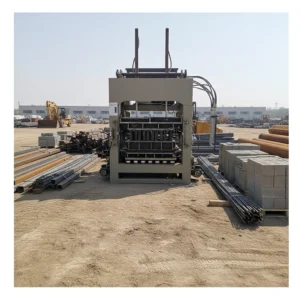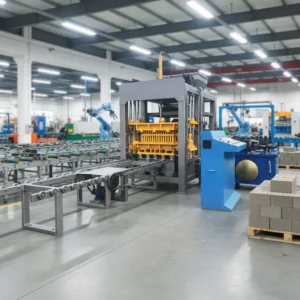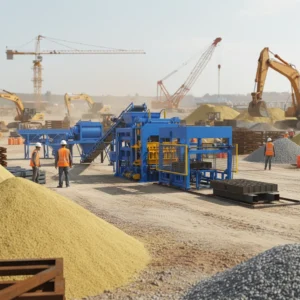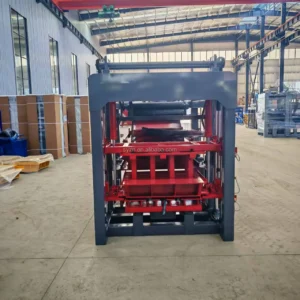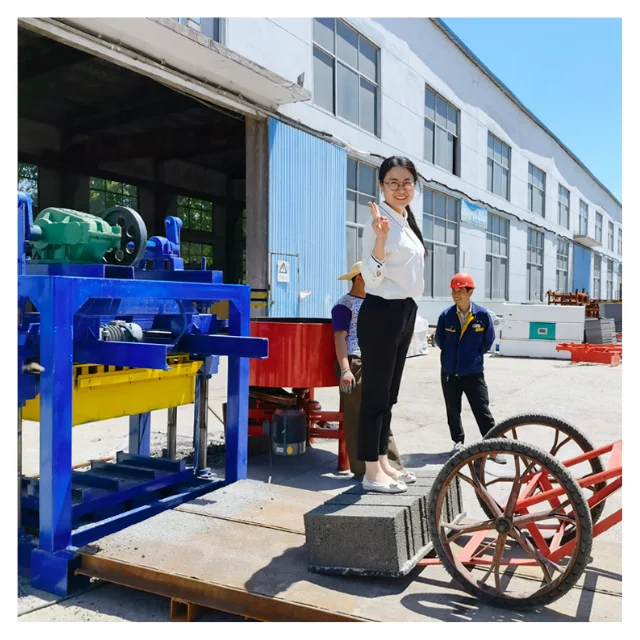
Upstream-downstream matching — the QTJ4-40 cycle of 40 seconds only reaches its daily target when mixer discharge, belt feeding and pallet return are timed so the press never waits on the next station.
Technical Specifications
| Parameter | Value |
|---|---|
| Model | QTJ4-40 |
| Product Type | Semi-Automatic Concrete Block Making Machine |
| Machine Power | 10.4 kW |
| Molding Cycle | 40 s |
| Output Capacity | 2,000–2,500 pcs / 8 h (basis not stated in source — confirm block format and material) |
| Theoretical Productivity (400×200×200 mm hollow block, 4 pcs/mould) | 360 pcs/h, 2,800 pcs/day |
| Theoretical Productivity (400×150×200 mm hollow block, 5 pcs/mould) | 450 pcs/h, 3,600 pcs/day |
| Theoretical Productivity (225×112.5×60 mm solid brick, 9 pcs/mould) | 800 pcs/h, 6,400 pcs/day |
| Pallet Size | 850 × 450 mm |
| Overall Dimensions (L×W×H) | 1,350 × 1,460 × 1,800 mm |
| Machine Weight | 1 T |
| Vibration System | Bed mould vertical vibration + upper mould compression vibration |
| Mould Actuation | Top die push-pull with automatic scraper |
| Automation Level | Semi-automatic |
| Voltage | Configured to buyer’s local voltage (exact V/Hz to be confirmed) |
| Raw Material Compatibility | Concrete, sand, cement, fly ash, lime, gypsum |
Application Suitability
| Application | Material or Output |
|---|---|
| Small to medium-scale block plants | Hollow blocks and solid bricks from local sand, cement and crushed aggregate |
| On-site construction production | Paving formats and wall blocks directly at the building site |
| First-plant entrepreneur setups | Semi-automatic line with lower initial investment, upgradeable later |
| Existing producers adding a new format | Supplementary line alongside current equipment using shared curing racks |
Why the Mixer Often Becomes the Real Bottleneck on a Semi-Automatic Block Machine Production Line
A 40-second moulding cycle is wasted when the mixer takes 70 seconds to discharge into the feed hopper.
I spent years commissioning block lines and the most common complaint was always the same: the press sits idle. The semi-automatic block machine production line only hits its theoretical output when every station around the press — raw material batching, mixing, belt conveying, pallet feeding, and manual or assisted stacking — is sized against the same 40-second beat. When the mixer is undersized, each cycle stretches by 30 to 40 seconds and daily output drops noticeably. [NEED_CITE: concrete mixing discharge time versus block press cycle coordination]
How the Press Fits Into the Complete Line Layout
The QTJ4-40 occupies a compact footprint of 1,350 × 1,460 × 1,800 mm and weighs 1 T, which makes it practical for smaller plant buildings where floor space is limited. A typical semi-automatic block machine production line starts with a pan mixer or twin-shaft mixer positioned so that discharge falls directly into a belt conveyor feeding the press hopper. The pallets circulate manually or on a short return conveyor, and finished wet blocks on pallets are wheeled to the curing area. The goal is to keep the press working continuously rather than waiting on any single upstream or downstream step.
Where Cycle Time Coordination Breaks Down
In my field experience, the weakest link is rarely the press itself. More often, a mixer chosen for lower capital cost discharges too slowly, or a belt conveyor runs at a speed that cannot refill the hopper before the next moulding cycle begins. Pallet handling also introduces delays if the curing racks are far from the press and workers spend most of the shift transporting pallets instead of feeding the machine. [NEED_CITE: block production line station synchronization and daily output impact] The semi-automatic block machine production line must be calculated station by station, with each piece of equipment rated against the same cycle assumption.
Reading the Specifications Against Your Block Format
The dual vibration system — vertical vibration on the bed mould combined with compression vibration on the upper mould — is designed to compact concrete evenly across the pallet. For hollow blocks at 400×200×200 mm, the theoretical rate is 360 pieces per hour based on 4 pieces per mould, while 400×150×200 mm blocks yield 450 pieces per hour at 5 per mould. The 850 × 450 mm pallet size must match both the mould dimensions and the curing rack spacing the buyer already uses or plans to build. The 10.4 kW total power draw influences the transformer sizing and dedicated circuit requirements on site.
The Hidden Cost of Treating the Press as a Standalone Purchase
When the quotation covers only the press and omits the mixer, belt conveyor, pallet return system and curing rack handling, the buyer is left to source and integrate those stations independently. This almost always leads to mismatched speeds: a conveyor that feeds too slowly, pallets that do not fit the existing forklift, or a mixer that cannot keep up. [NEED_CITE: block plant integration risks when equipment is sourced from separate suppliers] The daily shortfall accumulates quietly, and the buyer blames the press for output that the line layout never supported.
What Sets a Matched Line Apart
Every station around the QTJ4-40 is specified against the buyer’s actual block format, local aggregate and target daily output rather than pulled from a catalogue default. The pallet size and material are confirmed against the curing area dimensions and forklift capacity already on site. Voltage, frequency and control panel language are locked in before production begins, so commissioning is not delayed after arrival. Moulds are designed for the formats the buyer’s market actually sells, and the line layout document states the capacity assumption for each station, not just the press. [NEED_CITE: block machinery line layout documentation standards] The semi-automatic block machine production line approach means the buyer receives one coordinated system instead of assembling separate machines that may never synchronize.
Documentation & Verification
- Line layout showing station-by-station capacity calculated per your chosen block format
- Pallet specification sheet matched to your curing rack dimensions and forklift rating
- Voltage and control language confirmation signed off before production starts
- Factory test record demonstrating moulding cycle on your specified block type
- Mould drawing and format list covering every product in your market range
Installation, Commissioning & Support
- Foundation pad leveled to tolerance for the 1,350 × 1,460 mm machine footprint
- Dedicated circuit sized for 10.4 kW total draw at confirmed local voltage and frequency
- Mixer and belt conveyor positioned so discharge aligns with the press hopper inlet
- First-run moulding cycle verified on your aggregate mix before operator training begins
- Spare mould wear parts and pallet replacements listed for your production volume
- Daily and weekly lubrication schedule based on the 40-second cycle frequency
What to Share With Your Inquiry
To build an accurate line layout, provide the block formats you intend to produce, your target daily output, and the local aggregate available. Include your workshop dimensions, existing curing rack spacing, and the forklift you plan to use for pallet handling. Confirm your local voltage and frequency so the electrical system can be built correctly from the start.
Frequently Asked Questions
Q: How do I verify that each station in the line is matched to prevent bottlenecks?
A: Request a line layout document that states the throughput of every station — mixer, conveyor, press, pallet return — calculated against your specific block format. If the press cycles in 40 seconds but the mixer discharges every 70 seconds, the gap will reduce daily output. The layout should identify and resolve every mismatch before equipment is manufactured.
Q: What pallet size and material should I choose for my curing area?
A: The QTJ4-40 uses 850 × 450 mm pallets, but the material — wood, bamboo, or composite — must suit your curing environment and forklift load capacity. Pallets that warp in humid curing rooms cause block damage during transport. Confirm rack spacing and forklift tine width so pallets move smoothly from press to curing to dispatch.
Q: How are voltage, frequency and control language confirmed before shipment?
A: These are finalized during the quotation stage, not after the machine is built. Your local voltage and frequency determine motor winding and transformer specifications. If the press uses a control panel, the display language is set to your operator’s preference. Written confirmation before production prevents commissioning delays on site.
Q: What is typically included and excluded in a line quotation?
A: A press-only quotation covers the moulding machine and moulds but may exclude the mixer, belt conveyor, pallet return, stacking assistance and curing rack handling. A complete semi-automatic block machine production line quotation lists every station from raw material feeding through to curing, so the buyer knows exactly which equipment is supplied and which must be sourced locally.
Q: How do I plan an upgrade from semi-automatic to higher automation later?
A: The line layout should leave space for future additions such as automatic pallet feeding, stacker units or cubing systems. Electrical conduit and control panel capacity can be pre-wired during the semi-automatic stage. Confirming the upgrade path at the inquiry stage avoids repositioning the press or rebuilding foundations when automation is added.