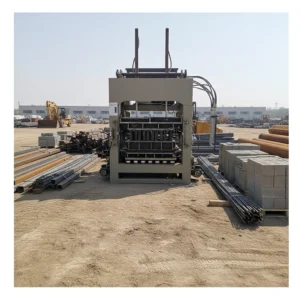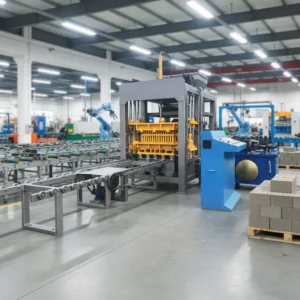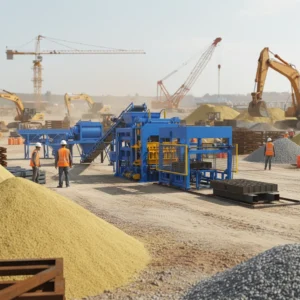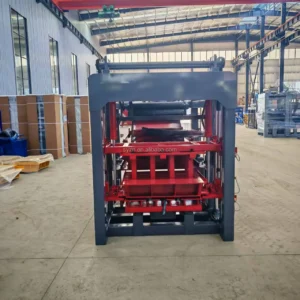
Matched Cycle-Time Engineering — every station from the mixer to the stacking area is sized so the QTJ4-40 press never waits for material or pallets during its 40-second molding cycle.
Technical Specifications
| Parameter | Value |
|---|---|
| Model | QTJ4-40 |
| Product Type | Semi-Automatic Concrete Block Making Machine |
| Machine Power | 10.4 kW |
| Molding Cycle | 40 s |
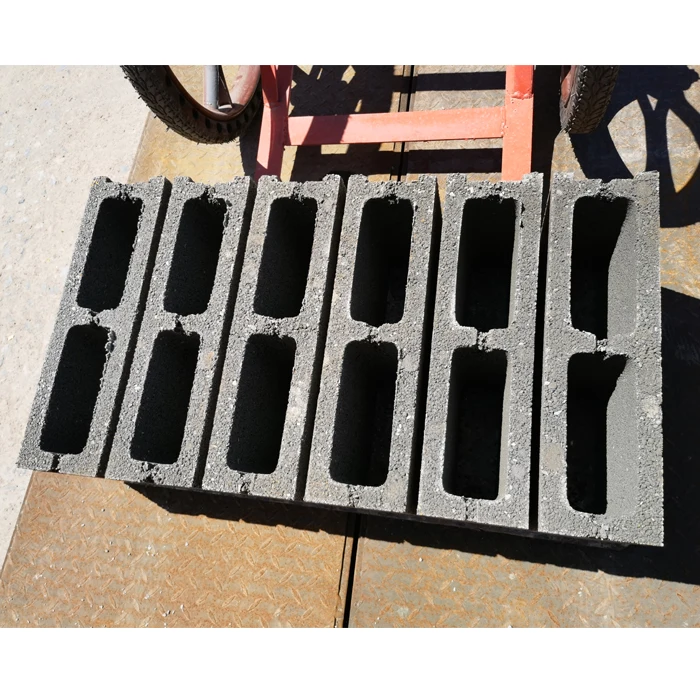
| Theoretical Productivity | 360 pcs/h on 400×200×200 mm hollow block, 4 pcs/mould; 450 pcs/h on 400×150×200 mm, 5 pcs/mould; 800 pcs/h on 225×112.5×60 mm solid brick, 9 pcs/mould |
| Raw Materials | Concrete, sand, cement, fly ash, lime, gypsum |
| Machine Weight | 1 T |
| Overall Dimensions (L×W×H) | 1350 × 1460 × 1800 mm |
| Pallet Size | 850 × 450 mm |
| Vibration System | Bed mould vertical vibration + upper mould compression vibration |
| Automation Level | Semi-automatic (top die push-pull, automatic scraper, manual pallet handling) |
| Voltage | According to local voltage (confirm exact V/Hz/ph before order) |
| Control System | To be confirmed before order (PLC / relay / manual panel) |
| Certification | To be confirmed before order |
Application Suitability
| Application | Material or Output |
|---|---|
| Small to medium block production workshops | Hollow block, solid brick and paver runs using concrete, sand and cement mixes |
| On-site block production for housing and construction contractors | Daily masonry supply from locally sourced crushed stone, sand and cement |
| Existing yards adding hollow and solid formats | Fly ash, lime or gypsum blended mixes across multiple mould changes |
Why the Mixer Discharge Rate Decides Your Real Daily Output
A semi-automatic block machine production line only runs as fast as its slowest upstream station.
The QTJ4-40 cycles every 40 seconds. That means the mixer must discharge a full batch of wet concrete into the hopper within that same window, or the press sits idle while the operator waits for material. I have walked into yards where a QTJ4-40 was paired with a mixer that needed 90 seconds to discharge, and the actual daily output was barely half the brochure figure [NEED_CITE: field observations on mixer-press cycle mismatch]. When sizing a semi-automatic block machine production line, the mixer capacity, discharge gate size and conveyor angle must all be calculated against the 40-second press cycle, not quoted as a standalone number.
Matching the Mixer to the 40-Second Press Cycle
For a semi-automatic block machine production line built around this press, the mixer must deliver a batch volume that fills the mould box in one pass and discharge it in well under 40 seconds. A pan mixer with a bottom discharge gate typically empties faster than a tilting drum mixer, which has to rotate fully to pour. The conveyor between the mixer and the press hopper also needs enough belt width and incline angle to move that volume without spillage. When the upstream stations are matched correctly, the operator only handles pallets manually while the press, mixer and conveyor run in a continuous loop.
Pallet Flow and Curing Area Layout Around the 850×450 mm Size
Every pallet that leaves the press must travel to the curing rack, and every cured pallet must return. The 850 × 450 mm pallet size governs the rack spacing, the forklift tine width and the stacking station footprint. If the curing racks in the yard were built for a different pallet dimension, the whole line stalls at the off-bear end [NEED_CITE: curing rack and pallet dimension compatibility in block plants]. Planning the semi-automatic block machine production line means drawing the pallet loop from press to rack to return conveyor before any equipment is ordered.
Reading the Specification Sheet Beyond the Headline Numbers
The 10.4 kW motor rating covers both the vibration motors and the hydraulic pump that drives the upper mould compression. The dual vibration setup — vertical vibration under the bed mould plus compression vibration from the upper mould — is what gives consistent block density across different formats on the same pallet size. Without that upper compression, hollow blocks with thin walls tend to crack at the web during de-moulding. The 1350 × 1460 × 1800 mm machine envelope is compact enough for a container-load workshop, but the surrounding line still needs clearance for the mixer, pallet return path and operator movement on both sides of the press.
The Hidden Cost of Treating the Press as a Standalone Purchase
When a buyer orders only the QTJ4-40 and sources the mixer, pallets and curing racks separately, the line almost never runs at the quoted cycle time. A mixer that is too small forces the operator to wait between batches. Pallets bought from a local timber yard may warp under the vibration table and cause block breakage at the de-mould station. Curing racks spaced for a larger pallet leave wasted floor area and reduce the total number of blocks that can cure in one shift [NEED_CITE: pallet warping and block breakage rates in small block plants]. These mismatches do not show up in the machine specification sheet, but they show up on the production floor every single day.
Why Procurement Here Covers the Whole Line
Block machinery is our single focus, so the QTJ4-40 is never quoted without confirming the mixer discharge rate, pallet specification and curing rack layout that match it. The semi-automatic block machine production line is specified against your actual mix design and local aggregate, not a catalogue default. Mould design covers the formats your market sells, including custom drawings for non-standard block dimensions. Automation level is selectable, so the line can start with manual pallet handling and add an automatic pallet feeder and stacker later. Installation support includes operator training on cycle-time discipline so the press is never starved or blocked during a shift.
Documentation & Verification
- Line layout drawing showing every station from raw material hopper to stacking area with the block format used for capacity calculation stated
- Machine specification sheet plus pallet specification so curing racks and forklifts can be checked against the 850 × 450 mm dimension
- Voltage, frequency and control language confirmation documented before production begins
- Factory test record showing cycle time and output per block format, not a single generic pieces-per-hour figure
- Mould drawing and format list covering every block type the line will produce
Installation, Commissioning & Support
- Foundation pad leveled to support the 1 T machine weight and vibration load without resonance transfer to adjacent structures
- Dedicated electrical circuit rated for 10.4 kW continuous draw with voltage and frequency confirmed to match local supply
- Machine arrives dismantled for container loading; on-site reassembly includes vibration table alignment and hydraulic pressure calibration
- First-run commissioning tests every block format on the mould list, recording actual cycle time and block density per format
- Operator training covers mould change procedure, pallet handling sequence and daily vibration motor inspection
- Wear parts list identifies vibration motor brushes, hydraulic seals and scraper blades with recommended replacement intervals
What We Need to Size Your Line Correctly
Send us the block formats your market sells, the daily output target and the raw materials available locally. Include your existing curing area dimensions, forklift tine width and the voltage and frequency at the site. If you already have a mixer or conveyor in the yard, share the model and discharge rate so we can confirm whether it matches the 40-second cycle or needs to be replaced before the semi-automatic block machine production line is finalized.
Frequently Asked Questions
Q: How is the daily output figure calculated, and which block format does it assume?
A: The theoretical productivity varies by format: 360 pcs/h on a 400×200×200 mm hollow block with 4 cavities, 450 pcs/h on a 400×150×200 mm hollow block with 5 cavities, and 800 pcs/h on a 225×112.5×60 mm solid brick with 9 cavities. Any daily output claim must state which format it is based on, because switching moulds changes the number per cycle and the total pieces per shift.
Q: Which mixer capacity and discharge rate match the QTJ4-40 so the press never waits?
A: The mixer must discharge a full batch in well under 40 seconds to keep up with the press cycle. A pan mixer with a bottom gate is generally preferred over a tilting drum for this reason. We calculate the batch volume from your chosen block format and mould cavity count, then specify the mixer size and conveyor angle accordingly.
Q: What pallet size, material and curing rack layout fit this line?
A: The press uses an 850 × 450 mm pallet. Curing racks must be spaced to accept this exact dimension, and forklift tines must be wide enough to carry loaded pallets without tipping. We confirm your existing rack spacing and forklift model before finalizing the line layout so there are no mismatches when the first pallets leave the press.
Q: Can the line start semi-automatic and be upgraded later?
A: Yes. The QTJ4-40 is designed to allow an automatic pallet feeder and stacker to be added after the initial installation. The press frame and control panel include mounting points and wiring provisions for the upgrade, so the transition does not require a full line shutdown or major structural modification.
Q: Which voltage and frequency options are available, and how is the control language confirmed?
A: The machine is built to match your local voltage and frequency, which must be confirmed in writing before production starts. If a PLC is specified, the display language is also confirmed at that stage so the operator can read cycle parameters and alarms in their preferred language from the first day of commissioning.