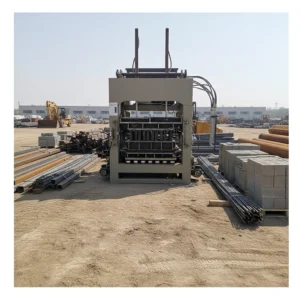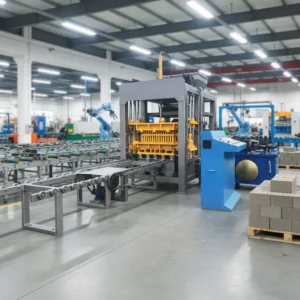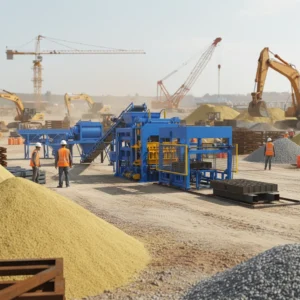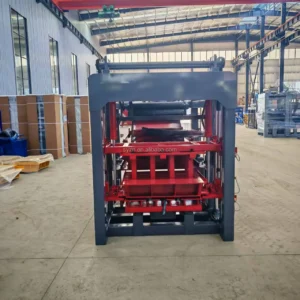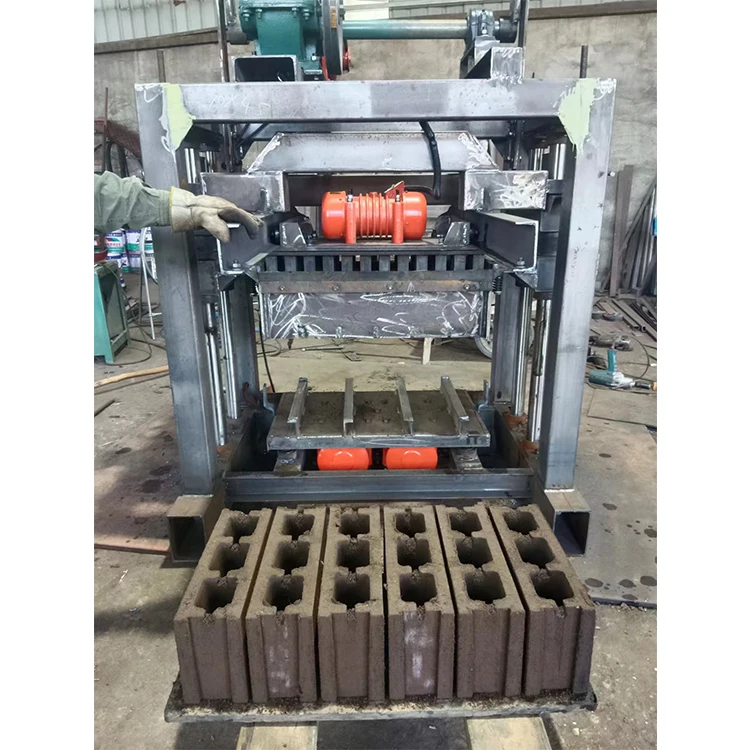
Matched System Line Integration — The QTJ4-40 press is specified alongside its raw material feeding, mixing, pallet circulation, and stacking stations so the 40-second molding cycle is never bottlenecked by upstream or downstream equipment mismatched to the buyer’s local mix and output target.
Technical Specifications
| Parameter | Value |
|---|---|
| Model | QTJ4-40 |
| Product Type | Semi-Automatic Concrete Block Making Machine |
| Rated Power | 10.4 kW |
| Molding Cycle | 40 s |
| Theoretical Productivity (400×200×200mm hollow block, 4 pcs/mould) | 360 pcs/hour, 2800 pcs/day |
| Theoretical Productivity (400×150×200mm hollow block, 5 pcs/mould) | 450 pcs/hour, 3600 pcs/day |
| Theoretical Productivity (225×112.5×60mm solid brick, 9 pcs/mould) | 800 pcs/hour, 6400 pcs/day |
| Output Capacity | 2000-2500 pcs/8hours (basis not stated in source — confirm block format / material / thickness) |
| Raw Materials | Concrete, sand, cement, fly ash, lime, gypsum |
| Machine Weight | 1 T |
| Overall Dimensions (L×W×H) | 1350 × 1460 × 1800 mm |
| Pallet Size | 850 × 450 mm |
| Vibration System | Bed mould vertical vibration + upper mould compression vibration |
| Mould Actuation | Top die push and pull with automatic scraper |
| Automation Level | Semi-automatic |
| Voltage | According to local voltage (source value — verify against manufacturer catalog) |
Application Suitability
| Application | Material or Output |
|---|---|
| Small to medium-scale concrete block production | Crushed stone, river sand, and cement for hollow blocks |
| Solid brick manufacturing | Fly ash, lime, gypsum, and sand blends |
| Paver and interlocking brick production | Fine aggregate and cement mixes with pigment additives |
| On-site contractor block production | Locally sourced sand and cement with portable pallet circuits |
Why the Line Around the Press Decides Your Real Daily Output
A semi-automatic block making machine production line only achieves its quoted cycle rate when the mixer batch size, pallet return speed, and stacking station cadence are all matched to the press.
Quotations often list the press output based on a 40-second cycle without accounting for how long the operator takes to feed the next pallet or clear the cured stack. When the mixer is undersized, the press waits for the next batch, and a theoretical 2800 hollow blocks per day drops to half that figure before the shift ends. I have seen lines where the buyer invested heavily in the press but left pallet handling and stacking completely manual, creating a bottleneck that no machine upgrade could fix. [NEED_CITE: common bottlenecks in semi-automatic block production lines]
How the 40-Second Cycle Dictates Line Station Sizing
The semi-automatic block making machine production line revolves around the QTJ4-40 completing one press cycle every 40 seconds. This means the mixer must discharge a fresh batch within that window, the pallet feeder must deliver a clean pallet in position, and the operator or stacking station must remove the loaded pallet before the next cycle begins. If any one of these stations lags, the press sits idle and the quoted capacity becomes irrelevant. Line planning starts from this cycle constraint and works outward.
Pallet Circuit and Curing Area Alignment
The 850 × 450 mm pallet size must be validated against the buyer’s existing curing racks and forklift tine spacing before the line is finalized. A mismatch here means wet blocks are stacked on the floor by hand while the press waits, or pallets do not fit the curing racks already on site. The pallet material — whether bamboo, PVC, or steel — also affects block surface finish and pallet return weight, which in turn changes how fast the operator can cycle them back to the press station. [NEED_CITE: pallet material and surface finish relationship in block production]
Interpreting Vibration and Actuation Specs for Mix Design
The dual vibration system combines bed mould vertical vibration with upper mould compression vibration, which together compact the concrete mix into the mould cavity more uniformly than single-direction vibration alone. For buyers using locally sourced river sand with higher fines content, this dual action helps achieve consistent block density across different formats. The top die push-pull mechanism with an automatic scraper controls the upper mould pressure and cleans excess material, reducing the manual finishing required after each cycle. These specs matter most when the buyer’s aggregate differs from the factory test mix.
The Hidden Cost of Specifying Stations in Isolation
When supporting stations are quoted separately from the press, the mixer may be rated for a batch volume that cannot keep pace with the 40-second cycle, or the pallet feeder may be too slow for continuous operation. The buyer then faces unplanned downtime, extra labour to manually shuttle pallets, and daily output that never approaches the press’s rated capacity. These mismatches are not visible in individual station specifications but only emerge once the full line is running on site. [NEED_CITE: production losses from unmatched station throughput in block plants]
Why Specifying the Full Line Reduces Commissioning Risk
The QTJ4-40 is configured as part of a matched system rather than assembled from unrelated suppliers, so raw material feeding, mixing, pallet circulation, and stacking are all sized against the same 40-second cycle. Voltage, frequency, and control language are confirmed before production begins, eliminating the delays that occur when a machine arrives with the wrong electrical configuration. Mould options are selected based on the block formats the buyer’s local market actually sells, not a catalogue default. The line layout document states which block format each output figure assumes, so there is no gap between quoted capacity and achievable daily production. [NEED_CITE: documentation standards for block production line quotations]
Documentation & Verification
- Line layout showing mixer batch size and pallet return speed matched to the QTJ4-40 cycle
- Capacity calculation stating the specific block format assumed for each output figure
- Pallet specification confirming 850 × 450 mm dimensions and material against buyer’s curing setup
- Voltage and frequency confirmation sheet signed before production release
- Factory test record run on the buyer’s specified block format and mix proportion
- Hydraulic and electrical schematic for on-site troubleshooting and spare parts ordering
Installation, Commissioning & Support
- Foundation requirements based on the 1350 × 1460 mm footprint and 1 T machine weight
- Dedicated power circuit sized for the 10.4 kW rated power with correct voltage and frequency
- Machine arrives partially assembled with top die and vibration unit pre-mounted for faster setup
- First-run commissioning includes mix proportion adjustment to local sand and cement
- Operator training covers 40-second cycle pacing, pallet loading sequence, and mould change procedure
- Wear parts list provided with mould scraper and vibration pad replacement intervals
What to Include in Your Line Inquiry
To size a semi-automatic block making machine production line accurately, share the block formats you plan to produce daily, your target output per shift, and the local aggregate and cement type available on site. Confirm your workshop dimensions, curing area layout, and existing forklift capacity so the pallet circuit can be designed around your infrastructure rather than a default configuration. State your local voltage, frequency, and preferred control panel language to avoid commissioning delays.
Frequently Asked Questions
Q: How is the 2000–2500 pcs/8h capacity calculated, and which block format does it assume?
A: That figure is listed without a stated basis in the source data, so it must be confirmed against your specific block format, wall thickness, and mix design before treating it as a firm daily target. The theoretical productivity table above shows separate figures for 400×200×200mm hollow blocks and 225×112.5×60mm solid bricks to illustrate how format changes the output.
Q: What mixer batch size and pallet return speed keep the press from idling between cycles?
A: The mixer must discharge a full batch within the 40-second molding cycle, and the pallet feeder must place a clean pallet before the next press stroke. Line planning calculates these intervals against your chosen block format, since larger hollow blocks consume more mix volume per cycle than smaller solid bricks, requiring a larger mixer or faster discharge rate.
Q: How should the 850 × 450 mm pallet size be validated before ordering?
A: Measure your curing rack shelf spacing and forklift tine width to confirm the pallet fits both. Pallet material also affects how wet blocks handle during transport to the curing area and how the block surface finishes. These measurements must be part of the line quotation so pallets arrive matching your existing infrastructure.
Q: Which supporting stations are included in the line quotation versus buyer-supplied?
A: The line quotation should specify raw material feeding, mixing, pallet circulation, and stacking stations matched to the QTJ4-40 cycle. Clarify which items are included and which the buyer provides, such as curing racks, forklifts, or water supply, so no gap appears during installation.
Q: What electrical details must be confirmed before the machine enters production?
A: Voltage, frequency, and control panel display language must be locked in before manufacturing begins. A mismatch in any of these causes commissioning delays after arrival, requiring on-site electrical modifications or component replacement that could have been avoided with upfront confirmation.