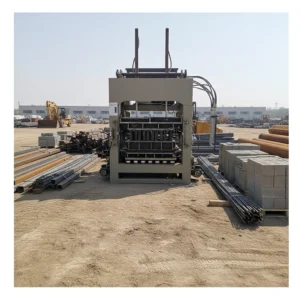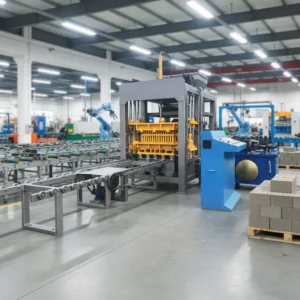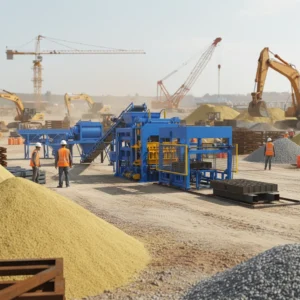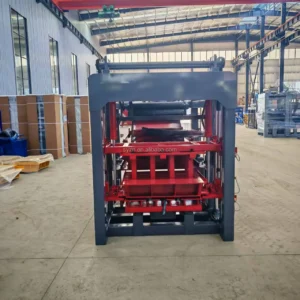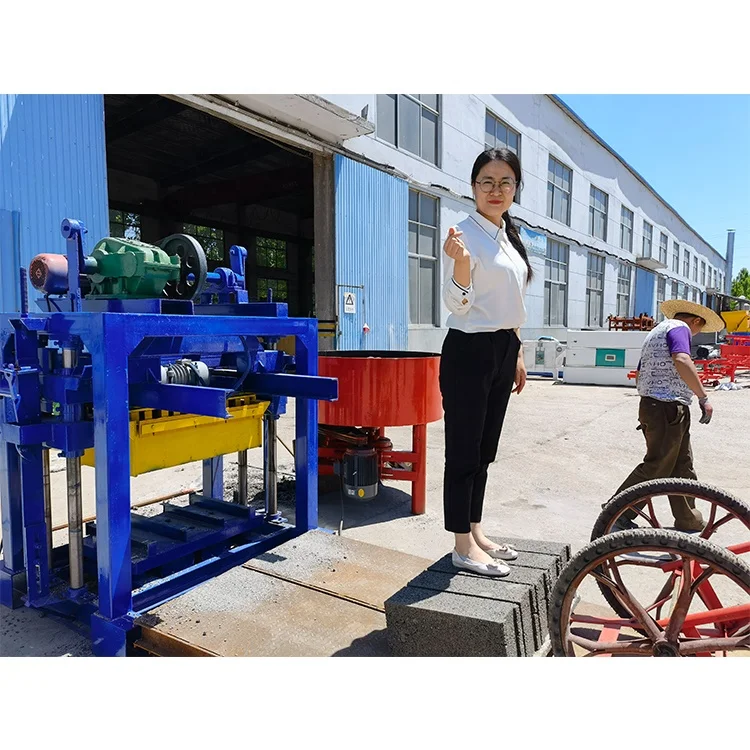
Integrated Line Rhythm — every upstream and downstream station around the QTJ4-40 is cycle-matched to its 40-second moulding tempo so the press never idles waiting for pallets or mixed material.
Technical Specifications
| Parameter | Value |
|---|---|
| Model | QTJ4-40 |
| Product Type | Semi-Automatic Concrete Block Making Machine |
| Machine Power | 10.4 kW |
| Molding Cycle | 40 seconds |
| Output Capacity | 2,000–2,500 pcs / 8 hours (basis not stated in source — confirm block format) |
| Theoretical Productivity (Hollow) | 360 pcs/h, 2,800 pcs/day based on 400×200×200mm, 4 pcs/mould |
| Theoretical Productivity (Solid) | 800 pcs/h, 6,400 pcs/day based on 225×112.5×60mm, 9 pcs/mould |
| Raw Materials | Concrete, sand, cement, fly ash, lime, gypsum |
| Machine Weight | 1 T |
| Overall Dimensions (L×W×H) | 1350×1460×1800 mm |
| Pallet Size | 850×450 mm |
| Automation Level | Semi-automatic (top die push/pull, automatic scraper, bed mould vertical vibration, upper mould compression vibration) |
| Voltage | Configured to local supply (voltage and frequency to be confirmed) |
| Control System | Not stated in source |
| Hydraulic Pressure | Not stated in source |
| Vibration Force | Not stated in source |
| Mould Change Time | Not stated in source |
| Key Features | Bed mould vertical vibration, upper mould compression vibration, automatic scraper, top die push/pull mechanism |
Application Suitability
| Application | Material or Output |
|---|---|
| Small-scale hollow block production | Crushed stone, sand, cement and fly ash aggregate |
| Solid clay-format brick manufacturing | Sand, cement, lime and gypsum blends |
| On-site contractor block production for housing projects | Locally sourced concrete and sand |
| Paving block and interlocking brick runs | Cement-bound aggregate with fine sand |
| Medium-volume building material supply | Mixed fly ash and cement raw feed |
Why Quoted Output Rarely Matches Day-One Production
A press that moulds every 40 seconds is only as fast as the slowest station feeding or clearing it.
Many buyers receive a capacity figure that assumes the mixer has already delivered fresh material and a pallet is already in position. In practice, the concrete block making machine production line stalls because the batch mixer runs a longer cycle than the press, or the operator is still carrying the last pallet by hand when the next cycle starts. I once laid out a line in West Africa where the QTJ4-40 was waiting nearly half its shift for mixed concrete — the mixer was rated for a different volume entirely. [NEED_CITE: line balancing principles for semi-automatic block plants]
Matching every station to the 40-second press cycle is the difference between a plant that runs at its stated rhythm and one that quietly loses half its day.
How Each Station Keeps the 40-Second Rhythm
The QTJ4-40 completes a moulding cycle every 40 seconds, which sets the heartbeat for the entire concrete block making machine production line. The raw material feeder and mixer must deliver a fresh batch to the hopper within that window, otherwise the press sits idle. Pallet feeding must place a clean board under the mould before the scraper clears the previous block. When every station is timed against the same cycle, the line runs continuously without operator guesswork.
Pallet Circuit and Curing Area Sizing
The 850×450 mm pallet size is the dimension that governs everything downstream. Curing rack spacing, forklift tine width, and the pallet-return conveyor width all derive from this measurement. If the pallets specified for the press do not match the racks already standing in the yard, the buyer faces either a rack rebuild or a pallet reorder before the first block cures. Confirming pallet material — bamboo, plywood or steel — against the curing environment and forklift capacity avoids that mismatch. [NEED_CITE: pallet material selection for concrete block curing]
Reading the Numbers That Matter
The 10.4 kW machine power determines the electrical panel rating and the minimum generator capacity when grid supply is unreliable. Plant owners sizing a transformer or backup set must add mixer, conveyor and lighting loads on top of the press draw. The overall footprint of 1350×1460×1800 mm defines the press bay, but clearance on both sides is needed for mould-change access and pallet infeed and outfeed paths. Vibration force and hydraulic pressure, once confirmed against the buyer’s mix design, directly govern block density and compressive strength — a light vibration on a stiff aggregate produces weak blocks, while excessive pressure on a lean mix causes cracking at demoulding. The semi-automatic scraper and top die mechanism reduce the operator’s physical load but still require a dedicated worker at the pallet-return end.
The Cost of Skipping Line Integration
When supporting equipment is treated as an afterthought, the press becomes the most expensive idle asset on the floor. A mixer that is slightly too small forces the press to pause between batches, and those pauses accumulate into lost pallets across a shift. Undersized pallet-return conveyors cause jams that stop the entire line while a worker clears the backlog. Buyers who select pallets without checking forklift compatibility end up moving cured blocks by hand, adding labour and breakage. [NEED_CITE: hidden costs of unbalanced block production lines]
Why Buyers Source the Full Line Here
Block machinery is the single focus of this operation, so the QTJ4-40 is specified alongside its mixer, pallet circuit and stacking stations as one matched system rather than assembled from separate suppliers. Configuration starts from the buyer’s actual mix design and local aggregate, not a catalogue default. Mould design covers the formats the buyer’s market actually sells, with custom drawings available when standard formats do not fit. Automation level is selectable — a buyer can begin with manual pallet handling and add automatic stacking later as volume grows. Installation support includes on-site commissioning and operator training so the line reaches its cycle rhythm from the first production day.
Documentation & Verification
- Line layout drawing with cycle time stated per station so the QTJ4-40 is never the bottleneck
- Capacity calculation naming the block format and pallet count assumed for daily output
- Pallet specification sheet matched to curing rack dimensions and forklift rating
- Voltage, frequency and control language confirmation record before production begins
- Factory test record showing the press running its full 40-second cycle under load
Installation, Commissioning & Support
- Foundation plan sized to the 1350×1460 mm press footprint and vibration load transfer
- Dedicated electrical circuit rated for the 10.4 kW draw plus starting surge of the vibration motor
- Machine ships partially assembled; press frame, hopper and scraper bolt up on site
- First-run cycle timing verified against every upstream and downstream station before handover
- Operator training covers mould change sequence, scraper adjustment and pallet feed alignment
- Wear parts list identifies vibration springs, scraper blades and mould liners for first reorder
What to Prepare Before Requesting a Quote
To size a balanced concrete block making machine production line around the QTJ4-40, share the target block formats and daily volume you need to hit. Confirm the raw materials available locally — especially aggregate grading and cement type — along with the voltage and frequency at your site. If you already have curing racks, forklifts or a mixer in place, send their specifications so the pallet circuit and batching station can be matched rather than duplicated.
Frequently Asked Questions
Q: How is the daily output of the complete line calculated, and which block format is assumed?
A: Daily output is calculated from the 40-second moulding cycle multiplied by the number of blocks per mould for a specific format. For example, 400×200×200 mm hollow blocks at four per mould yield a theoretical 2,800 pieces per eight-hour day. The actual line output also depends on mixer delivery rate and pallet return speed keeping pace with the press.
Q: Which supporting stations are included in the quotation, and which are buyer-supplied?
A: The quotation can cover the raw material feeder, mixer, pallet feeder and return conveyor, the QTJ4-40 press, and curing rack handling. Items such as the curing yard surface, forklift and water supply are typically buyer-provided. The scope is confirmed during the line layout stage before pricing is finalized.
Q: How do pallet size and material affect curing rack design and forklift selection?
A: The 850×450 mm pallet defines the rack slot width and spacing, as well as the forklift tine spread needed to move stacked pallets. Bamboo pallets require different rack support bars than steel pallets. Confirming these choices early prevents a situation where delivered pallets do not fit existing racks or forklift carriages.
Q: What electrical load does the full line draw, and what generator capacity is needed?
A: The QTJ4-40 press draws 10.4 kW, and the total line load adds the mixer motor, conveyor drives and lighting. A generator must cover the combined running load plus the starting surge of the largest motor. Voltage and frequency are confirmed before production so the control panel matches the site supply.
Q: Can the line be staged, starting with the press and adding automation later?
A: Yes. The semi-automatic QTJ4-40 can start with manual pallet handling and a standalone mixer. Automatic pallet feeding, stacking and cubing stations can be added as volume grows, provided the pallet size and line layout were planned for that upgrade path from the beginning.