
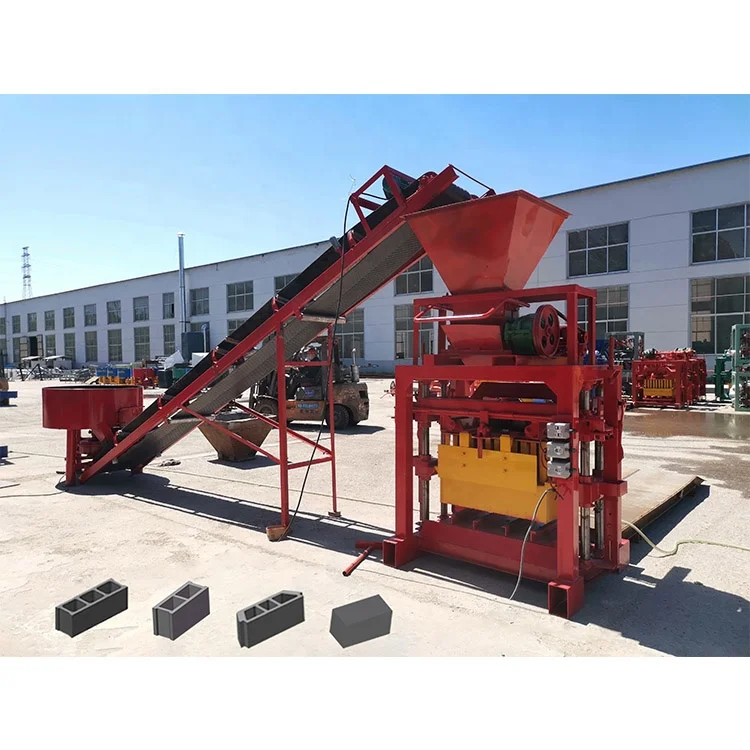
Line-matched station sizing — the QTJ4-35 is supplied as a coordinated press, mixer and conveyor set rather than a standalone unit, so material flow between stations is verified before dispatch.
Technical Specifications
| Parameter | Value |
|---|---|
| Model | QTJ4-35 |
| Product Type | Stationary Manual Block Making Machine |
| Overall Dimensions (L×W×H) | 2050 × 1660 × 1900 mm |
| Mould Formats | 390×190×190 mm (4 pcs/mould), 390×240×190 mm (3 pcs/mould), 390×120×190 mm (6 pcs/mould), 240×115×53 mm (21 pcs/mould) |
| Moulding Cycle | 35 s |
| Output Capacity | 3200 pcs/day (basis not stated in source — confirm block format, shift length and material) |
| Pallet Size | 850 × 450 mm |
| Vibration Form | Platform vibration |
| Vibration Force | 32 kN |
| Host Machine Power | 9.7 kW |
| Simple Line Power | Host 9.7 kW + 6 m belt conveyor 0.75 kW + small mixer 5.5 kW |
| Total Power Supply Requirement | 16 mm² cable, 100 A master switch with leakage protection |
| Automation Level | Manual (semi-automatic line option with conveyor and mixer) |
| Raw Material Compatibility | River sand, mechanism sand, gravel, crushed stone, slag, cinder, fly ash, pumice, perlite, shale, lightweight concrete |
Application Suitability
| Application | Material or Output |
|---|---|
| Small-scale hollow block plant | Crushed stone, river sand and cement on 390×190×190 mm format |
| On-site contractor block production | Local gravel and fly ash blends for wall construction |
| Paving and solid brick startup | Mechanism sand with 240×115×53 mm solid brick mould |
| Lightweight block manufacturing | Pumice, perlite or shale aggregate in 390×240×190 mm cavity format |
| First-time entrepreneur block line | Mixed aggregate with semi-automatic conveyor and mixer configuration |
Why "3200 Pieces per Day" Means Nothing Without the Full Line Context
The headline output figure only holds when every station — mixer discharge, conveyor feed and press cycle — is timed to the same rhythm.
I once watched a buyer order a QTJ4-35 based on a brochure number, then pair it with an undersized mixer sourced locally. The press finished its 35-second cycle and sat idle waiting for the next batch. Pallets piled up at the discharge end with nowhere to go. The stationary block making machine production line stalled for two weeks until we flew out and reconfigured the material flow [NEED_CITE: on-site commissioning delays caused by station mismatch]. That experience changed how I quote every line since: the number on the spec sheet belongs to a system, not a single press.
How the Three Stations Connect on a Compact Footprint
The stationary block making machine production line centres on the host press at 9.7 kW, flanked by a 6 m belt conveyor at 0.75 kW and a small mixer at 5.5 kW. The mixer discharges directly onto the conveyor belt, which feeds the host hopper at a rate matched to the 35-second moulding cycle. Station-to-station distances are set during installation so the conveyor neither starves nor overfills the hopper between cycles.
Where the Line Breaks Down If One Station Falls Behind
When the mixer cannot discharge fast enough, the conveyor runs empty and the press completes a cycle with a partially filled hopper, producing blocks with inconsistent density. When the conveyor outpaces the press, material accumulates at the hopper mouth and hardens between shifts. Each scenario forces the operator to intervene manually, defeating the purpose of adding the semi-automatic line configuration in the first place [NEED_CITE: block density variation from inconsistent feed rates].
Reading the Specs That Actually Determine Daily Output
Platform vibration at 32 kN must be matched to the mould area and the mix design. A stiffer aggregate like crushed stone requires full vibration force to achieve compaction, while lightweight materials such as perlite need reduced amplitude to avoid segregation. The 850×450 mm pallet size dictates how many pallets must be in circulation for continuous cycling — too few and the press waits for pallets to return from the curing area. The total line power draw across all three stations requires a 16 mm² supply cable and a 100 A leakage-protected master switch; undersizing the cable causes voltage drop that weakens the vibration motor and shortens its service life.
The Hidden Cost of Treating the Press as a Standalone Purchase
Buyers who order the host machine alone and add a locally sourced mixer later often find the discharge height does not align with the hopper inlet. Material spills onto the floor, requiring manual shovelling between every cycle. Pallet handling and curing rack systems are typically excluded from the quotation, leaving fresh blocks stacked by hand on whatever flat surface is available [NEED_CITE: manual handling injuries in small block plants]. The result is a line that technically produces blocks but cannot sustain the rhythm needed for consistent daily volume.
What We Specify Differently for This Machine Class
We treat the QTJ4-35 as the centre of a line, not a standalone catalogue item, so the mixer, conveyor and press are quoted and tested as one matched set. The mould format and cycle time are calculated against the buyer’s target block type and local aggregate rather than a default catalogue figure. Pallet size and material are confirmed against the buyer’s existing curing area and forklift capacity before production begins. Voltage, frequency and control language are locked in writing before dispatch so commissioning is not delayed by a mismatch at the panel. Wear parts and mould drawings are supplied with the shipment so the first replacement does not halt production.
Documentation & Verification
- Line layout drawing showing station placement and power drop points for the QTJ4-35 configuration
- Capacity calculation stating the specific block format and shift length behind the output figure
- Pallet specification sheet confirming 850×450 mm size, material and included quantity
- Voltage and frequency confirmation matched to site supply before production starts
- Factory test record run on buyer-specified mould format before crate closure
- Hydraulic and electrical schematic with leakage protection ratings for the 100 A master switch
Installation, Commissioning & Support
- Foundation pad sized for 2050 × 1660 mm host footprint with anchor bolt template
- Dedicated 16 mm² circuit with 100 A leakage-protected switch for the three-station line
- Host, conveyor and mixer shipped dismantled with bolt-together assembly on arrival
- Vibration force calibrated to buyer’s aggregate sample during on-site commissioning
- Operator training covering mould change across all four included formats
- Wear parts list identifying platform springs and hydraulic seals for first reorder
What to Include With Your Inquiry
Share the block format your market actually sells and the daily volume you need to sustain, so we can confirm whether the 35-second cycle delivers that volume on your specific mould. Tell us what aggregate is available locally — river sand, crushed stone, fly ash or a blend — because the vibration setting and mix ratio depend on it. Confirm your site voltage, frequency and the language your operators read on the control panel.
Frequently Asked Questions
Q: What does "3200 pcs/day" actually mean for the QTJ4-35?
A: That figure depends entirely on which block format is running, the shift length and how consistently the mixer and conveyor feed the press. On the 390×190×190 mm hollow block at four pieces per cycle, the maths works differently than on the 240×115×53 mm solid brick at twenty-one pieces. We state the output per format so you can plan against the product you actually sell.
Q: How do the mixer, conveyor and host hopper align on this line?
A: The mixer discharges onto the belt conveyor, which runs into the host hopper at a rate timed to the 35-second moulding cycle. If one station slows — a clogged mixer discharge or a belt running too fast — the press either starves or overfills, and block density suffers. Station heights and distances are set during installation.
Q: The host draws 9.7 kW but the full line needs more — how do I size the supply?
A: The complete three-station line draws across the host, the 0.75 kW conveyor and the 5.5 kW mixer simultaneously. We specify a 16 mm² feed cable and a 100 A master switch with leakage protection. Undersized cabling causes voltage drop at the vibration motor, weakening compaction and risking motor burnout.
Q: How many 850×450 mm pallets do I need for continuous cycling?
A: The number depends on your curing area layout and how quickly pallets return to the press. Too few pallets and the machine waits between cycles, cutting actual daily output well below the calculation. We confirm pallet quantity and material — bamboo, steel or PVC — against your existing curing racks and forklift before the order ships.
Q: Can I buy the host machine alone and add the conveyor and mixer later?
A: Yes, the host is available standalone. However, adding a locally sourced mixer later often means the discharge height does not match the hopper inlet, and material handling between stations becomes manual. Planning the full stationary block making machine production line from the start avoids costly retrofits.


