
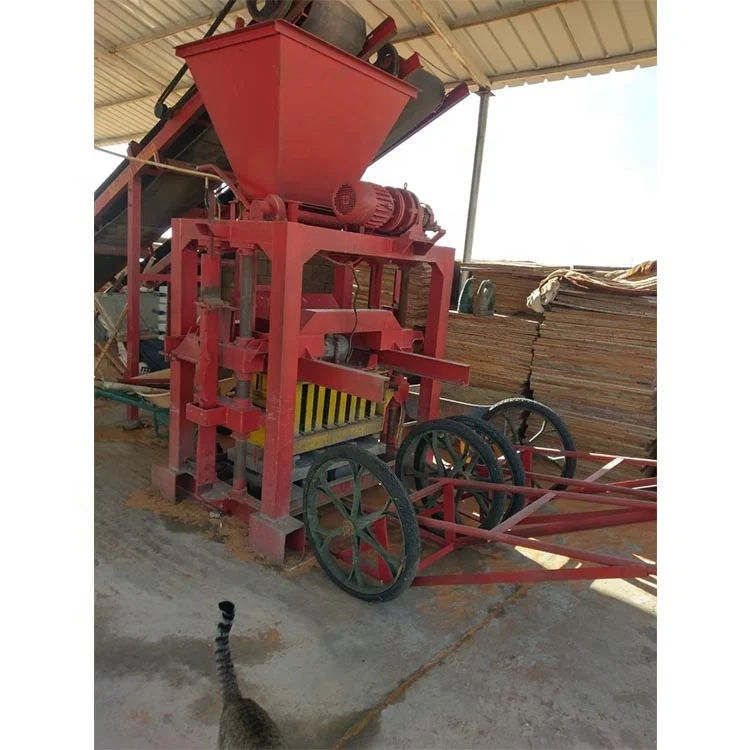
Complete station matching — The QTJ4-35 block making machine production line layout defines press cycle, mixer feed rate and pallet dimensions together before dispatch, preventing the common bottleneck where upstream stations outpace the press.
Technical Specifications
| Parameter | Value |
|---|---|
| Model | QTJ4-35 |
| Product Type | Concrete Block Making Machine |
| Overall Dimensions (L×W×H) | 1350×1460×1800 mm |
| Molding Cycle | 35 s |
| Vibration Frequency | 2800 r/min |
| Vibration Force | 30 kN |
| Total Power | 11.15 kW |
| Mixer Model | JQ350 |
| Pallet Size | 850×450×20 mm |
| Net Weight | 1500 kg |
| Output Capacity | 408 pcs/h (based on 400×200×200 mm hollow block, 4 pcs/mould) |
| Output Capacity | 510 pcs/h (based on 400×150×200 mm hollow block, 5 pcs/mould) |
| Output Capacity | 2100 pcs/h (based on 240×115×53 mm solid brick, 18 pcs/mould) |
| Automation Level | Semi-automatic (manual pallet handling) |
| Mould Format | Hollow block (8 inch, 6 inch), solid brick |
| Raw Materials | Crushed stone, sand, cement, dust, fly ash |
| Voltage & Frequency | To be confirmed with buyer |
| Control System | To be confirmed with buyer |
| Key Features | Semi-automatic operation, mechanical vibration, single-mould press, manual pallet transfer |
Application Suitability
| Application | Material or Output |
|---|---|
| Small-scale hollow block production | Crushed stone, sand, cement, fly ash for 8-inch and 6-inch blocks |
| Solid brick manufacturing for local supply | Cement and fine aggregate for 240×115×53 mm standard bricks |
| On-site block production for construction projects | Local aggregate and cement mixed at project location |
| Fly ash brick production for building material distributors | Fly ash, sand and cement blends |
| First-plant entrepreneur setup | Complete small-volume station from mixing to curing |
Why the Supporting Equipment List Decides Your Real Daily Output
A press rated for a 35-second cycle will wait idle if the mixer discharges every 50 seconds or the operator spends 20 seconds searching for the next pallet.
I spent three days on-site in West Africa watching a small block plant stall every fourth cycle. The mixer was oversized and dumped a full batch faster than the press could absorb, then sat empty while the next batch mixed. The block making machine production line looked correct on paper, but the rhythm between stations was never matched. The supporting equipment around the press — raw material feeding, mixing, pallet feeding and handling — determines whether the press runs at its stated cycle or spends half the shift waiting. [NEED_CITE: block production line synchronization standards]
Matching the JQ350 Mixer to the 35-Second Press Cycle
The JQ350 mixer included in this line scope is sized so that one discharge fills the hopper for roughly two to three molding cycles. This means the mixer batch time and the press cycle overlap instead of stacking sequentially. When the block making machine production line is planned as a single station rather than assembled from separate purchases, the mixer motor, drum volume and discharge gate opening are all set against the 35-second press cycle. The operator feeds raw materials at one end while the press completes its current cycle at the other, keeping material flow continuous without a surge bin in between.
Pallet Dimensions Define the Curing Area Before You Build It
The 850×450×20 mm pallet is not an arbitrary choice — it sets the footprint of every curing rack, the aisle width your forklift needs, and the square meters of shaded curing space required per day of production. Specifying pallet size inside the line quotation means the buyer can lay out the curing area on the same drawing as the press and mixer. When pallet dimensions are decided after the press arrives, operators often end up cutting replacement boards on-site or building curing racks that cannot stack the standard pallet, forcing blocks to cure flat on the ground where breakage climbs. [NEED_CITE: concrete block curing space requirements per pallet size]
Reading the Vibration and Pressure Numbers for Block Strength
The 30 kN vibration force at 2800 r/min works alongside hydraulic pressure to compact the concrete mix inside the mould cavity. Vibration frequency determines how thoroughly the mix settles around coarse aggregate, while the vibration force amplitude decides how much air is expelled before the block is ejected. For hollow blocks made with local crushed stone, the balance between these two values directly affects wall density and compressive strength. If the buyer switches to a finer sand or a higher fly ash content, the existing vibration setting may over-compact the mix, producing blocks that crack during curing because internal stress was locked in during pressing.
The Cost of Treating Pallets and Mixer as Afterthoughts
When pallet handling is excluded from the quotation, fresh blocks leave the press and sit on whatever surface the operator can find — often bare concrete where moisture wicks out too fast, leaving weak bottom courses. Manual pallet transfer also means the press cycle extends by however long the operator takes to slide the loaded pallet off and position an empty one. Over a full shift, those seconds compound into a noticeable gap between quoted and actual output. The same applies to mixer placement: if the JQ350 is positioned too far from the press hopper, material transport by wheelbarrow adds a variable delay that breaks the cycle rhythm. [NEED_CITE: manual pallet handling impact on block press cycle time]
Why Planning the Full Line Matters Here
Every station around the QTJ4-35 is specified on the same line layout drawing, so material flow direction, station spacing and utility connection points are defined before fabrication begins. The mixer discharge rate is calculated against the press molding cycle rather than selected from a catalogue default. Pallet material and quantity are stated in the quotation alongside the press, so curing rack design can proceed in parallel with machine production. Voltage, frequency and control panel language are confirmed during the proposal stage, preventing the common delay where a machine arrives on-site but cannot be powered until a transformer is sourced locally. The semi-automatic layout leaves clear station boundaries, so a buyer who later adds automatic pallet feeding or stacking can integrate those modules without replacing the press or mixer. [NEED_CITE: block plant automation upgrade path from semi-automatic stations]
Documentation & Verification
- Line layout drawing showing QTJ4-35 press, JQ350 mixer and pallet station positions with material flow arrows
- Capacity calculation sheet stating hourly output for each block format assumed in the quotation
- Pallet specification including board material, thickness tolerance and quantity loaded per container
- Voltage and control language confirmation record signed before production begins
- Factory test record with the buyer’s target block format and local aggregate sample
Installation, Commissioning & Support
- Foundation pad leveled to the 1350×1460 mm press footprint with anchor bolt template provided before shipment
- Dedicated electrical circuit sized for the 11.15 kW total connected load including mixer and press motors
- Machine shipped as a single press unit plus separate mixer and pallet stack, assembled on-site in sequence
- First production run supervised to verify the 35-second cycle holds with the buyer’s actual mix design
- Operator training covers mould change procedure, vibration adjustment and daily greasing points on the press
- Wear parts list identifies mould liners, vibration motor bearings and mixer blades with reorder part numbers
What We Need to Plan Your Line Layout
Send us the block formats you plan to sell, the daily volume you need to hit your project schedule, and the raw materials available within hauling distance of your site. Include your workshop or yard dimensions and the voltage and frequency at your connection point. If you already own forklifts or curing racks, share the pallet dimensions those assets were built around so the 850×450 mm pallet can be confirmed or adjusted before the line is finalized.
Frequently Asked Questions
Q: How is daily output calculated and which block format is assumed?
A: Each hourly capacity figure on this page states the exact block size and pieces-per-mould it is based on. Daily output is derived by multiplying the hourly figure by the number of effective working hours, subtracting mould change time and shift breaks. We provide a capacity calculation sheet with your quotation showing output for every format you plan to produce.
Q: What supporting equipment is included and what must I provide?
A: The line quotation covers the QTJ4-35 press, JQ350 mixer, pallets and the line layout drawing. The buyer typically provides the foundation, electrical connection to the main panel, water supply for mixing and the curing area. If you need raw material batching or automatic stacking added, those modules are quoted separately.
Q: How does the mixer feed rate match the 35-second press cycle?
A: The JQ350 drum volume and discharge gate are sized so one batch supplies roughly two to three press cycles. This lets the operator load raw materials into the mixer while the press completes its current cycle, keeping both stations busy without a surge bin between them.
Q: Can the pallet size be changed to fit my existing curing racks?
A: The 850×450×20 mm pallet is the standard for this press. If your curing racks or forklift are built around a different board size, we confirm whether the mould and press table can accommodate the change before the order is placed, and state any impact on cycle time.
Q: What is the upgrade path from this semi-automatic station?
A: The station boundaries are laid out so that automatic pallet feeding and stacking modules can be inserted later without replacing the press or mixer. We specify the mechanical and electrical interface points during the initial line layout so the upgrade does not require structural changes to the foundation.



