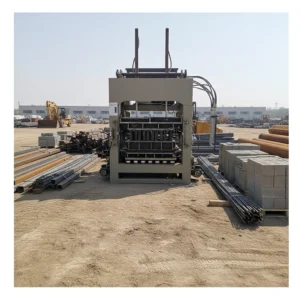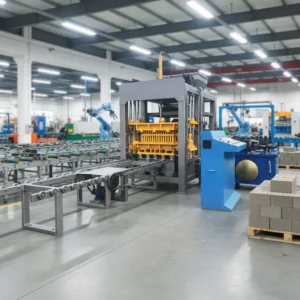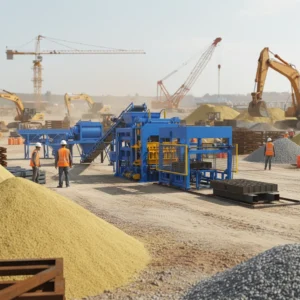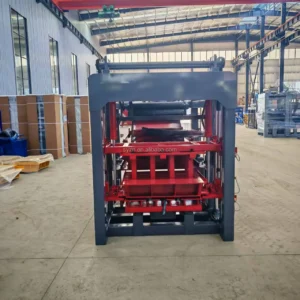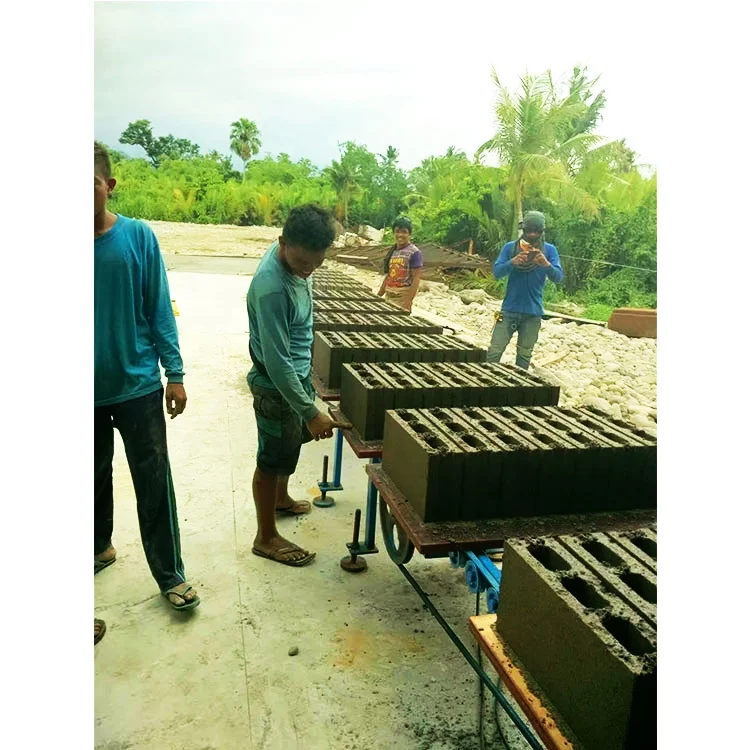
Integrated line balance — the QTJ4-25 press is specified alongside mixer output, pallet circulation, and curing workflow so no station starves or bottlenecks the next.
Technical Specifications
| Parameter | Value |
|---|---|
| Model | QTJ4-25 |
| Product Type | Semi-Automatic Concrete Block Making Machine |
| Overall Dimensions (L×W×H) | 6400×1500×2700 mm |
| Molding Cycle | 25 s |
| Vibration Frequency | 2800–5100 r/min |
| Vibration Force (Exciting Power) | 60 kN |
| Total Power | 17.9 kW |
| Mixer Model | JQ350 |
| Pallet Size | 850×550×20 mm |
| Total Weight | 2500 kg |
| Applied Products | Concrete hollow blocks (8 inch, 6 inch), solid bricks, pavers |
| Raw Materials | Crushed stone, sand, cement, dust, fly ash |
| Output Capacity | 480 pcs/h (basis: 390×190×190 mm hollow block, 4 pcs/mould) |
| Output Capacity | 600 pcs/h (basis: 400×150×200 mm hollow block, 5 pcs/mould) |
| Output Capacity | 2100 pcs/h (basis: 240×115×53 mm solid brick, 18 pcs/mould) |
| Hydraulic System | Hydraulic station equipped |
| Automation Level | Semi-automatic |
| Stacking Method | Manual pallet handling and stacking |
| Shipping Configuration | Shipped in 20GP container, nude packing |
Application Suitability
| Application | Material or Output |
|---|---|
| Small to medium hollow block plants | Crushed stone, sand, cement, fly ash mixes for 6-inch and 8-inch blocks |
| On-site production for building contractors | Local aggregate and cement blends on construction sites without fixed plant infrastructure |
| Solid brick manufacturing | Standard 240×115×53 mm bricks from sand-cement or fly ash-cement formulations |
| Paver and format expansion for existing plants | Interlocking pavers and kerbstones added to current block ranges via mould change |
What "Pieces per Hour" Leaves Out of a Block Machine Production Line
Cycle time at the press tells only part of the story — the mixer, conveyor, and pallet return must all keep pace or the press sits idle.
I remember a project where the buyer focused entirely on the press cycle, only to find the JQ350 mixer could not feed fast enough when switching to a denser fly ash mix. The conveyor dropped material slower than the hopper consumed it, and pallets piled up at the stacking end because two workers could not clear them in 25-second intervals. When planning turnkey block making equipment, every station between raw material in and cured block out needs a realistic time budget, not a catalogue number pulled from a single component [NEED_CITE: line balancing methodology for concrete product plants].
Mixer-to-Press Feed Rate Matching
The JQ350 pan mixer must discharge a full batch into the press hopper before the next molding cycle begins. If the mix is stiff — common with low water-cement ratios needed for high-strength hollow blocks — discharge slows and the 25-second cycle stretches. A block machine production line only holds its rated output when the mixer batch size and discharge time are calculated against the press consumption rate per format.
Pallet Circulation and Curing Area Coordination
With an 850×550×20 mm pallet, the return conveyor must bring empty pallets back before the press completes its next stroke. Semi-automatic operation means workers manually strip cured blocks and feed empty pallets back into the loop. If the curing rack spacing does not match this pallet dimension, or if the forklift tine width cannot handle 550 mm boards, pallets bottleneck at the curing end and the press stops [NEED_CITE: pallet circulation standards in semi-automatic block plants].
Station Interfaces That Determine Real Daily Output
Between the mixer discharge chute, belt conveyor, press hopper, pallet feeder, and return conveyor, there are at least five hand-off points where timing mismatches accumulate. Each adds seconds that do not appear on the press spec sheet but directly reduce daily throughput. Mapping these interfaces on a line layout drawing before production starts prevents costly rework after the equipment arrives on site.
Reading the Numbers That Actually Matter
Vibration force at 60 kN works with the hydraulic station to compact the mix during the 25-second cycle. Higher force does not automatically mean stronger blocks — the mix design and aggregate grading must match. The 2800–5100 r/min vibration frequency range allows the operator to tune compaction for different formats, from lightweight hollow blocks to dense pavers, but only if the raw material feed is consistent batch after batch. Total power of 17.9 kW across the press, mixer, and conveyor means the electrical supply must handle sustained draw without voltage drop, which directly affects motor torque and vibration consistency [NEED_CITE: electrical supply requirements for concrete block production equipment].
The Cost of Ignoring Line Balance
When the mixer undershoots the press demand, every molding cycle waits for material — a few seconds each time that add up to hours over a shift. When pallets cannot cycle back fast enough, wet blocks sit on the press table and get damaged before reaching the curing area. These problems do not show up in a quotation that lists only the press, but they dominate daily production reality and erode the output the buyer planned around [NEED_CITE: hidden bottlenecks in semi-automatic concrete block lines].
Why Specifying the Full Line Here Reduces On-Site Surprises
Machine, mould, pallet, and handling equipment are specified as one matched system rather than sourced separately. The line layout shows each station footprint and material flow direction so the buyer sees the full space requirement before ordering. Capacity calculations state output per block format with the mould and cycle time assumed, not a single headline number. Pallet specification accounts for curing rack dimensions and existing forklift capacity. Voltage, frequency, and control language are confirmed before production begins, so the line powers up without delay after arrival.
Documentation & Verification
- Line layout drawing showing mixer, conveyor, press, and pallet return station positions
- Capacity calculation sheet with output stated per block format and mould used
- Pallet material and thickness specification matched to curing rack spacing
- Hydraulic and electrical schematic with confirmed voltage and frequency
- Factory test record on buyer’s target block format before dispatch
- Operation and maintenance manual with wear parts and mould replacement list
Installation, Commissioning & Support
- Foundation pad sized for 6400×1500 mm footprint with vibration isolation
- Dedicated electrical circuit for 17.9 kW total load with voltage confirmed pre-production
- Press, mixer, and conveyor shipped in 20GP container for on-site assembly
- First-run cycle time verification against target block format and mix design
- Operator training on mould change, pallet feed, and manual stacking sequence
- Wear parts list covering vibration motor mounts, hydraulic seals, and mould liners
Preparing Your Line Inquiry
To size a block machine production line around the QTJ4-25, share your target block formats, daily output goal, local aggregate type and grading, available workshop length and curing area dimensions, site voltage and frequency, and whether existing forklifts or racks constrain pallet size. This information lets us map every station and confirm the line runs as a connected system from raw material to cured product.
Frequently Asked Questions
Q: How is daily output calculated when the line includes mixer batching, press cycle, and pallet return?
A: Daily output starts from the press cycle of 25 seconds per mould, then subtracts time for mixer discharge, pallet feed, and manual stacking. The result is stated per block format — for example, 480 pieces per hour on 390×190×190 mm hollow blocks — so the buyer can project a realistic shift total based on the actual product being run.
Q: What supporting equipment stations are included in the QTJ4-25 line?
A: The line covers the JQ350 mixer, belt conveyor, press with hydraulic station, pallet feeder, and return conveyor. Interfaces between stations are specified so material flow and pallet circulation match the press cycle. Stacking and curing remain manual at this automation level, with upgrade paths available later.
Q: How should pallet size be chosen for the curing area and forklift?
A: The 850×550×20 mm pallet must fit existing curing rack spacing and forklift tine width. If racks are already built, pallet dimensions are confirmed against them before production. Ordering pallets separately without checking rack and forklift compatibility leads to manual re-handling that slows the entire line.
Q: What electrical details must be confirmed before the line ships?
A: Voltage, frequency, and control display language are confirmed during the quotation stage. The 17.9 kW total load requires a stable supply to maintain vibration motor torque and hydraulic pump pressure. Mismatched voltage causes motor overheating and inconsistent block density across production runs.
Q: Can the semi-automatic QTJ4-25 line be upgraded to automatic stacking later?
A: Yes. The press and pallet return conveyor can accept an automatic stacker and cubing system added after the initial installation. Planning space for this upgrade during the first line layout avoids relocating stations when automation is introduced to reduce manual handling labor.