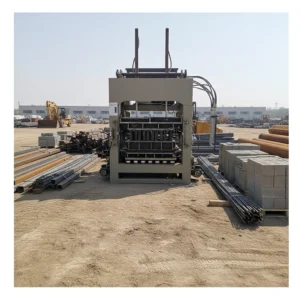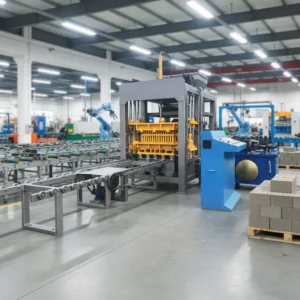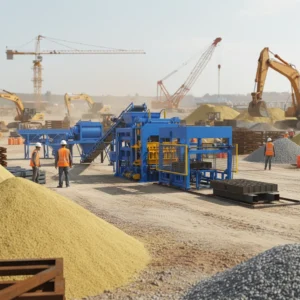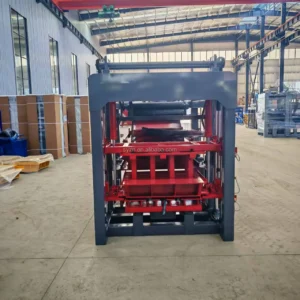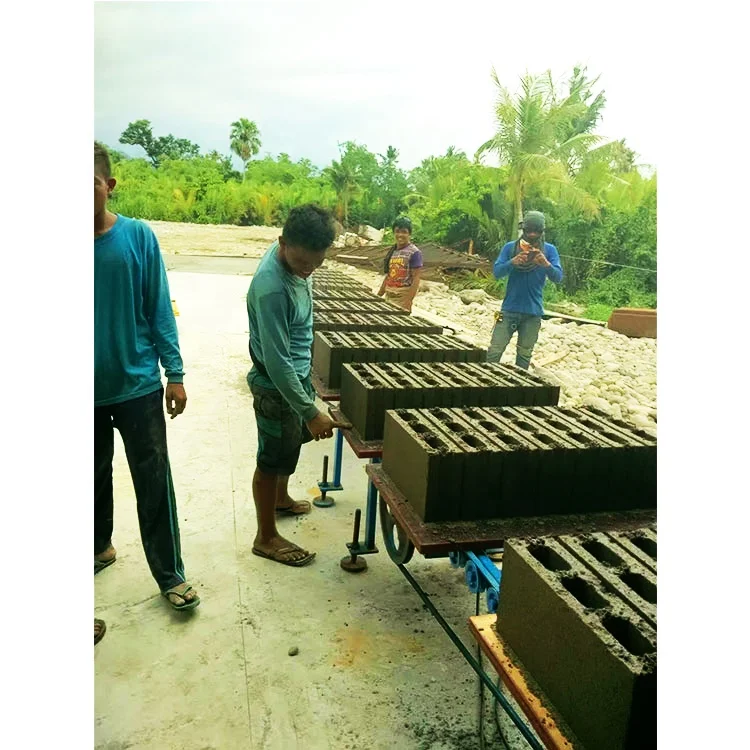
Matched Line Stations — QTJ4-25 cycle time of 25-30 s drives mixer discharge rate and pallet feed interval so the press never waits for upstream or downstream.
Technical Specifications
| Parameter | Value |
|---|---|
| Product Type | Kerb Stone Brick Making Machine |
| Model | QTJ4-25 |
| Overall Dimensions | 3060×1730×2580 mm |
| Rated Pressure | 16-21 MPa |
| Main Vibration Form | Platform Vibration |
| Vibration Frequency | 4200 r/min |
| Vibration Force | 45.5 kN |
| Pallet Size | 850×550 mm |
| Molding Cycle | 25-30 s |
| Overall Power | 14.9 kW |
| Total Mass | 4 T |
| Demolding Method | Vibration |
| Factory Area Required | 200 m² |
| Raw Materials | Crushed stone, sand, cement, fly ash, gravel, slag |
| Applied Products | Concrete blocks, hollow/solid blocks, pavers, interlocking blocks, curbstone, colored pavers |
| Warranty | 1 year |
Application Suitability
| Application | Material or Output |
|---|---|
| Kerbstone production for municipal road projects | Crushed stone and cement with high compaction density |
| Hollow block manufacturing for residential walls | Sand, cement and fly ash blends at 16-21 MPa rated pressure |
| Interlocking paver runs for commercial landscaping | Colored concrete mixes requiring consistent vibration force |
| Solid block output for load-bearing structures | Gravel and slag aggregates matched to local supply |
Why the Mixer Output Matters More Than the Press Cycle
A block production line only moves as fast as its slowest station, and the press is rarely the bottleneck.
When the QTJ4-25 completes a molding cycle in 25-30 seconds, the upstream mixer must discharge a fresh batch into the hopper before the next cycle starts. If the mixer takes 45 seconds to discharge, the press sits idle for a third of every minute. Downstream, if pallet return conveyors cannot clear and reset within the same window, the press again waits. I have watched a block production line in Central America where the press was technically capable but the supporting stations were sized from a generic catalogue, and the plant owner spent the first three months chasing throughput that never arrived [NEED_CITE: typical block line station mismatch consequences]. The turnkey block making equipment concept only holds when every station is specified against the same cycle target.
Station Timing Across the Full Block Production Line
A block production line built around the QTJ4-25 must treat the 25-30 second molding cycle as the master clock. Raw material feeding, mixing, pallet supply, and stacking stations each need a verified throughput that meets or slightly exceeds this interval. When a turnkey block making equipment proposal lists only the press capacity, the buyer inherits the risk of filling in the gaps with mismatched auxiliaries.
How Pallet Flow Determines Actual Daily Throughput
The 850×550 mm pallet size means every pallet in circulation must travel from the press to the curing area and back within a window that keeps the machine fed. If the curing rack layout or forklift capacity creates a pallet shortage at the feed station, the press stops. Line designers must calculate total pallets in rotation against curing time and return distance before the block production line can sustain continuous runs [NEED_CITE: pallet circulation calculation for block plants].
Reading the Core Specs for Line Integration
Platform vibration at 4200 r/min paired with 45.5 kN vibration force determines how quickly the concrete mix consolidates in the mould. This vibration profile must be matched to the buyer’s specific aggregate gradation and cement content, because a mix that is too dry or too coarse will not compact properly at this frequency. The 16-21 MPa rated pressure range provides the hydraulic clamping that holds the mould box stable during vibration. Pallet size of 850×550 mm must be checked against the buyer’s existing curing racks and forklift fork dimensions to avoid a situation where new pallets cannot be handled by current equipment. The 200 m² factory area requirement covers the press footprint plus material storage, mixing station, pallet return path, and curing rack space. Overall power of 14.9 kW for the press itself means the total connected load for the full block production line, including mixer, conveyors, and stacking units, will require a supply circuit sized well beyond that figure.
The Cost of Skipping Line-Wide Specification
When a buyer purchases the press alone and sources mixers, conveyors, and pallets separately, each supplier optimizes for their own equipment. The mixer supplier quotes a unit that meets batch volume but not discharge speed. The conveyor vendor supplies a belt that handles weight but not the return timing the press demands. The result is a block production line that technically runs but never reaches the throughput each component promised on paper [NEED_CITE: auxiliary equipment mismatch in block plants]. Commissioning delays multiply because voltage, control language, and PLC interfaces were never confirmed across the separate orders.
Why Sourcing the Full Line Together Matters
This approach treats the QTJ4-25 as the center of a coordinated turnkey block making equipment system rather than a standalone item. Machine, mould, pallet, and handling stations are specified as one matched set so cycle times align across every station. Configuration is set against the buyer’s actual mix design and local aggregate, not a catalogue default. Mould design covers the kerbstone, hollow block, and paver formats the buyer’s market actually sells. Automation level is selectable, allowing a plant to start with semi-automatic pallet handling and add stacking later. Installation and commissioning support includes operator training so the line reaches steady-state operation without prolonged trial and error.
Documentation & Verification
- Line layout drawing with capacity stated per block format and assumed mix design
- Machine specification sheet confirming vibration force, pressure, and pallet dimensions
- Pallet specification matched to buyer’s curing area layout and forklift capacity
- Hydraulic and electrical schematic for integration with existing plant utilities
- Voltage, frequency, and PLC display language confirmation before shipment
- Factory test record on buyer’s target block format before dispatch
Installation, Commissioning & Support
- Foundation pad sized to 3060×1730 mm footprint with vibration isolation for 45.5 kN force
- Dedicated power circuit for 14.9 kW press load plus separate feeds for mixer and conveyors
- Machine arrives assembled; pallet return and stacking frames bolt on at site
- First-run commissioning verifies 25-30 s cycle with buyer’s actual raw material blend
- Operator training covers mould change procedure across kerbstone and hollow block formats
- Wear parts list with hydraulic seals and vibration mounts identified for first reorder
What to Include in Your Inquiry
Send your target block formats with dimensions, the daily output you need for each format, and the raw materials available locally including aggregate type and gradation. Include your site dimensions and ceiling height so the 200 m² area requirement can be checked against your building. Confirm your local voltage and frequency along with preferred control language. If you have existing pallets, forklifts, or curing racks, provide their specifications so the line is designed around what you already operate.
Frequently Asked Questions
Q: How do I verify that the mixer output and pallet feeding rate match the QTJ4-25 cycle time?
A: Request a station-by-station capacity table from the supplier that lists each unit’s throughput in cycles per hour. Compare the mixer discharge time and pallet return interval against the 25-30 second molding cycle. Any station that takes longer than this window will force the press to idle, so the slowest station sets your real daily output.
Q: What pallet size and material should I choose given my curing area and forklift?
A: The standard 850×550 mm pallet must clear your curing rack spacing and fit your forklift fork width. Bamboo, PVC, and steel pallets each have different weight and lifespan characteristics. Confirm rack slot dimensions and fork capacity before ordering, because switching pallet material after delivery means replacing the entire circulating set.
Q: Which stations are included in the line quotation and which are buyer-supplied?
A: A complete turnkey block making equipment quotation should list raw material feeding, mixing, pallet supply, stacking, and curing rack handling individually. Clarify whether cement silos, water supply, and compressed air are included or assumed to be buyer-provided. Missing stations become bottlenecks that no amount of press tuning can fix.
Q: How is the line layout adapted when producing kerbstones, hollow blocks, and pavers on the same press?
A: Each format has a different mould weight, demolding time, and pallet loading pattern. The line layout must allow pallet flow and stacking stations to handle the largest and heaviest format you plan to run. Mould change procedure and storage position should be planned so format switches do not require moving heavy auxiliary equipment.