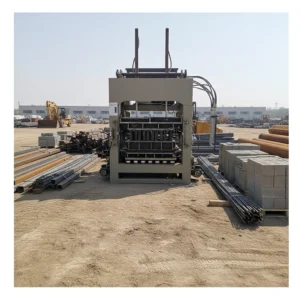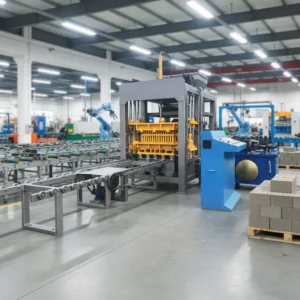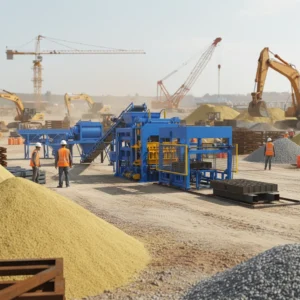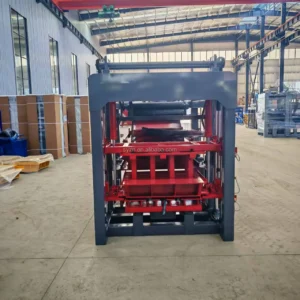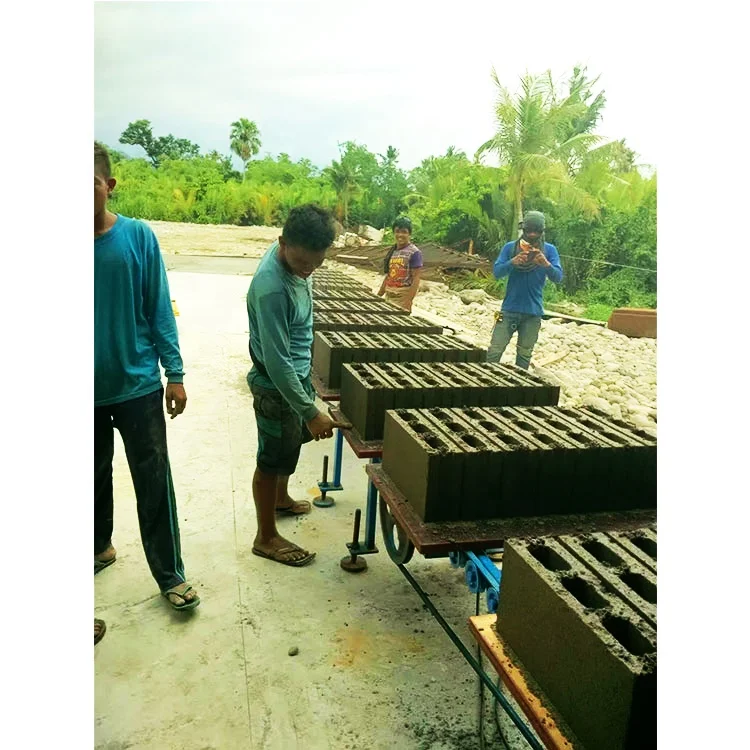
Matched Line Engineering — the QTJ4-25 is specified alongside its mixer, pallet return, and stacking stations so the press never waits for upstream or downstream equipment.
Technical Specifications
| Parameter | Value |
|---|---|
| Product Type | Kerb Stone Block Making Machine |
| Model | QTJ4-25 |
| Overall Dimensions (L×W×H) | 3060×1730×2580 mm |
| Rated Pressure | 16-21 MPa |
| Main Vibration Form | Platform Vibration |
| Vibration Frequency | 4200 r/min |
| Vibration Force | 45.5 kN |
| Pallet Size | 850×550 mm |
| Molding Cycle | 25-30 s (basis not stated in source) |
| Overall Power | 14.9 kW |
| Total Mass | 4 T |
| Demolding Method | Vibration |
| Factory Area | 200 m² |
| Warranty | 1 year |
Application Suitability
| Application | Material or Output |
|---|---|
| Kerb stone production | Concrete mixes with crushed stone and cement |
| Paving block manufacturing | Fly ash, sand, gravel, and cement blends |
| Hollow and solid block output | Slag, dust, and aggregate combinations |
| Interlocking and colored pavers | Pigmented concrete with fine aggregates |
What a "25-Second Cycle" Actually Means for Your block making machine production line
A cycle time is only valid when tied to a specific block format, mix design, and pallet return speed.
I have stood on job sites where the press finished its stroke, then sat idle because the mixer could not discharge fast enough or the pallet feeder jammed on warped boards. The QTJ4-25 completes a molding cycle in 25-30 seconds, but that figure assumes a particular block geometry and material consistency. When the upstream batching station delivers an uneven mix, the operator compensates by extending vibration time, and the quoted cycle stretches well beyond the brochure number [NEED_CITE: effects of mix variability on actual cycle time in concrete block production].
Keeping the Press Fed and the Pallets Moving
A block making machine production line lives or dies by its material flow. The QTJ4-25 demands a steady supply of mixed concrete at a rate that matches its cycle. If the batch mixer discharges every 40 seconds while the press finishes every 25, the press starves. Sizing the mixer to the press — and confirming discharge gate speed — removes that gap before the line is bolted down.
Pallet Circulation as a Constraint Point
With an 850×550 mm pallet, the return loop must carry each board from the stacking end back to the press inlay station within the molding cycle. If pallets stack up at the curing rack or the return conveyor runs slower than the press, output drops. Verifying pallet weight and surface flatness against the return conveyor’s load rating prevents mid-shift jams that halt the entire block making machine production line [NEED_CITE: pallet conveyor load rating standards for block plants].
Reading the Specs That Matter on the Floor
The 45.5 kN vibration force paired with 16-21 MPa hydraulic pressure determines how densely the concrete consolidates inside the mould. Higher vibration without sufficient hydraulic clamp force causes the mould to lift, producing blocks with uneven tops. The platform vibration form directs energy upward through the pallet, which works well for thinner formats like pavers and kerbstones where mould-fill uniformity is critical. The 4200 r/min frequency sits in a range that compacts fine aggregate mixes effectively, though coarser gravel blends may need vibration tuning during commissioning to avoid segregation.
The Cost of Ignoring Line Balance
When buyers purchase the press alone and bolt it to mismatched upstream equipment, the most common failure is pallet handling. Boards that do not meet the 850×550 mm specification jam the return conveyor, forcing operators to manually shuttle pallets — a task that pulls labor away from quality inspection. Voltage and frequency mismatches surface later, during commissioning, when the motor runs hot or the PLC display shows error codes in an unreadable language [NEED_CITE: common commissioning delays from unconfirmed electrical specifications].
Why Source the Full Line Here
Every quotation specifies the QTJ4-25 alongside its mixer capacity, pallet return conveyor, and stacking arrangement, so no station is left undefined. Machine configuration is set against your local aggregate and target block format rather than pulled from a default catalog. Mould design covers the formats your market actually buys, with custom drawings available when standard formats fall short. Pallet specifications — size, material, and weight — are confirmed against your existing curing racks and forklift before production begins. Electrical schematics include voltage, frequency, and PLC language confirmation, eliminating surprises when the container arrives at your site.
Documentation & Verification
- Line layout drawing showing each station position and pallet circulation path for the QTJ4-25 footprint
- Capacity calculation sheet stating which kerbstone or block format the cycle time assumes
- Pallet specification confirming 850×550 mm dimensions, material grade, and weight per board
- Hydraulic and electrical schematic with confirmed voltage, frequency, and control language
- Factory test record run on your specified block format before container loading
Installation, Commissioning & Support
- Foundation plan sized to the 3060×1730 mm footprint with anchor bolt positions marked
- Power feed specification matching the 14.9 kW total load on confirmed voltage and frequency
- On-site assembly supervision covering press leveling, pallet conveyor alignment, and mixer placement
- First-run parameter tuning including vibration duration and hydraulic pressure for your mix design
- Operator training on mould change procedure, daily lubrication points, and pallet inspection checks
- Wear parts list covering vibration springs, hydraulic seals, and pallet scraper blades for initial stock
Preparing Your Inquiry
To move from inquiry to a configured block making machine production line quotation, provide the block formats you intend to produce, your target daily output by format, and the raw materials available locally. Include your site’s voltage and frequency, the curing area dimensions, and any existing handling equipment such as forklifts or conveyors that the new line must connect to.
Frequently Asked Questions
Q: How do I confirm real daily output when the cycle time depends on block format?
A: Request a capacity calculation that lists cycle time and daily output for each specific block format you plan to produce, based on your confirmed mix design. A single headline number without a format reference does not reflect what the line will actually deliver on your floor.
Q: What supporting equipment must be included so the press never sits idle?
A: The mixer discharge rate, pallet feeder speed, and pallet return conveyor must all be timed to the press cycle. Omitting any of these stations means operators manually compensate, which reduces actual output below the quoted rate.
Q: How should I choose pallet size and material for my existing setup?
A: Cross-check the 850×550 mm pallet against your curing rack spacing, forklift fork width, and stacking height limit. Pallet weight and surface material also affect the return conveyor’s load rating and block release quality.
Q: How do I verify upstream mixing capacity matches the press cycle?
A: Confirm the mixer’s batch volume and discharge time against the QTJ4-25 cycle. If the mixer takes longer to discharge than the press takes to mold, the press will wait — and daily output drops accordingly.