
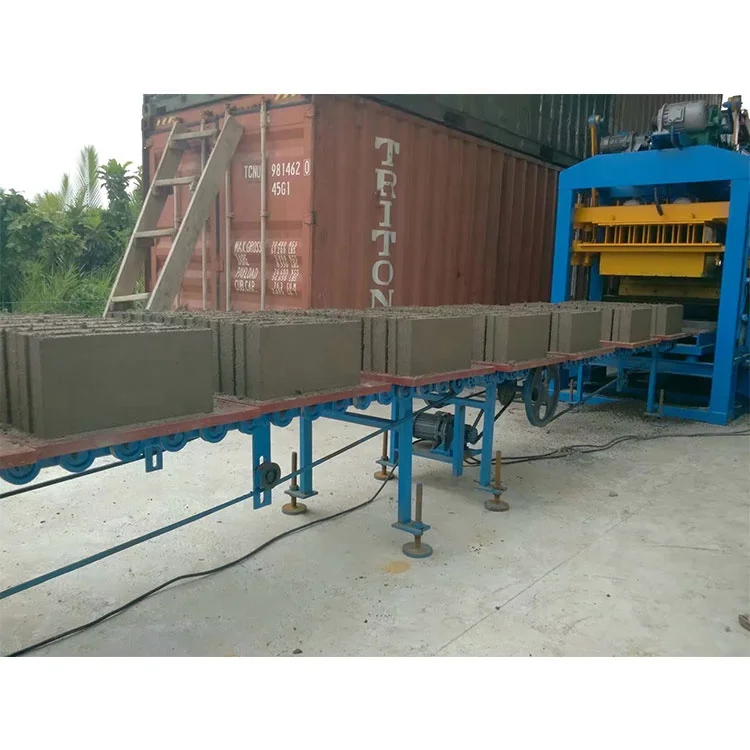
Line Synchronization — the QTJ4-25 press cycle is matched to upstream mixing output and downstream pallet return so no station idles while another waits.
Technical Specifications
| Parameter | Value |
|---|---|
| Product Type | Stationary Concrete Block Making Machine |
| Model | QTJ4-25 |
| Overall Dimensions (L×W×H) | 3060×1730×2580 mm |
| Total Mass | 4 T |
| Rated Pressure | 16–21 MPa |
| Main Vibration Form | Platform Vibration |
| Vibration Frequency | 4200 r/min |
| Vibration Force | 45.5 kN |
| Pallet Size | 850×550 mm |
| Molding Cycle | 25–30 s (basis not stated in source — confirm block format / material / thickness) |
| Overall Power | 14.9 kW |
| Demolding Method | Vibration |
| Factory Area Required | 200 m² |
| Warranty | 1 year (excluding spare parts) |
| Loading | 1×40HQ container (basic equipment) |
Application Suitability
| Application | Material or Output |
|---|---|
| Small to medium block plants | Hollow and solid concrete blocks from crushed stone, sand, and cement |
| Construction contractor on-site production | Interlocking blocks and curbstones using locally sourced gravel and slag |
| Paver and colored block manufacturing | Fly ash, dust, and sand mixes for paving formats |
| First block plant for entrepreneurs | Multiple format output on a single 850×550 mm pallet line |
What "25–30 Seconds per Cycle" Actually Means for Your Line
A cycle time is only as honest as the format, mix, and supporting equipment it assumes.
When a quotation lists a molding cycle without naming the block format or the aggregate blend it was measured on, buyers frequently discover that real daily output falls far short of expectation once the machine arrives. On job sites across West Africa and South Asia, I have watched operators push a stationary block making machine production line to its rated cycle on a clean sand mix, only to find that the local laterite-heavy aggregate doubles the press time and cuts strength below spec. The press itself is rarely the bottleneck — the mismatch between cycle assumption and actual raw material is [NEED_CITE: field testing standards for block press cycle validation].
Matching Every Station to the 25–30 s Press Heartbeat
The stationary block making machine production line built around the QTJ4-25 is designed so that the mixer discharge rate, belt feeder capacity, and pallet circulation loop all converge on the same 25–30 s interval. If the mixer delivers a fresh batch every 28 s but the pallet return takes 35 s, the press sits idle for seven seconds every cycle — compounding into hundreds of lost blocks per shift. The line specification therefore pairs a hopper feeder and platform mixer whose batch volume matches one pallet charge, keeping material at the press throat without overflow or starvation.
Pallet Circulation: Where Most Lines Lose Time
An 850×550 mm pallet is small enough to handle manually yet large enough to carry standard hollow and paving formats. The line layout positions the curing rack lanes parallel to the press discharge so that a single forklift circuit can collect loaded pallets and return empties without crossing the operator’s path. When pallet dimensions do not match the curing rack spacing or the forklift tine width already on site, pallets pile up beside the press and the stated factory area of 200 m² quickly turns into a bottleneck [NEED_CITE: pallet standardization in small-scale block plants]. Specifying pallet size against the buyer’s existing curing infrastructure is therefore the first step, not an afterthought.
Reading the Vibration and Pressure Numbers Together
The 45.5 kN vibration force at 4200 r/min works in combination with 16–21 MPa hydraulic pressure to compact the mix against the mould walls. Vibration alone settles the aggregate; pressure alone squeezes out air. Only when both are present at matched levels does the block leave the mould with sufficient green strength to survive the pallet transfer. For a laterite-rich sand with higher clay content, the upper end of the pressure range helps close micro-voids that vibration cannot reach, while a clean crushed-stone mix may achieve target density at the lower pressure setting, extending mould and hydraulic seal life.
The Cost of Ignoring Line Integration
A press quoted as a standalone unit often arrives to find no matching mixer output, no pallet return loop, and no curing rack plan. The result is operators hand-carrying loaded pallets to a distant yard, the press waiting for pallets to come back, and daily output settling at roughly half the quoted figure. Voltage and control language left unconfirmed until the crate is open add further delays — I have seen commissioning stretched by weeks because the PLC display arrived in a language the local electricians could not read, requiring a firmware swap before first production [NEED_CITE: commissioning delay causes in export machinery].
Why Procure the Full Line Here
Block machinery is our single focus, so the QTJ4-25 press, its moulds, pallets, and handling equipment are specified as one matched system rather than assembled from separate suppliers. Configuration is set against the buyer’s actual mix design and local aggregate, not a catalogue default. Mould design covers the formats the buyer’s market actually sells, including custom drawings to buyer specifications. Automation level is selectable, letting a plant start with manual pallet handling and add stacking later. Installation and commissioning include operator training on the exact line as delivered.
Documentation & Verification
- Line layout and capacity calculation stating the block format assumed for the quoted cycle time
- Machine specification sheet covering vibration force, pressure range, and pallet dimensions
- Mould drawing and format list for every block type included in the order
- Pallet specification matched to the buyer’s curing rack and forklift
- Voltage and control language confirmation signed off before production starts
- Factory test record on the buyer’s target block format before dispatch
Installation, Commissioning & Support
- 200 m² factory area with level concrete slab to support the 4 T machine mass and pallet circulation lanes
- Dedicated power circuit matching confirmed voltage and frequency for the 14.9 kW total load
- Machine dismantled into 1×40HQ container and reassembled on-site with alignment checks
- First-run parameter tuning of vibration frequency and hydraulic pressure to the buyer’s local aggregate
- Operator training covering mould change, pallet handling, and daily lubrication routines
- Wear parts and mould list supplied at order so replacement planning begins before first breakdown
What We Need to Size Your Line
Share the block formats you plan to sell, the daily output you need for each, and the aggregate materials available at your site. Confirm the voltage, frequency, and PLC display language your electricians require, along with the curing area dimensions and forklift capacity you already have on the ground.
Frequently Asked Questions
Q: How do upstream mixer output and downstream pallet return match the press cycle so the line never bottlenecks?
A: The mixer batch volume is set to fill one 850×550 mm pallet charge, and the belt feeder is timed to discharge within the 25–30 s press cycle. Downstream, pallet return lanes run parallel to the press so a forklift circuit collects loaded pallets and returns empties without interrupting the operator.
Q: Which pallet size and material should fit the curing area and forklift already on site?
A: The standard 850×550 mm pallet aligns with common curing rack spacing and standard forklift tine widths. If your existing racks or forklift differ, the pallet spec is adjusted before production so loaded pallets slot directly into your curing lanes without modification.
Q: What factory area and utility connections are needed for the complete line, not just the press?
A: The QTJ4-25 line operates within a 200 m² footprint including mixer, feeder, press, pallet circulation, and curing rack access. A level concrete slab, a dedicated power circuit matching confirmed voltage for the 14.9 kW load, and water access for mix preparation are the minimum utility requirements.
Q: How is raw material feeding configured to keep the press hopper supplied without manual intervention?
A: A platform mixer discharges into a belt feeder that delivers one pallet charge per press cycle. Hopper level sensors signal the mixer to start the next batch before the current charge is exhausted, maintaining continuous supply even when aggregate moisture varies batch to batch.
Q: Can stacking and cubing stations be added now or retrofitted later as volume grows?
A: The line layout reserves space and pallet flow direction for future stacking equipment. Starting with manual pallet handling keeps initial investment lower, and the mechanical interfaces for an automatic stacker are included in the base frame so retrofitting does not require structural modification.


