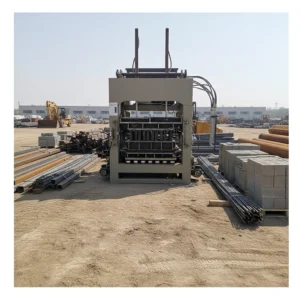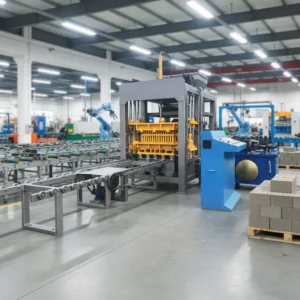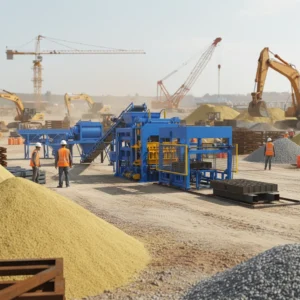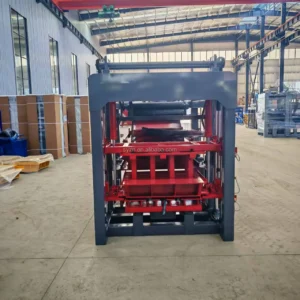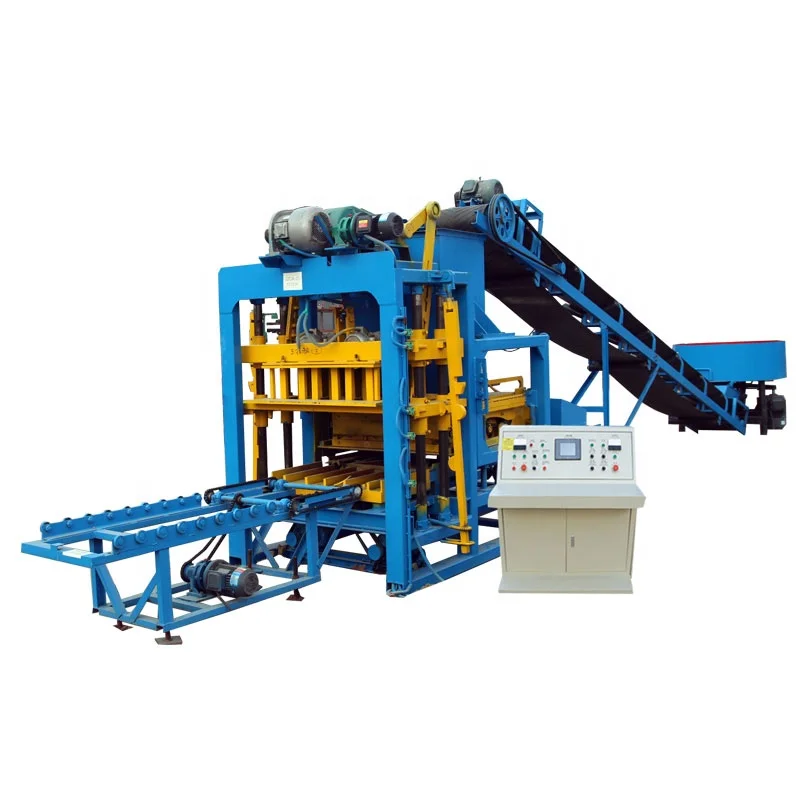
Line-Wide Cycle Matching — the QTJ4-25 press is only as fast as its slowest supporting station, so mixer output, pallet feed, and handling are specified against the 25-second molding beat before the line ships.
Technical Specifications
| Parameter | Value |
|---|---|
| Model | QTJ4-25 |
| Product Type | Concrete Block Making Machine |
| Overall Dimensions (L×W×H) | 6400×1500×2700 mm |
| Molding Cycle | 25 s (basis not stated in source — confirm block format and material) |
| Vibration Frequency | 2800–5100 r/min |
| Exciting Power | 60 kN |
| Total Power | 17.9 kW |
| Mixer Model | JQ350 |
| Pallet Size | 850×550×20 mm |
| Total Weight | 2500 kg |
| Control System | PLC with automatic plate-supplying, material-disturbing, and brick-discharging |
| Automation Level | Semi-automatic (manual stacking) |
| Output (Hollow 390×190×190 mm) | 4 pcs/mould, 480 pcs/h, 3800 pcs/8hr |
| Output (Hollow 400×150×200 mm) | 5 pcs/mould, 600 pcs/h, 4800 pcs/8hr |
| Output (Solid 240×115×53 mm) | 18 pcs/mould, 2100 pcs/h, 17000 pcs/8hr |
| Raw Materials | Crushed stones, sand, cement, dust, fly ash |
Application Suitability
| Application | Material or Output |
|---|---|
| Hollow block production (8 inch / 6 inch) | Crushed stone, sand, cement, fly ash blends |
| Solid brick manufacturing | Local aggregate and cement mixes |
| Small-scale block plant startup | Low-volume daily output with manual stacking |
| On-site construction block making | Project-limited footprint using site-available raw materials |
What the 25-Second Cycle Hides About Your Daily Output
The press never sets the real line speed — the slowest upstream or downstream station does.
A block production line supporting equipment setup that feeds material late or returns pallets slowly turns a 25-second cycle into a 40-second reality. I watched a mixer fall half a beat behind on a similar press line, and the host machine sat idle for over ten seconds every mould. Multiply that across an eight-hour shift and the daily shortfall reaches thousands of blocks. When planning a block line turnkey setup, every station’s tempo must be verified against the press cycle before anything leaves the factory [NEED_CITE: line cycle synchronization principles in concrete block manufacturing].
How the JQ350 Mixer Must Keep Pace with the Press
The QTJ4-25 consumes a predictable volume of mix every 25 seconds. The JQ350 mixer must deliver a fresh batch within that same window — not faster (which causes material to slump and segregate) and not slower (which starves the press). Batch size, mixing time, and discharge gate opening must all be calculated against the press’s material demand for each block format. When these match, the press runs continuously; when they do not, the block production line supporting equipment becomes the bottleneck rather than the enabler.
Pallet Flow: The Hidden Station Between Press and Curing
The 850×550×20 mm pallet leaves the press carrying wet blocks and must travel through stacking, curing, and return loops. If the curing rack spacing does not accept this pallet size, or if the forklift on site cannot handle the loaded weight, workers end up re-handling every pallet manually. That re-handling time is invisible in the press quotation but visible on the shift output tally. Specifying pallet dimensions against the buyer’s existing curing area and material handling equipment is a mandatory step in any block line turnkey setup [NEED_CITE: pallet and curing rack coordination in block plant design].
Reading the Specs That Actually Govern Line Output
The vibration frequency range of 2800–5100 r/min paired with 60 kN exciting power determines how densely the mix compacts inside the mould, directly shaping block strength and demoulding integrity. The total power draw of 17.9 kW across press and mixer defines the electrical supply requirement — undersized circuits cause tripping during peak vibration. The PLC-controlled automatic plate-supplying and material-disturbing functions reduce operator intervention at the press station, yet stacking remains manual at this configuration level, meaning downstream labour must still be planned. Pallet size at 850×550×20 mm sets the physical envelope for every handling station that follows.
The Cost of Skipping the Line-Wide Tempo Check
When a buyer orders the press alone and sources mixer, pallets, and handling separately, mismatched cycle times surface only during commissioning. A mixer that discharges too slowly forces the press to idle. Pallets that do not fit existing curing racks demand a second purchase or constant manual transfer. Voltage and control language confirmed too late delay startup by weeks while panels are rewired or PLC screens are reprogrammed. These are not rare failures — they are the default outcome when the line is assembled from isolated quotations rather than designed as one connected system [NEED_CITE: common commissioning delays in imported block machinery].
Why Buyers Source the Full Line Here
Every supporting station — raw material feeding, JQ350 mixing, pallet supply, and manual stacking — is configured around the QTJ4-25’s 25-second cycle so no station waits on another. Moulds are matched to the block formats the buyer’s market actually purchases, not a generic catalogue default. The pallet size of 850×550×20 mm is cross-checked against the buyer’s curing rack spacing and forklift capacity before production begins. Voltage, frequency, and PLC display language are confirmed during the order process, not discovered at the port of arrival. Factory testing runs the press with its designated mixer and pallet feed as one connected line, and the test record ships with the documentation package.
Documentation & Verification
- Line layout drawing showing each station’s position and material flow path
- Capacity calculation stating the block format and cycle time assumed
- Pallet specification sheet confirming 850×550×20 mm size and load rating
- Voltage, frequency, and PLC language confirmation record before production
- Factory test record with press and mixer running together as a line
Installation, Commissioning & Support
- Foundation plan matched to the 6400×1500 mm footprint and 2500 kg static load
- Electrical connection guide for the 17.9 kW total draw across press and JQ350 mixer
- PLC startup sequence covering automatic plate-supplying and material-disturbing calibration
- Pallet return path setup aligned to 850×550×20 mm pallet and site curing rack spacing
- Operator training on mould change procedure and vibration frequency adjustment
- Wear parts list covering mould liners, vibration springs, and hydraulic seals
What to Prepare Before You Send an Inquiry
Share the block formats your market demands — hollow, solid, or paver — along with target daily output for each. Confirm your local raw material mix (aggregate type, cement grade, available fly ash or dust) and your site’s voltage and frequency. If you already have curing racks or forklifts, send their dimensions so pallet and handling stations can be matched before the line enters production.
Frequently Asked Questions
Q: How do I verify the JQ350 mixer batch time matches the 25-second molding cycle?
A: The mixer’s batch volume and mixing duration are calculated against the press’s material consumption rate for your specific block format. We provide a line cycle chart showing each station’s timing so you can confirm the press never waits for material. This is verified again during the factory test before dispatch.
Q: Pallet handling and stacking are not in the press quotation — what else do I need?
A: The semi-automatic QTJ4-25 handles plate-supplying and brick-discharging through PLC control, but stacking and curing remain manual at this level. You need to plan pallet return conveyors or manual carts, curing rack space matching the 850×550 mm pallet, and forklift capacity for loaded pallets.
Q: How is the 850×550 mm pallet confirmed against my existing curing setup?
A: Before production, we request your curing rack internal dimensions and forklift load rating. The pallet specification is then cross-checked to ensure loaded pallets slide into racks without modification and remain within forklift capacity limits during transport to the curing area.
Q: When is voltage and PLC language locked in during the order process?
A: Voltage, frequency, and control language are confirmed after the quotation is accepted and before production begins. This ensures the electrical panel wiring and PLC screen text arrive configured for your site, avoiding rewiring or reprogramming delays during commissioning.
Q: Can I add automatic stacking to this line later?
A: The semi-automatic configuration supports a future upgrade path. Adding automatic stacking and cubing stations requires verifying that the pallet return conveyor and press discharge height align with the new equipment. We can provide the upgrade layout and interface specifications when you are ready to expand.