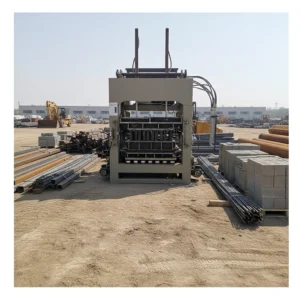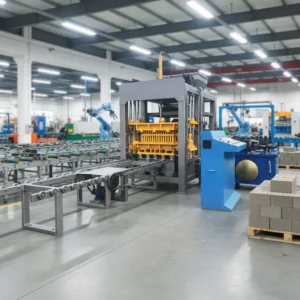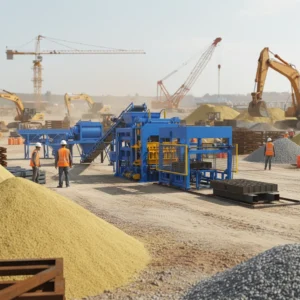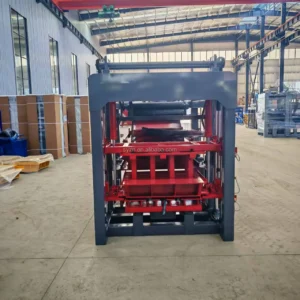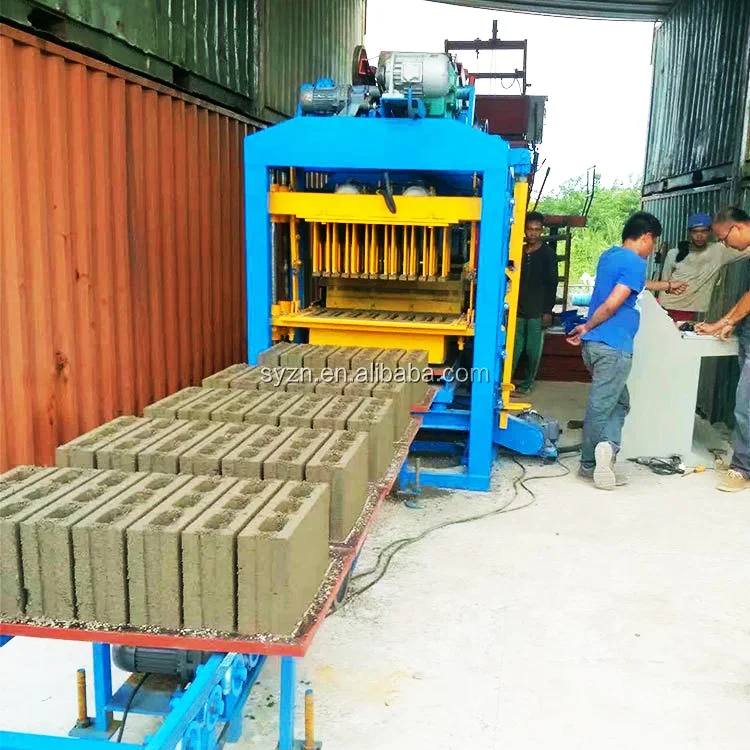
Matched System Layout — Raw material feeding, mixing, and pallet handling are specified around the QTJ4-25 so no station sits idle between cycles.
Technical Specifications
| Parameter | Value |
|---|---|
| Model | QTJ4-25 |
| Product Type | Semi-Automatic Concrete Block Making Machine |
| Overall Dimensions (L×W×H) | 3060×1730×2580 mm |
| Rated Pressure | 16–21 MPa |
| Main Vibration Form | Platform Vibration |
| Vibration Frequency | 4200 r/min |
| Vibration Force | 45.5 kN |
| Pallet Size | 850×550 mm |
| Molding Cycle | 25–30 s |
| Overall Power | 14.9 kW |
| Total Mass | 4 T |
| Demolding Method | Vibration |
| Factory Area Requirement | 200 m² |
| Control System | Available with PLC or MCC control |
| Voltage & Frequency | Configurable to site supply |
| Stacking Method | Manual or automatic stacking available |
Application Suitability
| Application | Material or Output |
|---|---|
| Hollow Block Production | Crushed stone, sand, cement, fly ash |
| Solid Block Manufacturing | Gravel, slag, dust, cement blends |
| Paver and Interlocking Brick | Colored aggregates with cement |
| Curbstone Forming | Coarse aggregate and high-strength mix |
Why the Mixer Output Dictates the Press Cycle
A block production line QTJ4-25 supporting equipment setup must keep every station synchronized, or the press sits idle waiting for feed.
When I set up a line like this in Ghana, the mixer could not keep pace with the press cycle. The brick machine waited every cycle for fresh material, and real daily output dropped noticeably below the quoted capacity. That mismatch happens when the line is specified station by station instead of as a complete loop. The block production line QTJ4-25 supporting equipment must be calculated together — mixer batch time, pallet feeder speed, and stacking rhythm all locked to the 25–30 s molding cycle [NEED_CITE: block line station synchronization principles].

Stations Around the Press
The block production line QTJ4-25 supporting equipment begins with raw material feeding and mixing. A pan mixer or twin-shaft mixer must deliver a consistent batch within the press cycle window. If the mixer takes longer than 25 seconds to discharge, the press loses a cycle. The pallet feeder must also place a clean pallet on the platform before the press completes demolding, keeping the rhythm unbroken across a full shift.
Curing and Return Loop
After the press ejects a loaded pallet, the wet blocks move to the curing area. The 850×550 mm pallet size must match the curing rack dimensions and the forklift the buyer already operates. A mismatch here means pallets pile up on the floor or racks sit half-empty. The pallet return loop feeds clean pallets back to the press, closing the circuit so the next cycle starts without manual intervention [NEED_CITE: pallet return loop design for block plants].
Reading the Specs in Context
The QTJ4-25 runs platform vibration at 4200 r/min with 45.5 kN of force, paired with 16–21 MPa hydraulic pressure. Together, these values compact the mix into a dense block — vibration settles the aggregate while pressure locks it in place. If the local mix design uses a high sand content, vibration alone may not achieve target strength without adequate pressure. The 25–30 s molding cycle assumes a specific block format and thickness; a taller hollow block or a dense paver may require a longer cycle, which the line layout must absorb. The 4 T machine mass provides the static weight needed to dampen vibration transmission to the foundation. The 14.9 kW overall power covers the press motor and vibration unit but does not include the mixer, conveyor, or stacking station — those draw additional load from the site supply.

When Stations Are Priced Separately
Buyers often receive a quotation that covers only the press. Pallet feeding, stacking, and curing rack handling are left out, so on day one the output piles up by hand. Workers carry loaded pallets to the curing area while the press waits for empty pallets to return. Daily throughput falls far short of the press rating, and labour costs climb [NEED_CITE: hidden costs of incomplete block line quotations]. The block production line QTJ4-25 supporting equipment quotation should list every station from mixer to stacker with cycle times matched.
Why the Line Is Specified Here
Block machinery is the single focus, so the press, mould, pallet, and handling equipment are specified as one matched system rather than assembled from separate suppliers. Configuration is set against the buyer’s actual mix design, local aggregate, and target block format instead of a catalogue default. The 850×550 mm pallet is chosen to align with the curing area footprint and existing forklift capacity. Automation level is selectable — a buyer can start with manual pallet handling and add automatic stacking later without replacing the press. Voltage, frequency, and control language are confirmed before shipment so the line powers up without rewiring on arrival.
Documentation & Verification
- Line layout and capacity calculation stating the block format assumed at each station
- Machine specification sheet with QTJ4-25 power, vibration, and pressure ratings
- Mould drawing and format list for hollow, solid, paving, and interlocking blocks
- Pallet specification matched to curing rack and forklift dimensions
- Voltage and control language confirmation record before dispatch
- Factory test record showing the complete line running as one system
Installation, Commissioning & Support
- 200 m² factory area covers press, curing racks, and pallet return loop
- Voltage and frequency confirmed before shipment to match site supply
- 14.9 kW press power requires a dedicated circuit separate from mixer load
- Platform vibration foundation isolated to prevent transmission to adjacent stations
- Pallet feeder alignment calibrated to the 850×550 mm pallet during commissioning
- Operator training covers mould change, cycle timing, and daily maintenance checks
Preparing Your Inquiry
Provide the target block format, daily output goal, and local raw material so the line layout can be calculated station by station. Confirm the available site voltage, frequency, and preferred control language before the quotation stage. Share the curing area dimensions and existing forklift capacity so the pallet specification fits your current setup.
Frequently Asked Questions
Q: How is line capacity calculated and which block format is assumed?
A: Capacity is stated per block format, not as a single number. The quotation lists output for each format — hollow block, solid block, paver — based on the 25–30 s molding cycle and the specific dimensions of that mould. Every station from mixer to stacker is timed to match that cycle.
Q: Does the quotation include pallet feeding, stacking, and curing?
A: A complete block production line QTJ4-25 supporting equipment quotation lists every station. Pallet feeding, stacking method, and curing rack handling are included with cycle times matched to the press so no station sits idle.
Q: How are mixer output and pallet feeder matched to the press cycle?
A: The mixer batch time and discharge rate are calculated against the 25–30 s molding cycle. The pallet feeder places a clean pallet before the press completes demolding, keeping the rhythm unbroken across a full production shift.
Q: What pallet size is specified and does it fit my curing area?
A: The standard pallet is 850×550 mm, chosen to match the press platform. Before shipment, we confirm this size fits your curing rack dimensions and the forklift you already operate on site.
Q: Is voltage and control language confirmed before shipping?
A: Voltage, frequency, and PLC display language are confirmed during the quotation stage. This prevents rewiring or control panel modification after the line arrives, so commissioning proceeds without delay.