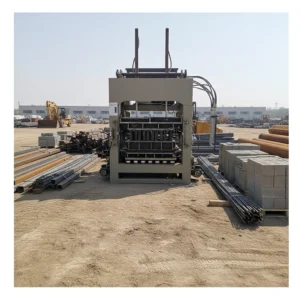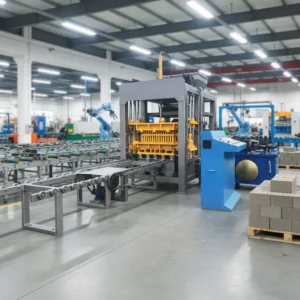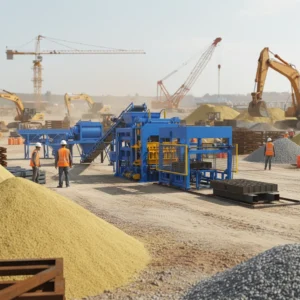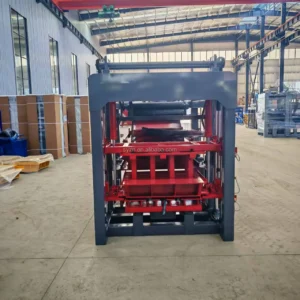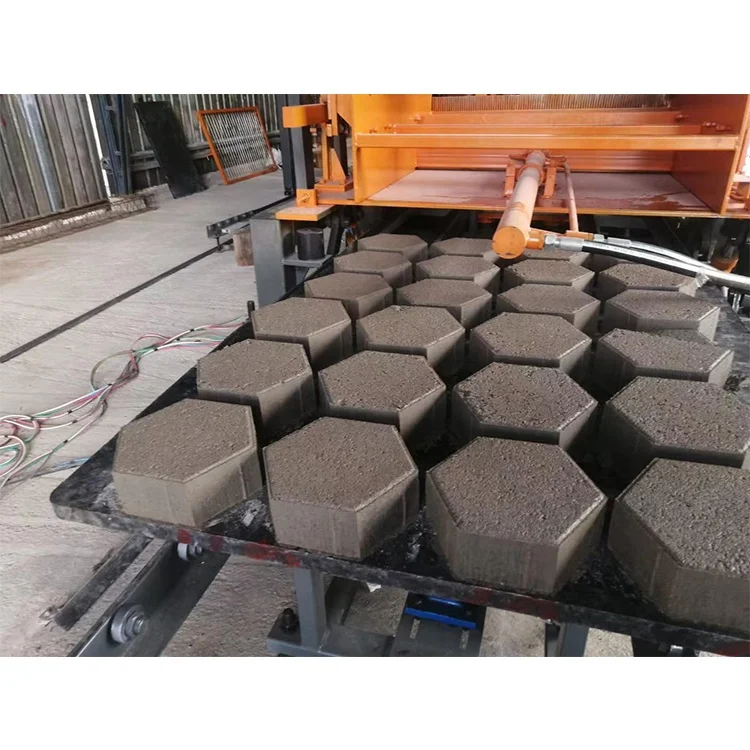
Coordinated Line Balance — Every station from raw material feeding to stacking is calculated around the QT8-15 cycle time so the press never waits for upstream or downstream delays.
Technical Specifications
| Parameter | Value |
|---|---|
| Model | QT8-15 |
| Product Type | Hydraulic Concrete Block Making Machine |
| Overall Dimensions (L×W×H) | 8300×1860×3000 mm |
| Rated Pressure | 21 MPa |
| Main Vibration Form | Platform Vibration |
| Vibration Frequency | 2800–4500 r/min |
| Vibration Force | 45 KN |
| Pallet Size | 950×900 mm |
| Molding Cycle | 15–20 s (basis to be confirmed per block format) |
| Overall Power | 55.5 kW |
| Total Mass | 8 T |
| Demolding Method | Hydraulic |
| Factory Area | 300 m² |
| Applied Products | Concrete hollow/solid blocks, pavers, interlocking blocks, curbstone, colored pavers |
| Raw Materials | Crushed stone, sand, cement, fly ash, gravel, slag, dust |
| Warranty | 1 year |
Application Suitability
| Application | Material or Output |
|---|---|
| Hollow block production for residential walls | Crushed stone, sand, cement, fly ash |
| Solid block manufacturing for load-bearing structures | Gravel, cement, slag blends |
| Paving block and colored paver runs | Fine sand, cement, pigment additives |
| Interlocking block and curbstone forming | Coarse aggregate, cement, dust |
| On-site contractor production for housing projects | Locally sourced aggregate and cement |
Why the Molding Cycle Number Means Nothing Without Line Balance
A 15–20 second cycle at the press only translates to real output when the mixer, pallet feeder, and stacker can all keep the same rhythm.
I once saw a block plant in West Africa where the press sat idle for seconds every cycle because the batching station could not discharge fast enough. The QT8-15 block machine production line was rated well on paper, but actual daily throughput fell far short because nobody had mapped the upstream mixer batch size and discharge interval against the press cycle. That mismatch is the single most common reason buyers feel misled by capacity figures [NEED_CITE: common causes of block plant underperformance in export markets].
Matching Every Station to the Press Rhythm
The QT8-15 block machine production line places the press at the center of a timed sequence. Raw material feeding must deliver a fresh batch to the mixer within the same window the press completes a molding cycle. If the pallet feeder arrives late, the press holds its vibration sequence and the entire line slows. Each conveyor belt speed, mixer discharge gate timing, and pallet return path is calculated so the press operates continuously without micro-stops that erode daily output.
Pallet Circulation as the Line Backbone
With a 950×900 mm pallet size, the pallet feeding system, curing rack dimensions, and forklift handling all share the same footprint constraint. The QT8-15 turnkey line specifies pallet return conveyors and rack spacing together, so cured blocks move off the rack and fresh pallets cycle back without manual intervention. When pallet规格 is chosen in isolation, buyers often discover their existing curing racks or forklifts cannot handle the dimensions, forcing a secondary purchase before the line can run [NEED_CITE: pallet handling mismatches in concrete block plants].
What the Vibration and Pressure Figures Mean on the Floor
Platform vibration at 2800–4500 r/min combined with 45 KN of vibration force and 21 MPa hydraulic pressure determines the density and strength consistency of every block that leaves the mold. These values must be matched to the buyer’s specific mix design and local aggregate gradation. A mix with high fly ash content responds differently to vibration than one with coarse crushed stone, so the frequency range allows adjustment per material. The hydraulic demolding method then releases the block without cracking, provided the pressure and vibration were correctly balanced for that mix. The 55.5 kW overall power draw covers the press, vibration motors, and hydraulic pump together, which must be factored into the full line electrical supply including the mixer and conveyor drives.
When One Undersized Station Costs the Whole Line
If the stacking station cannot clear cured pallets fast enough, the press backs up and operators start pulling blocks by hand — exactly the bottleneck the automation was supposed to prevent. Buyers who specify the press alone and source pallet handling separately often discover the return conveyor is too slow or the curing rack capacity is too small for a full shift. The result is a line that runs at partial capacity while the buyer assumes the press itself is underperforming [NEED_CITE: block production line bottleneck analysis].
Why Sourcing the Full Line From One Supplier Matters Here
Block machinery is our single focus, so the press, mold, pallet, and handling equipment are specified as one matched system rather than assembled from separate vendors. The QT8-15 configuration is set against the buyer’s actual mix design, local aggregate, and target block format instead of a catalogue default. Molds are designed for the formats the buyer’s market actually sells, including custom drawings when standard options do not cover local demand. Automation level is selectable, allowing a buyer to start semi-automatic and add stacking or cubing later. Installation and commissioning include operator training so the crew understands cycle timing across every station, not just the press controls.
Documentation & Verification
- Line layout drawing showing every station position and pallet flow path for the QT8-15 footprint
- Capacity calculation document stating which block format the molding cycle assumes
- Pallet specification matched to buyer’s curing area dimensions and forklift fleet
- Voltage, frequency, and PLC display language confirmation sheet before production
- Factory test record covering press cycle, vibration frequency, and hydraulic pressure verification
- Packing photographs and customs documentation support for export shipment
Installation, Commissioning & Support
- Foundation plan sized for the 8300×1860 mm press footprint and 8 T total mass with vibration isolation
- Electrical supply plan covering 55.5 kW total draw with dedicated circuit for vibration motors
- Pallet feeder and return conveyor alignment verified against 950×900 mm pallet tolerance
- Hydraulic system pressure set to 21 MPa and demolding sequence tested with buyer’s mix sample
- Vibration frequency calibrated within 2800–4500 r/min range per the specific aggregate gradation
- Operator training covering cycle timing across all stations, not just press controls
What to Include in Your Inquiry
Send your target block format and daily output requirement along with the local aggregate type and cement availability so the QT8-15 block machine production line can be configured to your actual conditions. Include your workshop dimensions and existing curing area layout so the 300 m² factory area allocation can be verified against your site. Confirm your local voltage and frequency supply and preferred control language to avoid commissioning delays after the equipment arrives.
Frequently Asked Questions
Q: How is the daily output of the full line calculated, and which block format is assumed?
A: Daily output is calculated by multiplying the molding cycle per pallet by the number of pallets per hour, then by the number of blocks per pallet for a specific format. The cycle time of 15–20 seconds varies by block type, so the capacity document states exactly which format is assumed. Without that assumption, output projections are unreliable.
Q: What supporting equipment stations must be included so the press cycle is not interrupted?
A: The line requires a raw material feeder, mixer with matched discharge timing, pallet feeder, pallet return conveyor, stacking station, and curing rack handler. Each station must complete its task within the press molding window. Missing any one station forces the press to idle, reducing actual throughput below the rated cycle.
Q: How do I confirm that the 950×900 mm pallet size matches my curing area and handling equipment?
A: Check your curing rack slot width, forklift fork spread, and stacker reach against the 950×900 mm pallet dimensions before ordering. If your existing equipment was sized for a different pallet, you will need adapter racks or new handling gear. We include pallet specification in the quotation so this can be verified early.
Q: What voltage, frequency, and control language options are available for the line?
A: Voltage and frequency are configured to match the buyer’s local supply, and PLC display language is confirmed before production begins. These details must be locked in during the quotation stage, not after shipment, to prevent commissioning delays on site.
Q: How is the 300 m² factory area allocated across the press, material feed, curing, and stacking?
A: The layout allocates space for the press zone, raw material storage and feeding, mixer placement, pallet circulation path, stacking area, and curing racks. The exact allocation depends on your block format mix and daily volume target, which determines how many curing rack positions are needed for a full shift rotation.